
As AI agents and automation tools become increasingly prevalent, a fundamental question arises for many in the data-driven world:
When it comes to AI data scraping, which proxy IP provider should you choose? Is there a truly “more stable” option available?
There’s no single, universally correct answer to this question. However, by dissecting the problem into its core components—proxy type, service provider capabilities, and specific use cases—we can establish a clear and logical framework for making an informed decision.

Understanding Proxy IPs: The Unseen Architect of AI Data Collection Success
At its core, a proxy IP acts as an intermediary, a digital go-between for your internet requests. Instead of directly connecting to a target website, your request first goes to the proxy server, which then forwards it to the website. The website sees the proxy’s IP address, not yours. This simple mechanism is absolutely vital for AI data collection, primarily addressing three critical challenges:
- Evading Rate Limiting: Websites often restrict the number of requests from a single IP address within a certain timeframe to prevent abuse. Proxies allow you to distribute requests across many IPs, bypassing these limits.
- Preventing IP Blocking and Blacklisting: Using a single IP for high-volume scraping makes it easy for target websites to identify and block it, halting your data collection efforts. Proxies provide a rotating pool of IPs, making detection much harder.
- Accessing Geo-Restricted Content: Many websites display different content or entirely block access based on geographical location. Proxies with IPs in various regions enable your AI agents to access location-specific data, ensuring comprehensive data coverage.
Why AI Data Scraping Has a Unique Reliance on Proxy IPs
AI data collection distinguishes itself from conventional web scraping through two defining characteristics:
- Continuous Operation (Long-Duration Tasks): AI models require vast, continuously updated datasets. This translates to scraping tasks that often run for extended periods, from hours to days or even weeks.
- Batch Requests (High-Frequency Access): To gather sufficient data, AI agents typically perform a large volume of requests in rapid succession, often targeting thousands or millions of pages.
Given these demanding requirements, an inadequate or poorly managed IP strategy can quickly lead to disastrous outcomes:
- Interrupted Scraping: Frequent IP blocks cause your data pipeline to stall, leading to significant delays.
- Incomplete Data Sets: Blocked IPs mean missed data points, resulting in fragmented and potentially biased datasets that can negatively impact AI model training and performance.
- Volatile Success Rates: Without a robust proxy solution, the success rate of your scraping tasks can fluctuate wildly, making it impossible to predict data acquisition timelines or ensure data integrity.
👉 In essence, for AI data collection, a proxy IP isn’t just an accelerator; it’s a fundamental stability mechanism. It ensures uninterrupted data flow, which is paramount for the continuous learning and operation of AI systems.
Choosing the Right Proxy IP Type: A Foundational Decision for AI Success
Before evaluating any service provider, the most crucial step is to determine the optimal type of proxy IP for your specific AI data collection needs. This choice profoundly impacts your success rates, costs, and overall project stability.
What kind of proxy IP is truly necessary for your AI data scraping project?
Data Center IPs: Speed and Cost-Effectiveness, But With Caveats
Data center proxies originate from commercial server farms. They are synthetic IPs not associated with internet service providers (ISPs) that serve individual users. Their primary advantages include:
- Blazing Fast Speeds: Directly connected to high-bandwidth data centers, these proxies offer superior connection speeds, making them ideal for tasks where speed is paramount and detection is not a major concern.
- Lower Cost: Due to their artificial nature and ease of generation, data center IPs are generally the most affordable proxy option.
However, their drawbacks are significant, especially in the context of sophisticated AI scraping:
- Higher Detectability: Websites, particularly those with advanced anti-bot measures, can often identify data center IPs through various means (IP ranges, ASN, server characteristics).
- Lower Success Rates on High-Risk Sites: For target websites employing stringent anti-scraping technologies—like major e-commerce platforms, social media networks, or news aggregators—data center proxies frequently face immediate blocking, leading to poor success rates.
While suitable for low-intensity scraping of less protected sites, data center proxies are generally not the go-to for robust AI data collection.
Residential IPs: The Gold Standard for AI Data Scraping
Residential IPs are the real-world IP addresses assigned by Internet Service Providers (ISPs) to genuine residential users. This origin makes them inherently more trustworthy in the eyes of target websites, as they mimic legitimate user traffic. Residential IPs are broadly categorized into two types:
- Static Residential IPs (ISP Proxies): These are residential IPs that are provided by an ISP but are hosted on a server, offering a fixed IP address. They combine the authenticity of a residential IP with the stability and speed often associated with data center proxies. They are excellent for maintaining a consistent online identity, managing specific accounts, or monitoring localized content where a fixed location is beneficial.
- Dynamic Residential IPs (Rotating Residential Proxies): These IPs change frequently, often with every request or after a set interval. They originate from a vast network of real user devices (with user consent, typically through peer-to-peer networks). Their key strength lies in their ability to rotate through countless unique IP addresses, making it incredibly difficult for websites to detect and block scraping activity.
In the realm of AI data scraping:
👉 Dynamic residential IPs are overwhelmingly the preferred and more commonly used choice. They strike the optimal balance between “real user identity” and the ability to “constantly change IP,” which is crucial for evading detection during continuous, high-volume AI data collection tasks. They offer unparalleled anonymity and success rates against even the most robust anti-bot systems.
A Comprehensive Overview of Core Proxy IP Types for AI Data Collection:
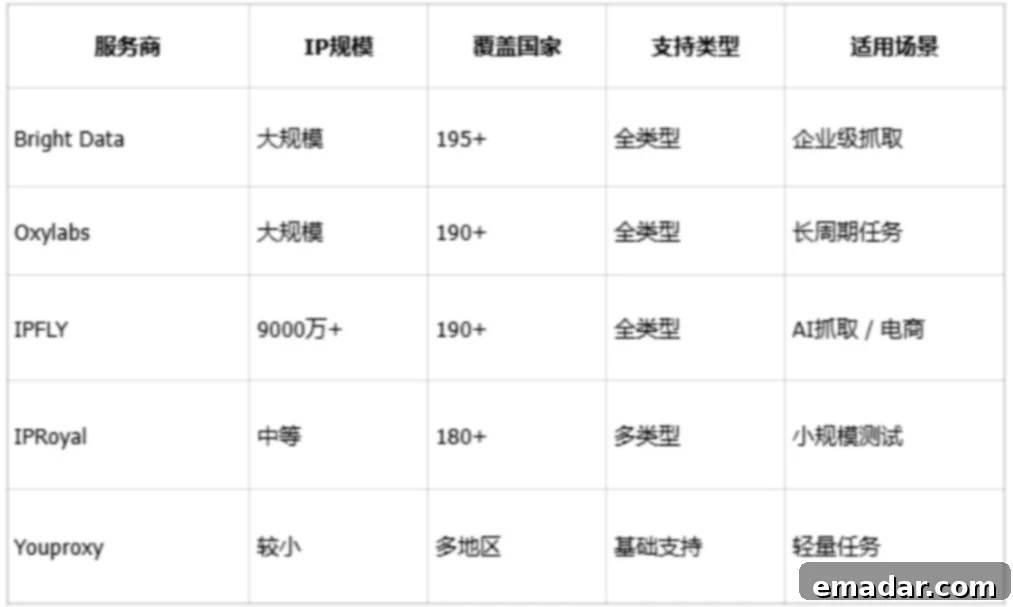
Navigating the Landscape of Mainstream Proxy Service Providers: A Detailed Analysis
Instead of a simple ranking, let’s explore prominent proxy providers based on their distinct features, target audiences, and operational logic, helping you understand where each fits within the AI data scraping ecosystem.
Bright Data: The Industry Pioneer for Comprehensive Enterprise Solutions
Bright Data is frequently at the forefront of discussions in the proxy industry, renowned for its extensive suite of tools and robust network. It’s often considered the gold standard for large-scale and complex data projects.
Its distinguishing characteristics include:
- Comprehensive Feature Ecosystem: Bright Data offers a complete range of services, including a sophisticated Proxy Manager, a Web Scraper IDE, Data Collector, and a vast array of APIs, making it a one-stop solution for intricate data acquisition needs.
- Support for Complex Data Collection Scenarios: From highly dynamic websites with advanced bot detection to global market research requiring precise geo-targeting, Bright Data’s network and tools are designed to handle the most challenging scraping tasks.
- Largest IP Pool: Boasting one of the largest and most diverse IP networks globally, including residential, data center, ISP, and mobile proxies, it offers unparalleled reach and flexibility.
This makes Bright Data exceptionally well-suited for:
- Dedicated Data Teams: Organizations with in-house data science or engineering teams that require granular control and advanced functionalities.
- Enterprise-Level Projects: Large businesses and corporations undertaking mission-critical data initiatives where reliability, scale, and advanced features are non-negotiable.
However, it also comes with notable considerations:
- Higher Cost Structure: Reflecting its premium features and reliability, Bright Data’s services are among the most expensive on the market.
- Steeper Learning Curve: The sheer breadth of its features and advanced configuration options can require a significant investment in time and expertise for new users to fully leverage.
Oxylabs: The Stability-Oriented Enterprise Solution
Oxylabs positions itself as a robust “enterprise infrastructure” provider, focusing on delivering maximum stability and reliability for business-critical operations. It’s often chosen by organizations prioritizing consistent performance above all else.
Its core strengths lie in:
- Superior Network Stability: Oxylabs is highly regarded for its consistent uptime and robust infrastructure, ensuring that scraping tasks run smoothly without unexpected interruptions.
- Support for Large-Scale Tasks: Designed to handle high-volume data extraction, it excels in scenarios requiring the processing of vast amounts of data over extended periods.
- Ethical Sourcing: Oxylabs emphasizes its commitment to ethical proxy acquisition, ensuring compliance and peace of mind for corporate clients.
This provider is an excellent fit for:
- Long-Term Projects: Businesses with ongoing data intelligence needs, such as competitive analysis, market trend monitoring, or SEO tracking.
- Operations Demanding High Stability: Any business process where data integrity and continuous availability are paramount, making it ideal for financial data analysis, brand protection, or compliance monitoring.
Conversely, its approach tends to be more standardized, meaning:
- Less Flexibility in Customization: While powerful, Oxylabs’ solutions are often more prescriptive, offering less room for highly specific or niche customizations compared to providers with more open-ended toolkits.
- Enterprise-Focused Pricing: Like Bright Data, it comes with a premium price tag, aligning with its enterprise-grade service level.
IPFLY: Optimized for Execution-Layer Efficiency in AI Automation
IPFLY carves out a niche by focusing intently on “execution efficiency,” particularly valuable for AI automation tasks that require high success rates and streamlined operations. Its design philosophy emphasizes the practical aspects of getting data acquired effectively.
From an execution efficiency perspective, IPFLY’s approach centers on:
- Robust Dynamic Residential IP Resources: Providing access to extensive pools of dynamic residential IPs, crucial for mimicking diverse user behavior and bypassing sophisticated anti-bot measures.
- Advanced IP Scheduling and Filtering Mechanisms: Implementing intelligent algorithms to manage IP rotation, selecting optimal IPs based on target website behavior, and filtering out non-performing proxies to maximize success rates. This ensures that only the most effective IPs are utilized.
- Support for Multi-Node Task Execution: Facilitating the distribution of scraping tasks across various geographic nodes, enhancing both speed and geo-targeting capabilities, essential for global data collection.
- High Success Rate Focus: IPFLY specifically designs its infrastructure and algorithms to achieve high success rates even against challenging targets, minimizing the need for manual intervention or task re-runs.
In practical use, this type of solution is particularly well-suited for:
- AI Automation Scraping: Perfect for AI agents and automated workflows that demand reliable and continuous data input without constant oversight.
- Cross-Border E-commerce Monitoring: Essential for tracking product prices, competitor activities, and localized trends across different regions and online marketplaces.
- Multi-Region Data Tasks: Any project requiring data from specific geographical locations where local IP authenticity is critical for accurate results.
Especially in scenarios demanding long-term, uninterrupted operation for AI applications, the stability and intelligent management offered by solutions like IPFLY become a critical differentiator, directly impacting the quality and continuity of data feeds.
IPRoyal: The Accessible Entry-Level Choice
IPRoyal clearly defines its position in the market by focusing on affordability and ease of use, making it an attractive option for individuals and smaller projects.
Its primary characteristics are:
- Cost-Effective Pricing: IPRoyal offers some of the most competitive rates, particularly for its residential and data center proxy services, making it budget-friendly.
- User-Friendly Interface: The platform is designed for straightforward setup and management, reducing the barrier to entry for new users or those with limited technical expertise.
- Diverse Proxy Offerings: Beyond standard residential and data center proxies, IPRoyal also provides static residential (ISP) proxies and specialized sneaker proxies, catering to various niche needs.
IPRoyal is an ideal choice for:
- Small-Scale Testing and Development: Perfect for developers and researchers conducting initial tests or proof-of-concept projects that don’t require massive scale.
- Budget-Constrained Users: Individuals or small businesses looking for reliable proxy services without a significant financial outlay.
- Personal Use Cases: General web browsing, accessing geo-restricted content for personal use, or small-scale market research.
However, it’s important to note its limitations for larger endeavors:
- Potential for Stability and IP Quality Fluctuations in Large Tasks: While adequate for smaller projects, the stability and consistent quality of IPs might become less predictable when scaled up for very large or continuous AI data collection tasks.
- Less Advanced Features: It generally offers fewer advanced features or specialized tools compared to enterprise-grade providers.
Youproxy: The Lightweight, Tool-Oriented Solution
Youproxy positions itself as a more tool-centric and lightweight service, focusing on simplicity and accessibility rather than enterprise-level complexity.
Its main characteristics are:
- Extreme Ease of Use: Youproxy prioritizes a straightforward user experience, making it simple to get started with minimal configuration.
- Very Low Cost: It’s designed to be highly affordable, often appealing to users with very limited budgets or those needing proxies for auxiliary tasks.
This makes Youproxy suitable for:
- Lightweight Scraping Tasks: Ideal for quick, one-off data checks, small personal projects, or tasks where the target website has minimal anti-bot protections.
- Auxiliary Uses: Can be used as a supplementary tool for minor tasks within a larger data collection strategy, or for basic anonymity needs.
- Beginners: A good starting point for individuals new to proxy usage due to its simplicity.
For complex AI tasks, however, it typically requires pairing with more robust solutions:
- Limited Scalability and Reliability: Its lightweight nature means it might not offer the consistent performance, vast IP pools, or advanced management features required for demanding, large-scale, or continuous AI data collection.
- Best as a Complement: For critical or extensive AI projects, Youproxy is usually best utilized in conjunction with a more stable and feature-rich primary proxy provider.
FAQ: Common Questions on AI Data Collection and Proxy IPs
Q1: Is it better to use Data Center IPs or Residential IPs for AI scraping?
Answer: The choice largely depends on the target website’s anti-bot measures and the sensitivity of the data you’re collecting.
- Low-Restriction Websites: For sites with minimal security, data center IPs can be sufficient due to their speed and lower cost. Examples might include publicly available government data or simple directories.
- High-Restriction Websites: For sites with advanced bot detection (e.g., e-commerce giants, social media platforms, news outlets, booking sites), residential IPs are strongly recommended. Dynamic residential IPs, in particular, offer superior anonymity and success rates as they emulate real user traffic, making them much harder to detect and block.
In the context of AI data collection, where continuous, accurate, and stable data flow is paramount, dynamic residential IPs generally provide the most reliable foundation.
Q2: Why do my scraping tasks frequently fail, even with proxies?
Answer: Frequent failures can stem from several issues, often interconnected:
- IP Blacklisting or Detection: Your proxy IPs might be identified as suspicious and blocked by the target website. This can happen if the IP pool is small, or if the IPs have been previously abused.
- Excessive Request Frequency: Even with proxies, sending requests too rapidly can trigger rate limits or CAPTCHAs, signaling non-human behavior.
- Abnormal Behavioral Patterns: Websites analyze user behavior. Rapid, sequential page visits, lack of mouse movements, or inconsistent browser fingerprints can flag your AI agent as a bot.
- Unstable IP Quality: Some proxy providers offer lower-quality IPs that are frequently down, slow, or already flagged, leading to intermittent failures.
- Improper Header Management: Failing to rotate user-agent strings, accept-language headers, and other HTTP headers can also lead to detection.
Among these, issues related to IP quality and management often account for the majority of failures.
Q3: Is more frequent IP rotation always better?
Answer: No, not necessarily. While rotation is key to avoiding detection, there’s a balance to be struck:
- Too Rapid Rotation: Switching IPs too quickly can paradoxically appear abnormal, as genuine human users don’t constantly change their IP address within seconds. This can lead to CAPTCHAs or soft blocks.
- Too Slow Rotation: Conversely, using a single IP for too long makes it easy for websites to identify and block it once the request threshold is met.
A more effective and nuanced strategy is to tailor rotation frequency to the task:
- Independent Requests: For scraping tasks where each request is independent (e.g., checking individual product prices across many URLs), rotating the IP for every single request (or every few requests) can be highly effective.
- Continuous Operations/Sticky Sessions: For tasks requiring a continuous session (e.g., logging into an account, navigating multiple pages within a single user journey, or completing a multi-step form), using a “sticky IP” for a duration of 5–30 minutes (or longer if supported by the provider) allows the AI agent to maintain a consistent identity, mimicking a real user session.
Q4: Will using a proxy IP affect my scraping speed?
Answer: Yes, proxies can affect scraping speed, but the impact varies significantly by proxy type and quality:
- Data Center IPs: Generally offer faster connection speeds because they are hosted on high-bandwidth servers with direct internet access.
- Residential IPs: Can be slightly slower than data center proxies. This is because the request travels through a real user’s device, which might have varying internet speeds, and the routing can be less direct.
However, for AI data collection:
👉 Stability and success rate are almost always more critical than raw speed. A slightly slower connection that consistently delivers data is far more valuable than a fast connection that frequently gets blocked, leading to wasted effort and incomplete datasets. The “effective speed” (data collected successfully per unit time) of a stable residential proxy often surpasses that of a faster but easily detectable data center proxy.
Q5: Why is “stability” emphasized so much for AI scraping?
Answer: The emphasis on stability in AI data collection stems from the inherent nature of AI tasks:
- Long-Running Processes: AI models require continuous data feeds, meaning scraping tasks often operate without interruption for extended periods. Instability causes significant downtime.
- Batch Execution and High Volume: AI agents perform numerous requests in bulk. Even minor instability, when multiplied across millions of requests, can lead to massive data loss.
- Automated Workflows: AI pipelines are designed to be autonomous. Instability breaks these chains, requiring manual intervention, debugging, and restarting, which defeats the purpose of automation.
- Cost Implications: Interrupted or failed scraping means wasted computing resources, proxy bandwidth, and developer time. High stability ensures efficient resource utilization and lower operational costs.
- Data Quality and Model Performance: Inconsistent data collection can lead to incomplete, biased, or outdated datasets, directly compromising the accuracy and effectiveness of the AI models being trained or used.
Ultimately, stability ensures that the AI receives a consistent, high-quality data stream, which is foundational for its successful operation and learning.
Conclusion: The Strategic Choice for AI Data Harvesting
Revisiting our initial query:
Which proxy IP is the absolute best?
A more pragmatic and accurate answer is:
- There is no single “absolute best” proxy provider or IP type. The optimal choice is always contextual.
- The true measure of suitability is whether it “fits your specific AI data collection task.” This involves evaluating factors like the target website’s defenses, the volume and frequency of your requests, your budget, and the level of data accuracy and continuity required.
However, observing current trends and technological advancements in anti-bot systems:
👉 For robust and reliable AI data collection, dynamic residential IPs are rapidly becoming the default and most recommended choice. Their inherent authenticity, vast pools, and rotating nature provide the stability and anonymity necessary to navigate the increasingly complex landscape of web scraping. Providers like IPFLY, with their focus on execution-layer optimization for dynamic residential IPs, are particularly well-positioned to support the demanding requirements of AI automation. When making your choice, always conduct thorough testing and consider your long-term data strategy to ensure sustained success.
To explore effective solutions for your AI scraping needs, consider checking out leading dynamic residential IP providers such as IPFLY, known for its focus on execution efficiency and stability.