
Navigating the intricacies of LinkedIn profile name extraction is paramount for businesses seeking to ethically and effectively gather professional data. This process hinges on a delicate balance between adhering to LinkedIn’s stringent platform-specific naming conventions and fulfilling cross-border data privacy compliance requirements such as GDPR and CCPA. Any deviation from these rules can lead to severe repercussions, including IP bans, account restrictions, and significant legal liabilities. This comprehensive guide delves into the uncompromising core rules governing profile name extraction, drawing insights from LinkedIn’s official User Agreement, global privacy regulations, and landmark legal precedents like the HiQ Labs v. LinkedIn case. Our aim is to provide a robust framework and actionable guidelines for compliant data extraction practices, ensuring your operations remain both effective and secure.
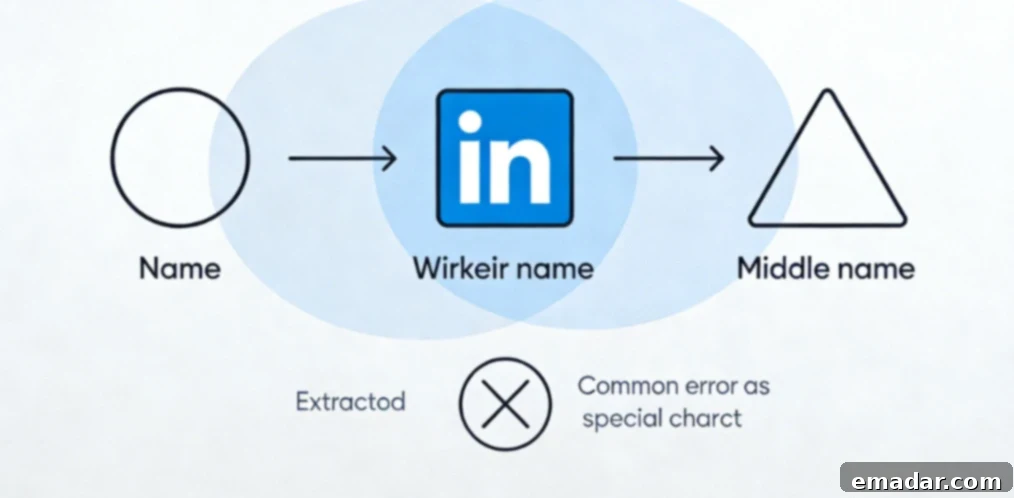
LinkedIn’s Official Profile Name Field Rules: No Room for ‘Creativity’
LinkedIn maintains an exceptionally strict policy regarding the content allowed within its profile name fields – the primary source for any name extraction efforts. These fields are explicitly designed to contain only a user’s true or preferred professional first name, middle name, last name, and pronouns. This rigid enforcement is not arbitrary; it underpins the platform’s commitment to fostering a professional, trustworthy environment, ensuring data integrity for networking, search functionalities, and overall user experience. Any content that deviates from these guidelines is considered a violation, leading to immediate profile restrictions, invalid data extraction results, and potentially severe penalties. Prohibited content universally includes:
- Special Characters, Emojis, Flags, or Marketing Information: Users are explicitly forbidden from incorporating company logos, job titles, certifications, or any promotional messaging directly within their name fields. Such embellishments disrupt the professional aesthetic and misuse a fundamental identity element.
- Pseudonyms, Fictitious Names, Company Names, or Organizational Designations: A LinkedIn profile must reflect a user’s genuine professional identity. The use of aliases, false names, or substituting a personal name with a company or organization name is strictly prohibited. LinkedIn reserves the right to request identity verification, such as a passport, to confirm the authenticity of a profile’s name.
- Email Addresses, Website URLs, or Irrelevant Symbols: Embedding contact information or external links within the name field is a direct violation of LinkedIn’s terms. This practice is often associated with spam or phishing attempts and will inevitably lead to temporary or even permanent account bans.
For data extraction tools, understanding and respecting these rules is paramount. It implies that only structured name data (first name, last name, pronouns) originating from compliant profile name fields should be considered valid for extraction. Attempting to extract names from profiles that violate these guidelines will not only yield unreliable, unusable data but will also significantly increase the likelihood of triggering LinkedIn’s sophisticated anti-scraping and abuse detection systems, potentially leading to your IP addresses being flagged and blocked. Prioritizing data quality from source to extraction is a foundational step in any ethical data collection strategy.
Public vs. Private Data: Defining the Extraction Boundaries
LinkedIn thoughtfully categorizes user profile data into two distinct classifications: public data (accessible without login) and private data (accessible only after logging in). The rules and legal ramifications for extracting name information differ significantly between these two categories, creating a critical distinction for anyone engaging in data collection.
- Public Data Extraction: Navigating Legal Grey Areas and Platform Prohibitions
Public data, which typically includes a user’s full name, current job title, and general location, is viewable by anyone without needing a LinkedIn account or login. From a purely technical and legal standpoint, the landmark case of HiQ Labs v. LinkedIn established a precedent, suggesting that accessing publicly available data on the internet may, in certain jurisdictions, be permissible. However, it is crucial to understand that LinkedIn’s platform rules explicitly prohibit automated scraping of any data, public or private. This means that while some courts might deem accessing public data legal, LinkedIn’s terms of service remain steadfast. Automated extraction of public profile names, even if technically visible without a login, can and often will trigger LinkedIn’s robust defense mechanisms, resulting in severe IP rate limiting or outright bans.
- Private Data Extraction: An Absolute Prohibition with Severe Consequences
Any name-related data that becomes visible only after a user logs into their LinkedIn account – such as names appearing in mutual connection notes, private messages, or restricted profile sections – falls under the category of private data. Automated extraction of private data through any means is unequivocally and strictly prohibited. Such actions constitute a direct and egregious violation of LinkedIn’s User Agreement. The consequences for attempting to extract private data are severe and can include permanent account closure, IP blacklisting across the platform, and potential legal action from LinkedIn, citing breach of contract and unauthorized access.
A critically important piece of practical advice for all data extractors is to never attempt to bypass LinkedIn’s technical control measures, irrespective of whether the data is public or private. This includes circumventing login protections, CAPTCHAs, or any other security features implemented by LinkedIn. Such actions can quickly escalate beyond platform violations and lead to legal charges under statutes like the U.S. Computer Fraud and Abuse Act (CFAA), which criminalizes unauthorized access to computer systems. Ethical data extraction mandates a deep respect for platform boundaries and legal frameworks, prioritizing compliance over aggressive, risky collection methods.
Global Compliance Rules: GDPR, CCPA, and CPRA Elevate Name Extraction Standards
Beyond LinkedIn’s platform-specific rules, any organization involved in data extraction must rigorously adhere to a complex web of global data privacy regulations. Among these, the European Union’s General Data Protection Regulation (GDPR), along with California’s Consumer Privacy Act (CCPA) and its successor, the California Privacy Rights Act (CPRA), exert the most profound influence on name extraction practices, significantly raising the bar for compliance and accountability.
- General Data Protection Regulation (GDPR): The Imperative of Consent and Purpose Limitation
For LinkedIn users residing within the European Union, the GDPR imposes stringent requirements on the processing of personal data, which unequivocally includes names. Storing, using, or processing extracted name data mandates explicit, affirmative consent from the data subject – even if the name is publicly visible on LinkedIn. Relying on “legitimate interest” as a legal basis for scraping public data is often highly contentious and difficult to justify under GDPR, requiring a rigorous balancing test that typically favors the individual’s rights. Furthermore, GDPR emphasizes data minimization and purpose limitation, meaning extracted names must only be used for the specific, stated business purpose for which they were collected. Failure to obtain proper consent or adhere to these principles can result in monumental fines, potentially reaching up to 4% of a company’s global annual turnover or €20 million, whichever is higher.
- California Consumer Privacy Act (CCPA) and California Privacy Rights Act (CPRA): Empowering Consumer Rights
For LinkedIn users who are California residents, the CCPA and CPRA grant extensive rights over their personal information, including extracted names. These rights include the ability to know what data is being collected, to request its deletion, and to opt-out of the sale or sharing of their personal information. Data extractors operating within the scope of these laws must establish transparent and robust processes for handling such requests. This includes having clear data deletion protocols and mechanisms for consumers to exercise their right to opt-out. Non-compliance can lead to statutory damages per consumer and significant penalties from state regulators.
A universal and non-negotiable compliance requirement across all jurisdictions is that all extracted name data must only be utilized for its stated, legitimate business purpose. This typically includes activities like professional recruitment, targeted B2B outreach, or market research. It is strictly prohibited to sell, arbitrarily share, or use this data for unauthorized marketing campaigns, unrelated commercial ventures, or any purpose not clearly communicated to and agreed upon by the data subjects (where applicable). Adhering to these principles is not merely a legal obligation but also an ethical cornerstone of responsible data stewardship, protecting both individuals’ privacy and your organization’s reputation.
IPFLY Proxy: Your Indispensable Safeguard for Compliant LinkedIn Name Extraction
While strict adherence to platform rules and global privacy regulations forms the bedrock of compliant data extraction, it is often insufficient on its own to navigate LinkedIn’s advanced technical barriers. IP quality and sophisticated behavioral simulation are equally critical components for successful and sustainable data collection. LinkedIn employs an intelligent IP reputation scoring system that rapidly identifies and flags IP addresses associated with data centers (e.g., from cloud service providers) or shared proxy pools as high-risk. This often leads to immediate blocking of any scraping attempts from such IPs, rendering your efforts futile. IPFLY’s advanced proxy solutions are engineered precisely to overcome this challenge, providing authentic, high-purity IP resources that align seamlessly with LinkedIn’s detection logic.
- IPFLY Static Residential Proxies: Unparalleled Authenticity and Stability
Our static residential proxies are 100% genuine, ISP-assigned IP addresses, dedicated for individual user use. This means they mimic the network environment of real LinkedIn users, eradicating the risks associated with shared or abused IPs. By simulating legitimate user behavior and network origins, these proxies ensure that your compliant public name extraction requests are not flagged as “suspicious” by LinkedIn’s sophisticated IP reputation system. These dedicated IP addresses offer permanent validity and unlimited bandwidth, making them ideal for sustained, long-term LinkedIn name extraction projects, such as collecting recruitment data specific to the EU or US regions, where stable, geographically consistent IP presence is crucial.
- 99.9% Uptime and Banking-Grade Encryption: Reliability Meets Security
IPFLY’s entirely self-developed, high-performance server infrastructure guarantees an industry-leading 99.9% uptime. This exceptional reliability ensures uninterrupted connectivity, which is vital for continuous and high-volume data extraction tasks. Beyond stability, we prioritize the security of the data you extract. Our banking-grade encryption technology provides robust protection against potential data breaches, safeguarding the integrity and confidentiality of all extracted name data. This adherence to the highest security standards is fully compliant with the data security requirements stipulated by GDPR and CCPA, giving you peace of mind that your operations are secure from end to end.
- Extensive Global Coverage Across 190+ Countries and Regions
IPFLY boasts an expansive global IP pool that spans over 190 countries and regions. This extensive coverage includes all major LinkedIn target markets, such as the European Union, the United States, and the Asia-Pacific region. This global footprint empowers you to legally and ethically extract name data for highly targeted regional professional datasets, free from geographical IP restrictions. Whether you’re building a candidate pipeline in Germany or identifying B2B leads in Japan, IPFLY provides the localized, authentic IP presence necessary to conduct your extraction activities compliantly and effectively.
Are you ready to embark on a journey of compliant, low-risk LinkedIn profile name extraction, meticulously avoiding IP blocks, account restrictions, and complex legal compliance risks? Look no further. Register your IPFLY account today and unlock access to our cutting-edge, ISP-assigned static residential proxies. These exclusive, high-anonymity IP resources are expertly designed to simulate genuine user behavior across more than 190 global regions, facilitating seamless cross-border data extraction with an unparalleled 99.9% uptime for consistent performance. With IPFLY, configuring your proxy setup takes just a few clicks, enabling you to commence LinkedIn profile name extraction operations that fully adhere to both LinkedIn’s platform rules and stringent global GDPR/CCPA compliance requirements. Eliminate all worries about IP reputation issues, data security vulnerabilities, and potential legal pitfalls. Empower your business with reliable, secure, and compliant LinkedIn data. Start extracting smarter, not harder!