
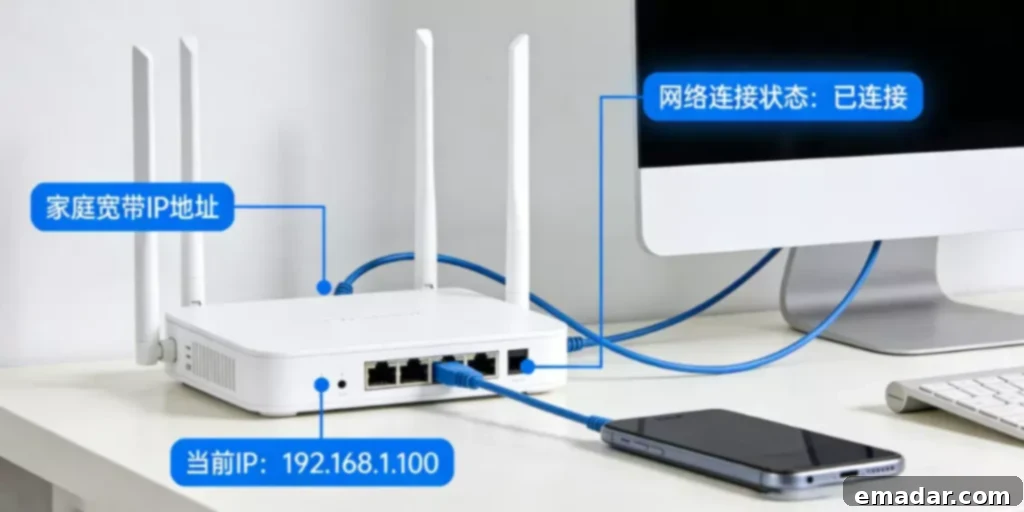
Understanding Home Broadband IPs: Why They Matter for Online Accounts
Many individuals start seriously investigating “home broadband IPs” only after experiencing frequent account verifications, traffic limitations, or even account control issues.
Then, they often encounter a counter-intuitive phenomenon: operating from their home network suddenly makes everything smoother.
This isn’t just a matter of luck; it’s a direct result of platform risk management logic.
The True Identity of Home Broadband IPs in Systems: It’s Not About Speed, But Being “Human-Like”
From a technical standpoint, home broadband IPs (residential IPs) have several distinct characteristics:
- They originate from genuine ISPs (Internet Service Providers) like Verizon, Comcast, or local providers.
- Their usage patterns are long-term, stable, and consistent.
- The number of accounts associated with a single IP is limited.
- Usage behavior aligns with typical human habits and routines.
These characteristics are precisely the core signals that platforms use to identify “real human users.”
Platforms aren’t necessarily concerned with whether you are a “home user.”
What they care about is:
Are you behaving “like a real person who has been around for a while?”

Why Many Platforms Are More Tolerant of Home Broadband IPs
Whether it’s overseas social media, payment platforms, or e-commerce backends, risk management systems essentially do one thing:
Reduce uncertainty.
The advantage of home broadband IPs lies in:
- IP changes have clear reasons (rebooting the router, ISP policies).
- Geographic location is generally stable over time.
- Usage time distribution is natural.
- Behavioral patterns are traceable and explainable.
Therefore, home broadband IPs often receive lower risk scores in the following scenarios:
- Initial account registration and nurturing.
- Long-term login and content management.
- Payment, verification, and appeal processes.
- Merchant backend and advertising account management.
In simple terms: The “credibility” of a home broadband IP comes from its predictability.
Home Broadband IP ≠ Always Safe: A Common Misconception
It’s crucial to clarify that:
A home broadband IP merely provides a “lower initial risk” rating; it doesn’t grant “immunity” from risk management.
Even on a home broadband IP, if you:
- Operate multiple strongly linked accounts simultaneously.
- Use automated scripts.
- Frequently switch devices or browser fingerprints.
- Exhibit noticeably abnormal behavioral patterns.
Your account will still be re-evaluated.
Risk management systems never solely “trust” an IP; they continuously assess whether your behavior is reasonable.
Why Do Many People Use Proxies While Seeking “Home Broadband Level” IPs?
You may have noticed a trend:
Many proxy solutions are emphasizing “residential,” “home network,” and “real ISP” characteristics.
The reason is simple.
In risk management models, IPs are broadly categorized as:
- Home Broadband / Residential IPs
- Corporate Dedicated Lines
- Data Center IPs
Among these, home broadband IPs typically have the lowest default risk weight, especially in social media and account systems.
Therefore, when users can’t directly use their real home networks, they often choose residential IPs that closely mimic home broadband characteristics to reduce environmental discrepancies.
In practical applications, some teams use these residential IPs to handle core account operations, rather than frequent switching.
For example, some residential IPs are commonly used to simulate long-term, stable home network environments, resolving stability issues in account logins, verifications, and content management, rather than for short-term traffic boosting.
The Realistic Limitations of Home Broadband IPs in Multi-Account Scenarios
A very real question is:
Can one home broadband IP run many accounts?
Technically, yes, but the risks accumulate rapidly.
The reasons are:
- Platforms analyze the correlation between accounts under the same IP.
- Login times and operational paths are prone to overlap.
- Once one account is flagged, other accounts are also re-scrutinized.
Therefore, in multi-account systems, a more reliable approach is usually:
- One account
- One isolated environment
- One long-term, stable IP
Rather than overloading all accounts on a single home broadband connection.
The Relationship Between Home Broadband IPs and “IP Cleanliness”
Many people only look at “whether it’s a home broadband IP” but overlook another crucial factor: who used this IP before.
If an IP:
- Has been used by numerous accounts.
- Has a complex history of activity.
- Has been flagged by the platform multiple times.
Then, even if it has residential attributes, its risk score may be high.
Therefore, experienced users often pay more attention to:
- Whether it is exclusively used.
- Whether historical behavior is isolated.
- Whether the IP has been screened.
This is why some solutions that offer multi-layered IP screening and behavior isolation mechanisms are better suited for long-term account use. A screening mechanism reduces the probability of historical IP contamination, which helps with account stability.
Which Scenarios Are Most Suitable for Using Home Broadband IPs?
Based on extensive practical experience, home broadband IPs are more suitable for the following scenarios:
- Long-term operation of overseas social media accounts.
- E-commerce seller backends.
- Advertising accounts and BM (Business Manager) management.
- Payment platform logins and verifications.
- Daily use by content creators.
The commonality of these scenarios is: Stability > Speed > Quantity.
A More Practical Judgment Method
To quickly determine whether you should use a home broadband IP, ask yourself these three questions:
- Is this account intended to exist long-term?
- Is the operational behavior primarily manual?
- Does it involve funds, permissions, or core functions?
If the majority of answers are “yes,”
Then a home broadband IP, or a residential IP that closely resembles home broadband characteristics, is often a more reliable choice.
Summary in One Sentence
The real value of a home broadband IP isn’t “that it’s at home,” but that it makes your behavior appear “reasonable, consistent, and trustworthy” in the eyes of the platform.
In an increasingly sophisticated risk management system, instead of constantly changing environments, it’s better to make the environment itself resemble a real, long-term user.