
Understanding Transparent Proxies: A Comprehensive Guide
In the realms of network access, enterprise network management, and data operations, proxies are frequently used network tools. Among them, the transparent proxy is a type that appears often but is easily misunderstood. Many newcomers mistakenly use it for cross-border e-commerce, overseas social media operations, multi-account management, and other scenarios that require IP isolation and privacy protection, leading to account risk control.
So, what exactly is a transparent proxy? What is its core working principle? What are its advantages and disadvantages? And how should it be correctly selected?
This article will systematically analyze the core information of transparent proxies, combining technical principles and practical application scenarios. It will also provide clear proxy selection advice to help you avoid common pitfalls.
What is a Transparent Proxy? Core Definition and Essential Features
A transparent proxy, also known as an inline proxy / invisible proxy, is a special type of forward proxy deployed at the network layer. Its core characteristic is that it is unnoticeable to the user and completely transparent to access. It does not hide the user’s real IP or proxy behavior.
Unlike ordinary proxies that require manual configuration of proxy addresses and ports, transparent proxies are deployed on the server-side by enterprises or network administrators. When users access the network, they do not need to make any browser, application, or system settings. The access process is almost the same as a direct connection to the network. However, in essence, all network requests are automatically taken over and forwarded by the proxy server.
It is important to clarify that the “transparency” of a transparent proxy is only for the user-side, not for the target server. The target server can clearly obtain the user’s real IP through the X-Forwarded-For field in the request header. It can also clearly identify that the access has gone through proxy forwarding. This is the core difference between it and other proxy types, and it is also the key reason why it cannot be used in privacy protection scenarios.

The Core Working Principle of a Transparent Proxy
The technical deployment and request forwarding logic of transparent proxies are relatively simple. They are mainly deployed at key nodes in the network exit, and there is no user-side operation throughout the process. The specific workflow is as follows:
- Server-Side Deployment: The administrator deploys the transparent proxy on the gateway device, routing node, or firewall of the enterprise/campus network, covering all terminal users of the entire network.
- Automatic Request Takeover: When a user initiates a network access request, the request is automatically intercepted by the transparent proxy node, without the user having to manually point to the proxy server.
- Original Request Forwarding: The proxy server directly forwards the request to the target server, retaining the real IP identifier (X-Forwarded-For) in the request header throughout the process, without any modification or hiding.
- Response Return Along the Original Route: After the target server processes the request, it returns the response data to the transparent proxy node along the original route, and then the proxy node forwards it to the user.
Throughout the process, the proxy server only acts as a “forwarder” without any identity disguise. This is the fundamental reason why the target server can easily identify the real source of the visit.
Three Core Technical Features of Transparent Proxies
Combining technical principles and actual usage performance, transparent proxies have the following three typical characteristics, which are also the core basis for their adaptation to specific scenarios:
- Zero Configuration on the User Side: After deployment is complete, all terminal users can use it without any operation, which greatly reduces the network management and deployment costs of enterprises/institutions.
- Full-Link Traffic Takeover: All network requests of all users within the network will pass through the proxy node according to preset rules, which is convenient for the administrator to centrally perform traffic scheduling, monitoring, and control.
- Full Exposure of Real Information: The user’s real IP is not hidden, and any proxy-related identifiers are not deleted or modified. The target server can 100% identify the real source of the visit and proxy behavior.
- Supports Basic Caching Acceleration: Can cache static resources frequently accessed by users (images, CSS, web pages, etc.), realize the local retrieval of subsequent accesses, and improve access speed.
Core Advantages and Obvious Limitations of Transparent Proxies
Transparent proxies are tools designed for centralized network management. Their advantages and disadvantages revolve around this core positioning. The advantages are particularly prominent in enterprise/institutional scenarios, while the limitations make them completely unsuitable for privacy protection and business operation scenarios:
Core Advantages
- Low Deployment and Maintenance Costs: One-time deployment on the server-side covers all users, no need for dedicated personnel to guide users, and only the proxy server needs to be maintained later.
- Improve Overall Network Efficiency: Reduce repeated downloads through static resource caching, reduce network bandwidth consumption, and improve users’ web page access speed.
- Facilitate Centralized Management: Can uniformly perform content filtering, access control, intercept malicious websites and dangerous traffic, and record user access logs to achieve behavior auditing and traceability.
- Enhance Overall Network Security: Implement filtering of malicious traffic and virus content at the proxy level, and establish a basic security barrier for the internal network.
Obvious Limitations
- No Anonymity: The user’s real IP and proxy behavior are exposed throughout the process, and the target server can directly trace the source of the visit, which cannot meet privacy protection needs at all.
- Highly Limited Application Scenarios: Only applicable to network management scenarios, and cannot be used for IP isolation, multi-account operation, cross-border access, and other scenarios that require hiding identity.
- Risk of Privacy Leakage and Performance Bottleneck: All traffic passes through the proxy server, and users’ access behavior and data are at risk of leakage. If the proxy server is not configured sufficiently, it will become a performance bottleneck for the entire network, resulting in access delays.
- Easy to Trigger Platform Risk Control: If misused in e-commerce, social media, and other platforms, the platform will directly identify proxy behavior and mark the real IP, which can easily lead to account association, traffic restriction, or even account suspension.
Exclusive Applicable Scenarios for Transparent Proxies
Based on the positioning and characteristics of transparent proxies, they are only suitable for scenarios that do not require hiding user identity and focus on centralized management and efficiency improvement. Specifically, these include:
- Unified Management of Enterprise Intranet: Realize bandwidth allocation and management, filter non-work-related websites, intercept malicious traffic, and ensure the security of the enterprise intranet.
- Campus/Office Network Traffic Scheduling: Perform unified control over the overall traffic of campus/office networks, cache commonly used teaching/office resources, and improve network usage efficiency.
- Operator/Institution Content Caching Acceleration: Cache popular web pages, videos, and static resources to reduce bandwidth consumption for cross-network access and improve users’ network access experience.
- Basic Network Security Protection: As a security node at the network exit, filter unsafe websites, software download links, and intercept initial requests for network attacks.
Detailed Comparison of Transparent Proxies and Common Proxy Types
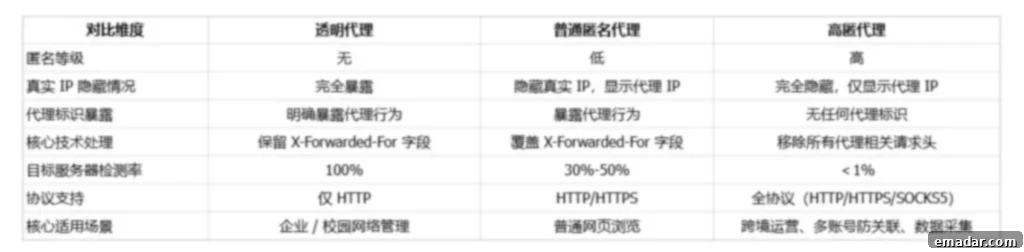
To more clearly understand the positioning of transparent proxies, compare them with ordinary anonymous proxies and high-anonymous proxies in core dimensions. These three types are also the current mainstream proxy types. The differences are mainly concentrated in IP hiding, anonymity, and applicable scenarios:
Common Misuses of Transparent Proxies and Selection Avoidance Guide
Two High-Frequency Misuses
- Misuse in Privacy Protection / Business Operation Scenarios:
Many beginners use transparent proxies for cross-border e-commerce, overseas social media account farming, data collection, and other scenarios, but end up with their accounts being banned.
- Thinking “Being Able to Access Means a Good Proxy”:
Some users judge the quality of a proxy by “whether it can access the target website,” ignoring the platform’s identification of proxy behavior and real IP, resulting in ineffective operation.
Core Selection Principle: Match According to Business Needs
The key to proxy selection is not “which one is better,” but whether it matches your own business needs. Different needs correspond to different proxy types. Do not generalize:
- If the need is for centralized management, traffic scheduling, and cache acceleration of enterprise/campus/office networks, transparent proxies are a cost-effective choice that can achieve network control at a low cost.
- If the need is for ordinary web browsing with low anonymity requirements, you can choose ordinary anonymous proxies.
- If the need is for cross-border e-commerce operation, multi-account anti-association on overseas social media, data collection, and account operation, these scenarios require strong anonymity and IP isolation. Avoid transparent proxies and choose high-anonymous proxies (such as ipfly).
Proxy Selection Recommendations for Different Business Scenarios
Combining actual business needs, give entry-level selection recommendations to help you directly avoid 90% of proxy selection pitfalls:
- Network Management Needs (Enterprise Intranet, Campus Network) → Transparent Proxy.
- General Privacy Protection Needs (Daily Browsing, Anti-Advertising Tracking) → Ordinary Anonymous Proxy.
- High-Requirement Business Needs (Cross-Border Operation, Multi-Account Anti-Association, Data Collection, Overseas Advertising) → High-Anonymous Residential / Data Center Proxy.
For scenarios such as cross-border e-commerce and overseas social media operation that require high IP authenticity and anonymity, not only should you avoid transparent proxies, but you should also choose high-anonymous proxy services with real network environment, low detection rate, and multi-region nodes (such as IPFLY) to meet the stable usage needs of cross-border businesses.
Conclusion
Transparent proxies are dedicated tools tailored for centralized network management. Their core value lies in achieving unified network control, efficiency improvement, and basic security protection at a low cost, rather than privacy protection and business operation.
Many people stumble upon transparent proxies because of mismatched scenarios and tools – misusing tools that are only suitable for network management in cross-border, account operation, and other scenarios that require strong anonymity and IP isolation. Understanding the core positioning of transparent proxies, clarifying the differences between different proxy types, and selecting according to business needs is the key to avoiding pitfalls.
The core logic of proxy selection is never “being able to access is enough,” but how the platform views your access behavior. Only by making the access behavior fit the characteristics of real users, while effectively hiding identity and IP, can stable use be achieved in various business scenarios.
IPFLY has 90 million+ high-quality IP resources worldwide, supporting:
- ✅Highly stable static residential IPs (customizable country/city)
- ✅Massive dynamic residential IPs, supporting automatic rotation
- ✅High purity and strong anti-risk control capabilities
- ✅Exclusive customer service IP environment configuration guidance
Register IPFLY to make your account ‘invisible’ overseas and truly achieve safe operation!