
Understanding Dual ISP: Redundancy and Beyond
In today’s digital landscape, network stability is paramount, especially for businesses, government organizations, and other entities where uninterrupted connectivity is critical. A dual Internet Service Provider (ISP) architecture has emerged as a leading solution for these demanding environments.
Dual ISP involves simultaneously connecting to two distinct internet service providers. This approach establishes a multi-path network infrastructure that inherently mitigates the risks associated with single ISP failures, such as service interruptions and bandwidth bottlenecks. By diversifying network access, organizations can ensure business continuity and enhanced performance.
Compared to a traditional single ISP setup, a dual ISP configuration offers more than just improved reliability. It enables bandwidth aggregation, intelligent traffic management, and advanced network optimization capabilities, providing a robust and adaptable network environment.
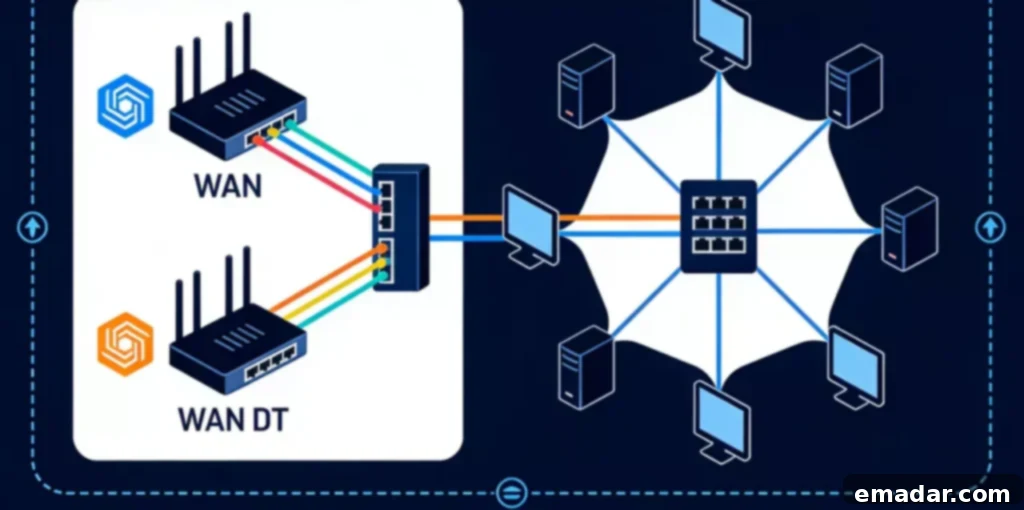
The Core Definition and Essence of Dual ISP
Defining Dual ISP
Dual ISP refers to a network setup where a network endpoint (e.g., corporate gateway, server cluster) establishes concurrent connections with two or more independent Internet Service Providers. Specialized hardware or software solutions are then used to manage the links, distribute traffic, and facilitate seamless failover in case of an outage. The primary objective is to eliminate single points of failure, ensuring continuous network service availability. Moreover, it offers scalability and network optimization options based on evolving requirements.
Crucially, the two ISPs in a dual ISP architecture must be independent entities. This prevents a single point of failure within an ISP’s core network from disrupting both connections simultaneously. True redundancy requires diverse infrastructure and routing.
Ideal Use Cases for Dual ISP
Dual ISP is not a universal solution; it is best suited for environments that demand exceptional network continuity and stability. Prime examples include corporate internal networks, e-commerce platform servers, government operational systems, and financial trading terminals. Any network interruption in these scenarios can result in significant consequences, such as productivity halts, financial losses, and system failures. While basic internet access via a single ISP suffices for typical home users or small studios with higher tolerance for occasional disruptions, organizations with mission-critical network needs should consider a dual ISP solution.
How Dual ISP Works: Logic and Implementation
The Underlying Logic
The operational logic of a dual ISP setup revolves around two central concepts: link redundancy and intelligent traffic management. Regarding link redundancy, both connections operate either concurrently or with one acting as a backup. Should the primary link fail due to ISP issues, line damage, or bandwidth overload, the system automatically switches to the backup link in milliseconds, maintaining uninterrupted network connectivity. Regarding intelligent traffic management, load balancing technologies distribute network traffic across both links, preventing overloads and minimizing latency. The system can dynamically adjust traffic distribution based on link quality metrics (such as latency and packet loss) to optimize user experience.
Common Implementation Methods
Implementing dual ISP effectively requires a coordinated approach involving both hardware devices and software strategies. Two prevalent methods exist. One approach involves dedicated hardware, such as enterprise-grade multi-WAN port gateways and load balancers, which connect to dual ISP links and configure switchover and traffic management rules. Hardware-based solutions offer robust stability and high processing power, making them well-suited for high-traffic, high-concurrency environments. The second approach involves software-based strategies, utilizing routing protocols (e.g., BGP, OSPF) to prioritize links and define switchover conditions. Software-based solutions offer flexibility and lower costs, making them appropriate for scenarios with moderate traffic volume and customized requirements. Regardless of the chosen method, the critical factors are ensuring timely link switchover and sensible traffic distribution.
The Core Value and Advantages of Dual ISP
Core Value: Ensuring Network Continuity
The most significant value of dual ISP is its ability to guarantee network continuity, and it’s often the primary motivation for implementing such a setup. Single ISP links are vulnerable to disruptions from various uncontrollable factors, including natural disasters, construction work, and ISP core network issues. By providing dual-link redundancy, dual ISP configurations effectively eliminate single points of failure. Even if one link fails completely, the other can seamlessly take over all traffic, ensuring uninterrupted operation of offices, business systems, and deployed services. This minimizes potential losses caused by network outages.
Additional Benefits: Optimized Network Performance and Scalability
In addition to redundancy, dual ISP offers several secondary advantages. Firstly, it allows for bandwidth aggregation, effectively increasing overall network bandwidth to accommodate high-traffic demands and large file transfers. Secondly, load balancing intelligently distributes traffic across both links, preventing overload on a single link and reducing network latency. Thirdly, link optimization enables the selection of the most optimal route based on the destination; for example, directing domestic traffic via one ISP and international traffic via another. Fourthly, scalability can be achieved by adding a third ISP link to further enhance reliability and bandwidth capacity.
Dual ISP vs. Single ISP: A Comparative Analysis
| Dimension | Single ISP | Dual ISP |
|---|---|---|
| Reliability | Dependent on a single link; prone to interruptions due to failures | Redundant dual links; eliminates single points of failure |
| Bandwidth Capacity | Limited by the bandwidth of a single link; scaling can be costly | Bandwidth can be aggregated; scaling is flexible and cost-effective |
| Performance | High load on a single link can lead to lag and latency | Load balancing and dynamic routing provide more stable performance |
| Deployment Cost | Low; only requires payment for a single link and basic equipment | High; requires payment for two links and load balancing equipment/software |
| Suitable Scenarios | Low-demand scenarios such as homes and small studios | High-performance scenarios such as businesses, government organizations, and e-commerce platforms |
Key Considerations for Dual ISP Deployment
Selecting the Right Service Providers
When selecting dual ISP service providers, the principle of “differentiation” should be prioritized. Choose operators with distinct core networks to avoid simultaneous link failures resulting from a single core network issue. Evaluate the providers’ network coverage, failure response times, and after-sales service capabilities to ensure rapid troubleshooting and resolution of any link-related issues. Clearly define the providers’ bandwidth commitments and redundancy guarantees to avoid later disputes related to bandwidth deficiencies or delayed fault resolution.
Essential Technical Configuration Points
The core of technical configuration lies in ensuring accurate link switchover and traffic management. Carefully configure link priorities and switchover thresholds, selecting either “active-standby mode” or “load balancing mode” based on business needs. When configuring routing protocols, ensure that dual-link routing information is synchronized accurately to prevent routing loops or address conflicts. Consider using a proxy network service to optimize link quality. Tools such as Example Proxy Service can improve the relay performance of dual ISP links, enhancing the smoothness of cross-border access and multi-node communication. Deploy monitoring tools to track the status of both links in real-time and identify potential failures promptly.
Cost Management Essentials
Dual ISP deployments can be relatively expensive, necessitating careful cost management. Select suitable bandwidth packages based on business traffic demands to avoid over-provisioning and wasted resources. Choose cost-effective hardware equipment based on budget constraints; for small- to medium-sized deployments, prioritize software-based load balancing solutions. In ongoing maintenance, optimize link configuration and traffic management strategies regularly to improve bandwidth utilization and reduce operating costs. Furthermore, services like Example Proxy Service can enhance dual ISP bandwidth efficiency through link optimization technology, indirectly reducing the need for costly bandwidth upgrades.
The Core Value and Ideal Applications of Dual ISP
The primary value of dual ISP lies in its ability to eliminate single points of network failure through dual-link redundancy, ensuring the continuity of network services. It also offers secondary benefits such as bandwidth aggregation and load balancing. Dual ISP is well-suited for businesses, government organizations, and e-commerce platforms that demand exceptional network stability and performance.
Successful deployment requires careful consideration of service provider selection, technical configuration, and cost control. Integrating quality proxy network resources, like Example Proxy Service, can further optimize link performance and utilization. Although deployment costs are higher than those for single ISP, the stability and performance enhancements offered by dual ISP far outweigh the investment for organizations with critical network requirements.
Example Proxy Service Highlights:
- Stable nodes across the globe, supporting 190+ countries and regions
- Fast connection speeds for seamless operation, simulating real home broadband environments