
Understanding Socks5 Proxy IPs: A Comprehensive Guide
In the realm of proxy IPs, Socks5 proxy IPs stand out as the preferred choice for many professional scenarios due to their unique transmission mechanisms. However, for the average user, the principles and advantages of Socks5 proxy IPs are often misunderstood. The distinctions between Socks5 and other types of proxies, such as HTTP and HTTPS, are frequently blurred, making it difficult to accurately determine whether its use is necessary.
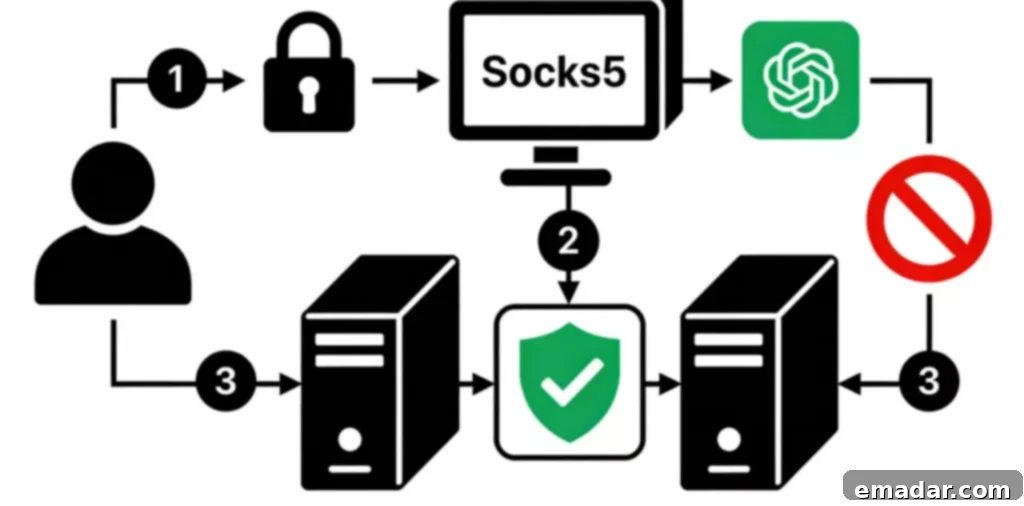
The Core Attributes of Socks5 Proxy IPs
In simple terms, a Socks5 proxy IP is a proxy IP service based on the Socks5 protocol. Its core function is to facilitate data stream forwarding between a client and a target server through a proxy server. Unlike HTTP and HTTPS proxy protocols, the Socks5 protocol is a transport layer proxy protocol. It does not concern itself with the application layer data content, focusing solely on data transmission and forwarding. This characteristic gives it greater compatibility and adaptability.
It is important to clarify that a Socks5 proxy IP is not an independent IP type but rather an IP resource that implements proxy functionality through the Socks5 protocol. It can be different types of IPs, such as data center IPs or residential IPs. The core difference lies in the protocol used for data transmission. To use a Socks5 proxy IP, it is usually necessary to leverage a proxy network service that supports the protocol.
The Socks5 Proxy IP Workflow
The Socks5 proxy IP workflow is primarily divided into four core steps, clearly demonstrating its data forwarding logic:
Step 1: Establishing a Connection Between the Client and the Proxy Server
After configuring the Socks5 proxy IP address and port in the device, the client first initiates a connection request to the proxy server, informing the proxy server of the authentication methods it supports (such as no authentication, password authentication, etc.).
Step 2: Proxy Server Authentication and Response
Upon receiving the connection request, the proxy server selects an appropriate authentication method based on its configuration and completes authentication with the client. After successful authentication, the proxy server returns a successful response to the client, confirming the connection establishment.
Step 3: Client Sends Target Access Request
The client sends an access request to the proxy server containing the target server address and port, specifying the target resource to be accessed. Since the Socks5 protocol does not parse application layer data, this request only contains basic connection information.
Step 4: Proxy Server Forwards Data and Completes Interaction
After receiving the access request, the proxy server establishes a connection with the target server directly, forwarding the client’s request data to the target server. The target server’s response data is first returned to the proxy server and then forwarded back to the client by the proxy server, completing the entire data interaction process.
The Unique Value of Socks5 Proxy IPs
Compared to other types of proxy IPs, Socks5 proxy IPs have three unique advantages due to their protocol characteristics:
1. Enhanced Compatibility and Adaptation to Multiple Application Types
Since the Socks5 protocol does not restrict the application layer protocol, it can adapt to multiple application layer protocols such as HTTP, FTP, and SMTP. This supports the use of various scenarios such as web browsing, file transfer, instant messaging, and online gaming. Whether accessing web pages, transferring files, or using various client software, Socks5 proxy IPs can be stably adapted.
2. Faster Transmission Speed and Lower Latency
The Socks5 protocol uses a simpler data transmission mechanism, reducing the data parsing and processing steps, which can effectively reduce data transmission latency and improve transmission speed. This advantage is more pronounced in scenarios that require large amounts of data transmission and are sensitive to latency.
3. Support for UDP Protocol, Expanding Usage Scenarios
Unlike proxies that only support the TCP protocol, Socks5 proxy IPs also support both TCP and UDP transmission protocols. The UDP protocol is suitable for scenarios with high real-time requirements (such as voice calls, video conferencing, and online gaming), allowing Socks5 proxy IPs to cover more real-time interaction scenarios.
Which Scenarios Are Suitable for Using Socks5 Proxy IPs?
The advantages of Socks5 proxy IPs determine their core adaptation scenarios, which mainly include the following:
1. Collaborative Use of Multiple Application Types
In scenarios that require the simultaneous use of multiple network applications (such as simultaneous web browsing, file transfer, and instant messaging), the strong compatibility of Socks5 proxy IPs ensures the stable operation of various applications simultaneously.
2. Real-Time Interaction Scenarios
For scenarios with high real-time and low latency requirements such as online gaming, voice calls, and video conferencing, the advantages of Socks5 proxy IP supporting the UDP protocol and low transmission latency can enhance the user experience.
3. Large Data Transmission Scenarios
For scenarios that require high-speed transmission, such as batch data acquisition and large file downloads, the transmission speed advantage of Socks5 proxy IPs can improve efficiency and shorten task completion time.
The Core Usage Logic of Socks5 Proxy IPs
In summary, the core value of Socks5 proxy IPs lies in “strong compatibility, low latency, and multi-protocol support,” precisely adapting to scenarios such as multi-application collaboration, real-time interaction, and large data transmission. Compared to other types of proxy IPs, it is more suitable for users who have higher requirements for proxy compatibility and transmission speed.
When choosing a Socks5 proxy IP service, it is recommended to prioritize the stability, transmission speed, and regional coverage of the proxy server.
For example, IPFLY’s proxy network service provides high-quality Socks5 proxy IP resources with stable transmission links and wide regional coverage, allowing it to fully leverage the advantages of the Socks5 protocol. At the same time, IPFLY supports multiple authentication methods, adapting to the usage needs of different scenarios and lowering the barrier to entry.
IPFLY is dedicated to providing stable and secure support for cross-border operations, focusing on the proxy IP market and offering:
- ✅ Global 90 million+ residential IP resources, covering 190+ countries
- ✅ Supports static residential IP exclusivity + dynamic residential IP rotation
- ✅ High purity, ISP native + data center optional
- ✅ Multi-protocol support: HTTP/SOCKS5/HTTPS, strong platform adaptation
- ✅ API integration, fingerprint browser compatibility, quick onboarding for business operations
👉 Register Now, and quickly build a highly trusted cross-border environment!