
What is an ISP? Your Gateway to the Internet Explained
In the simplest terms, an Internet Service Provider (ISP) acts as the “bridge builder” and “network manager” connecting us to the vast world of the internet. Without an ISP, individual devices and corporate networks would be unable to access the global internet. Our daily activities, such as browsing websites, sending messages, and watching videos, would be impossible.
To fully understand “what is an ISP,” we’ll start with the most basic definition and gradually break down its core logic and value.
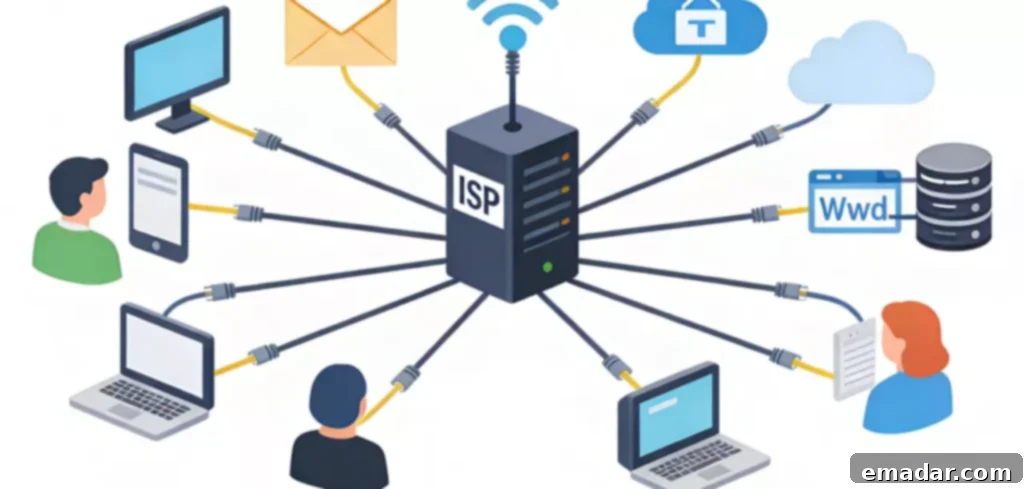
Understanding the Internet Service Provider (ISP)
ISP stands for “Internet Service Provider.” As the name suggests, an ISP is an organization or company that provides internet access services and related network value-added services to individual users, businesses, and other entities. In essence, the core function of an ISP is to “establish a connection channel between devices and the internet,” allowing previously isolated devices to access the global network, enabling data transmission and resource access.
It’s important to note that ISPs not only provide basic network access services but also offer a range of value-added services, such as domain name registration, virtual hosting, and network security protection. However, for the average user, the most frequent interaction is with the core network access service: the home broadband and mobile data plans we subscribe to are essentially network access services purchased from the corresponding ISP.
Main Types of ISPs
ISPs can be categorized based on their target audience, network coverage, and service type. Different types of ISPs cater to different usage scenarios:
1. Backbone ISPs: The “Core Hubs” of the Internet
Backbone ISPs own national or regional backbone network resources. They construct the core transmission network of the internet, responsible for high-speed data transmission between different regions and networks. The customers of these ISPs are primarily other ISPs (such as secondary ISPs), large enterprises, and government agencies. Ordinary users rarely interact directly with them. The network quality of backbone ISPs directly determines the network transmission efficiency and stability of an entire region, serving as the core guarantee for the normal operation of the internet.
2. Secondary ISPs: The “Direct Service Providers” for End Users
Secondary ISPs lease network resources from backbone ISPs and then provide internet access services to end users such as individuals and small to medium-sized businesses. The vast majority of ISPs we encounter daily fall into this category. Examples include telecommunications companies like Verizon, AT&T, and Comcast, all of which are secondary ISPs. The core advantage of these ISPs is their proximity to end users, allowing them to offer personalized access services (such as broadband with different bandwidths and mobile data plans with varying data allowances). They are also responsible for network installation, maintenance, and other after-sales services.
3. Specialized ISPs: The “Niche Service Providers” Offering Specific Value-Added Services
Specialized ISPs do not provide basic network access services. Instead, they focus on providing specific types of network value-added services, such as domain name service providers, virtual hosting service providers, and network security service providers. These ISPs offer supplementary services to the basic network service, meeting the specific network needs of users and businesses. For example, when a business builds a website, it needs to apply for a domain name and virtual hosting from a specialized ISP. Individual users who need to improve network security may choose security protection services provided by a specialized ISP.
Why Are ISPs Considered an “Essential” for Getting Online?
Understanding “what is an ISP” also requires understanding its core function. ISPs play an indispensable role in our online experience, with their role spanning the entire process of network access, data transmission, and service assurance:
1. Providing Network Access Channels: Connecting Devices to the Internet
This is the most core function of an ISP. ISPs build network infrastructure such as fiber optic cables and base stations to provide users’ devices (mobile phones, computers, routers, etc.) with a physical channel to access the internet. By subscribing to the services of an ISP, users obtain the corresponding network access permissions, allowing their devices to connect to the global internet from an “isolated state,” enabling interconnection with other network devices. For example, home broadband connects routers to the internet through fiber optic cables, and mobile phones connect to mobile networks through base stations; both of these essentially rely on the access channel provided by ISPs.
2. Assigning IP Addresses: Giving Devices a “Network ID”
An IP address is the unique identifier of a device on the internet. Without an IP address, a device cannot be recognized by other network devices, and data cannot be transmitted accurately. The allocation of IP addresses is the responsibility of ISPs. When a user’s device connects to the internet, the ISP automatically assigns an IP address to the device (which may be a dynamic IP or a static IP). This IP address is assigned by the ISP from its pool of IP address resources, ensuring that the device can participate in network communication normally. For example, after a home router connects to broadband, the ISP will assign a public IP address to the router, and the router will then assign private IP addresses to devices within the home, enabling multiple devices to share the network.
3. Ensuring Data Transmission: Optimizing Network Links, Improving Transmission Efficiency
Data transmission between a user’s device and the target server requires complex network links, and ISPs ensure smooth and efficient data transmission by optimizing routing and deploying network nodes. ISPs’ network nodes are located in different regions, providing multiple alternative paths for data transmission. When a link is congested or fails, it will automatically switch to a better path, avoiding data transmission interruption or excessive delay. For example, when accessing overseas network resources, the international export links of a high-quality ISP are smoother, which can reduce data transmission latency and improve the access experience.
4. Providing Network Maintenance and After-Sales Service: Solving Problems During Internet Use
Ordinary users inevitably encounter various problems during internet use, such as network disconnections, slow internet speeds, and inability to access specific resources. ISPs provide professional network maintenance and after-sales service to help users solve these problems. ISP repair personnel will come to the door to check network equipment and lines, and technical customer service will remotely troubleshoot network faults, ensuring that users’ network services can operate normally. For example, when a home broadband connection fails, contacting the corresponding ISP customer service can result in an on-site repair service.
5. Providing Value-Added Services: Meeting Diverse Network Needs
In addition to basic network access services, ISPs also provide a variety of value-added services to meet the diverse needs of users and businesses. For example, providing dedicated line access services for enterprise users to ensure stable transmission of enterprise business data; providing cloud storage, network TV, and other services for individual users; and providing basic network security protection for all users to resist common network attacks.
How to Choose the Right ISP as a User
Understanding “what is an ISP” and its core functions allows you to significantly improve your online experience by choosing the right ISP. When choosing an ISP, ordinary users can focus on the following aspects:
1. Network Quality
Prioritize ISPs with strong network stability, low transmission latency, and low packet loss rates. You can learn about the network quality of different ISPs in your local area by consulting nearby users or checking network reviews.
2. Coverage Area
Choose an ISP with comprehensive coverage in your residential or work area to avoid poor network signals or inability to access the internet due to insufficient coverage. For example, some remote areas may only have network coverage from one ISP, so you need to confirm this in advance.
3. Service Quality
Pay attention to the after-sales service quality of the ISP, such as customer service response speed, on-site efficiency of repair personnel, and fault resolution capabilities. High-quality after-sales service can quickly resolve network problems when they occur, reducing the impact.
4. Value for Money of the Package
Choose a suitable package based on your internet usage needs to avoid overspending. For example, users who regularly browse the web and watch videos can choose a 100M-500M broadband package; users who need high-frequency downloads and live streaming can choose a higher bandwidth package.
The ISP is the “Fundamental Pillar” of the Internet Ecosystem
In summary, understanding “what is an ISP” allows you to understand that it is the core link connecting us to the internet and the fundamental pillar of the internet ecosystem. From providing network access channels and assigning IP addresses to ensuring data transmission and providing after-sales maintenance, the role of the ISP spans the entire process of getting online, directly affecting our online experience.
For the average user, there is no need to deeply understand the technical details of the ISP, but understanding its basic definition and core functions can help us better choose network services and communicate more clearly with the ISP to solve network problems when they occur. In practical use, choosing a high-quality ISP is key to ensuring a great online experience.