
Unraveling the IP Protocol: Clearing Up Common Misconceptions
In the realm of networking knowledge, many harbor misconceptions about the Internet Protocol (IP). These range from believing that “IP guarantees data delivery” to thinking “an IP address is the device’s physical address” or asserting “IPv6 has completely replaced IPv4.” Such misunderstandings can hinder a proper grasp of network principles and impede effective troubleshooting.
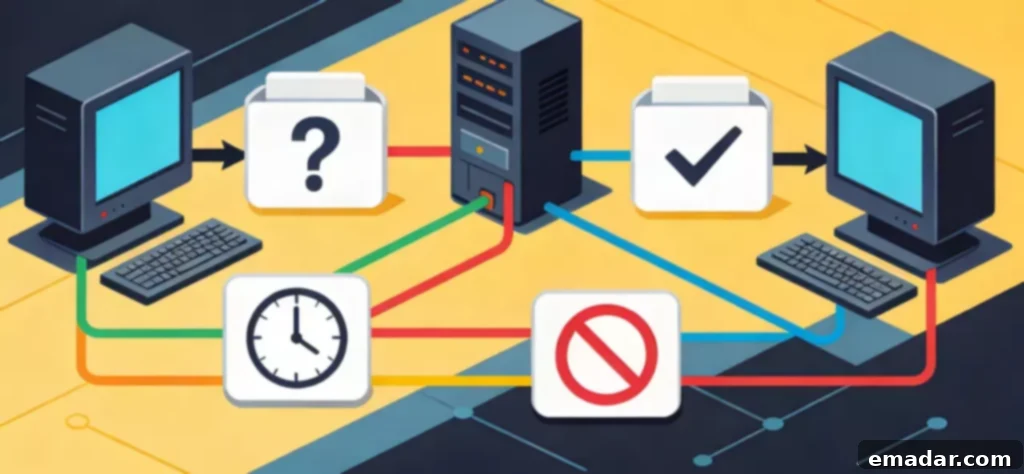
As a foundational protocol of the internet, IP is often known by name but not understood in depth. This superficial understanding makes it easy to be misled by surface-level observations or inaccurate information. This article aims to correct these misunderstandings, providing a clear and comprehensive understanding of the IP protocol.
Understanding the Core Definitions of the IP Protocol
Misconception: IP Protocol and IP Address are Interchangeable
Correct Understanding: The IP protocol and IP address are distinct concepts. The IP protocol, short for “Internet Protocol,” is a set of rules governing data transmission across the internet – a ‘rule system’. An IP address, assigned to network devices, is a unique identifier within this system – a product of the rules. Think of the IP protocol as traffic laws and the IP address as a license plate; they are related but fundamentally different.
Explanation: The IP protocol dictates the format and allocation of IP addresses, as well as data transmission procedures. IP addresses, assigned according to these rules, identify a device’s location on the network, ensuring precise data delivery. Without the IP protocol, IP addresses would lack a unified format and allocation standard. Conversely, without IP addresses, the IP protocol’s rules would be unenforceable. This synergy highlights their interdependent yet distinct roles.
Misconception: The IP Protocol is the Sole Transmission Protocol on the Internet
Correct Understanding: The IP protocol is the core, but not the only, transmission protocol. Internet communication relies on the TCP/IP protocol suite, a collection of protocols that includes TCP, UDP, HTTP, and DNS. Each protocol fulfills a specific function, working together for smooth internet operation.
Explanation: The IP protocol primarily handles addressing and routing, moving data from sender to receiver. The TCP protocol ensures reliable data transmission, managing issues like data loss or out-of-order packets. UDP facilitates rapid data transfer, suitable for real-time applications like video calls and gaming. HTTP, an application-layer protocol, manages web data transmission and parsing. These protocols, among others, form a complete internet communication system, each playing a vital role.
Misconception: IPv4 and IPv6 Differ Only in the Number of Addresses Available
Correct Understanding: While the address quantity is a primary difference, IPv4 and IPv6 also differ significantly in address format, transmission efficiency, security, and compatibility. IPv6 not only resolves IPv4’s address exhaustion issue but also offers performance and security enhancements.
Explanation: Beyond the number of addresses (approximately 4.3 billion for IPv4 and an immense quantity for IPv6), key differences include:
- Address Format: IPv4 uses a 32-bit dotted decimal format, while IPv6 uses a 128-bit colon-hexadecimal format.
- Transmission Efficiency: IPv6 streamlines the header structure, reducing router processing overhead and improving transmission efficiency.
- Security: IPv6 incorporates IPsec for enhanced data transmission security.
- Compatibility: IPv6 is not directly compatible with IPv4, requiring tunneling techniques for interoperability.
Understanding the Transmission Logic of the IP Protocol
Misconception: The IP Protocol Guarantees Reliable Data Transmission Without Data Loss
Correct Understanding: The IP protocol is an unreliable transmission protocol. It doesn’t guarantee data delivery, and data can be lost, corrupted, or arrive out of order. The IP protocol aims to deliver data to the destination, but it doesn’t verify completeness or order.
Explanation: The IP protocol uses a connectionless transmission method, where sender and receiver don’t establish a connection before data transfer, and packets are transmitted independently. This allows high transmission efficiency but sacrifices reliability. If a packet encounters network congestion or router failure, it might be dropped. Varying transmission paths can also lead to packets arriving in the wrong order. Reliable data transmission relies on upper-layer protocols like TCP, which use retransmission, checksums, and sequencing to compensate for IP’s shortcomings.
Misconception: IP Data Packets are Modified During Transmission
Correct Understanding: The IP protocol specifies that routers only modify the control information in the packet header (such as Time-To-Live (TTL) and header checksum) when forwarding IP packets. The data portion remains unchanged. The original data is parsed and processed only upon reaching the destination device.
Explanation: IP packets consist of a header and a data section. The header contains control information like source IP, destination IP, TTL, and protocol type. Routers modify these control fields as needed (e.g., decrementing TTL, recalculating the checksum). The data section, however, which contains the original data, is never altered by routers, ensuring data integrity. Data corruption is typically due to physical factors like transmission line interference, not router modification.
Misconception: The IP Protocol Always Selects the Shortest Physical Path for Data Transmission
Correct Understanding: The IP protocol uses an “optimal path” based on multiple factors, which isn’t always the shortest physical route. Routers consider network congestion, latency, link quality, and bandwidth to select the most efficient transmission path.
Explanation: Router routing tables store transmission path priorities for different IP address ranges, determined by routing protocol algorithms (e.g., RIP based on hop count, OSPF based on link state). For example, the shortest physical path from Beijing to Shanghai might be congested. A router would choose a slightly longer but smoother path to ensure faster, more stable data transmission. The IP protocol selects the “logically optimal path,” not the “physically shortest path.”
Understanding the Usage Logic of the IP Protocol
Misconception: Every Device in a Household Has a Unique Public IP Address
Correct Understanding: Most home networks share a single public IP address to access the internet. Individual devices use private IP addresses and rely on the router’s NAT (Network Address Translation) to share the public IP.
Explanation: Due to IPv4 address scarcity, ISPs don’t assign a unique public IP to each home device. Instead, they assign one to the router. The router assigns private IP addresses (e.g., in the 192.168.1.x range) to devices within the local network. These private IPs are only usable within the local network. When a device accesses a public resource, the router’s NAT function translates the device’s private IP to the public IP, enabling internet access. This conserves public IP address resources.
Misconception: An IP Address Can Directly Locate a Device’s Physical Location
Correct Understanding: An IP address can roughly locate a device’s network location (city, region, ISP) but cannot pinpoint its exact physical location (home address, office address). IP address location is tied to the network access point, not the device itself.
Explanation: IP address allocation is linked to the ISP’s network coverage. Each IP address range corresponds to a specific region and ISP. Therefore, you can use an IP address to find the ISP and general area (e.g., Chaoyang District, Beijing) but not the specific street and house number. For example, when a phone connects to cellular data, the IP address corresponds to the mobile base station’s location. When connected to Wi-Fi, the IP address corresponds to the broadband node the router is connected to. Accurate physical device location requires technologies like GPS or BeiDou; IP addresses alone are insufficient.
Misconception: Cross-Border Access Requires Modifying the Core Configuration of the IP Protocol
Correct Understanding: Cross-border access doesn’t require altering the IP protocol’s core configuration. It involves using a proxy network service to obtain a foreign IP address and relying on the IP protocol’s standard routing rules for data transmission. The IP protocol’s core configuration (address format, transmission rules) is globally unified and adaptable to overseas network environments without modification.
Explanation: The main requirement for cross-border access is to bypass geographical restrictions, which are essentially regional validations of the visiting device’s IP address. Regular users’ public IP addresses are domestic, which won’t pass the validation. Therefore, proxy network services are required to obtain foreign IP addresses. These services follow the IP protocol’s rules to assign users independent foreign IP addresses, so their devices can be identified as local by overseas networks, and optimize the routing path to ensure stable data transmission. Services like IPFLY’s proxy service achieve cross-border access in this manner. Users don’t need to modify any core IP protocol settings; a simple setup is all that’s needed.
Misconception: Using a Proxy Network Service Changes the Working Principle of the IP Protocol
Correct Understanding: Using a proxy network service doesn’t change the IP protocol’s working principle. It simply provides different IP addresses and optimized routing paths to meet specific network access needs. The IP protocol’s core logic (addressing, routing, data packet transmission) still follows global standards, and proxy network services provide services within the IP protocol framework.
Explanation: A proxy network service acts as an “intermediate forwarding node.” User data is first transmitted to the proxy server, and then the proxy server forwards it to the target network resource. During this process, the IP protocol’s working principle doesn’t change. Data is still packaged into IP packets, containing the source IP (the user device’s IP or the proxy server’s IP) and the destination IP (the target resource’s IP), and routed through routers to reach the destination device. Quality proxy network services (like IPFLY) optimize the deployment of proxy server nodes and the routing configuration to ensure smoother data transmission, but they don’t alter the core rules of the IP protocol.
Correctly Understanding the IP Protocol: Start by Avoiding Misconceptions
Many misconceptions about the IP protocol stem from an incomplete understanding of its core characteristics (connectionless, unreliable) and application logic (addressing + routing). To correctly understand the IP protocol, you need to grasp the core concept of a “rule system”: the IP protocol is the underlying rule for internet communication, the IP address is an identifier under that rule, and the reliability of data transmission needs to be guaranteed by other protocols working together.
Avoiding these common misconceptions will help you more accurately understand how the internet works and find solutions to network problems (such as IP address conflicts or issues with cross-border access) more quickly. If you have specific needs like cross-border access, choosing a legitimate proxy network service (like IPFLY) will allow you to meet your needs within the IP protocol framework without modifying core settings. We hope that this article will help you establish a correct understanding of the IP protocol and better enjoy network services.
Why Choose IPFLY Solutions?
IPFLY helps users efficiently configure proxy IPs through the following technological advantages:
- Self-built server network: Covers major cities around the world, with high IP resource purity, avoiding “blacklist” issues.
- Dynamic IP allocation mechanism: Automatically rotates IPs, reducing the risk of long-term use of the same address.
- Multi-level IP filtering: Uses big data algorithms to eliminate low-quality IPs, ensuring proxy link success.
👉 Choose IPFLY for peace of mind, Claim your Discount and Get High-Quality IPs Now!