
High-Speed Proxy IPs: Beyond Bandwidth – Ensuring Optimal Performance
Many people, when selecting a proxy service, immediately think: “I need a high-speed proxy IP!”
However, after purchasing and using the service, they often encounter these issues:
- Webpages load slowly.
- Video streaming is buffering.
- Login processes are taking too long and are frequently interrupted.
- Batch operations suffer from frequent disconnections.
This raises the question: If these are advertised as high-speed proxy IPs, why are they so slow?
The problem lies in a common misconception: High-speed doesn’t just mean large bandwidth. It means the entire connection path should have no bottlenecks.
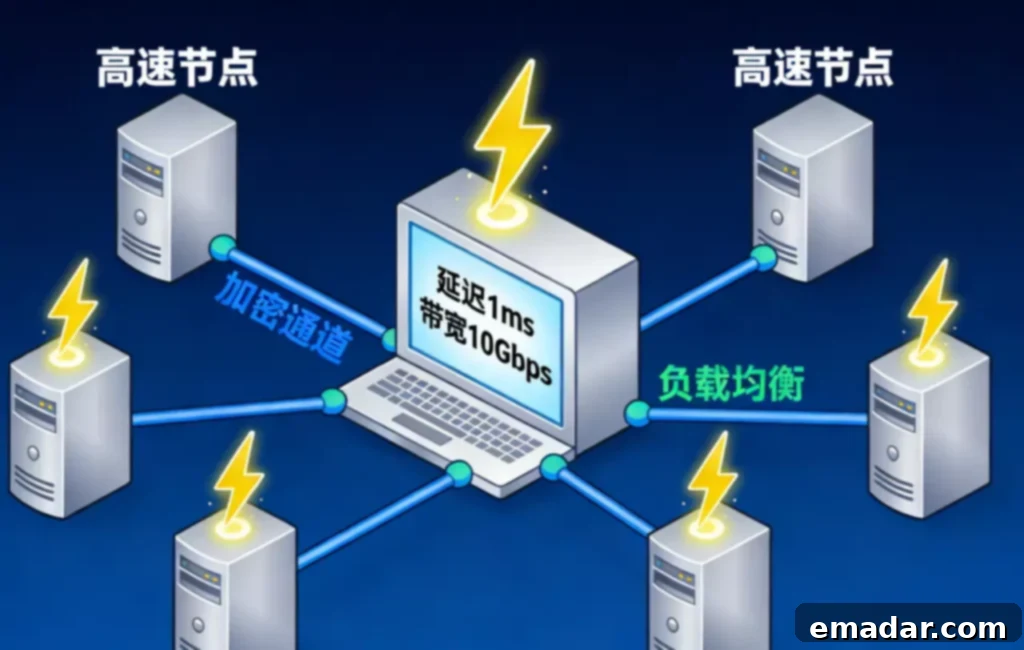
Why Your “High-Speed Proxy IP” Might Still Be Slow
The real determinant of proxy speed is not a single parameter, but rather the entire network path. Several factors can contribute to a slow experience, even with a supposedly high-speed proxy IP.
1. The IP Itself Might Be Fast, But Other Factors Are Holding It Back
A typical access path includes:
Your Local Device → Proxy Server → Target Website → Return Path
Many so-called high-speed proxy IPs are only fast in one small segment – the proxy server’s exit point.
The issues often lie before or after this point:
- Inefficient routing for international connections.
- Overloaded nodes (too many shared users).
- Poor quality return routes with significant packet loss.
The result is: Good speed test results, but inconsistent and unreliable performance in real-world use.
2. Shared IPs: Essentially “Fighting for Speed”
Many users don’t realize that a shared proxy means multiple individuals are simultaneously competing for the same network channel.
This might be manageable during off-peak times, but during periods of high demand:
- Bandwidth is divided among users.
- Latency increases dramatically.
- Requests are queued, leading to delays.
This explains why some users experience:
Usable performance during the day, but a complete standstill at night.
Key Characteristics of a Truly High-Speed Proxy IP
If you regularly use proxies for activities like cross-border operations, managing multiple accounts (matrix setups), AI-related tasks, or web scraping, it’s crucial to evaluate a proxy service based on the following criteria to determine if it’s genuinely high-speed.
1. Short Connection Path: Avoid Detours
The essence of high speed isn’t just “running fast,” but also minimizing unnecessary turns.
- Does the proxy directly connect to the target country?
- Does it have optimized international exit points?
- Are there multiple intermediary nodes that increase latency?
A longer connection path inevitably leads to higher latency.
2. Dedicated Resources: More Than Just “Claimed Dedication”
Many providers claim to offer dedicated proxies, but in reality:
- Multiple users are assigned to a single IP range.
- While the port might be dedicated, the underlying network line is shared.
A truly stable, high-speed proxy IP must have controllable bandwidth, network path, and exclusive IP usage rights.
3. Real-Time Monitoring of Node Load
This is the key difference between basic proxies and professional-grade solutions.
Providers like IPFLY, which operate their own server infrastructure, have a significant advantage:
- Nodes aren’t used to full capacity; they have load limits.
- High-latency or problematic network routes are automatically removed.
- Quality filtering is performed before IP assignment.
Therefore, the high-speed proxy IP you receive isn’t just a random IP, but a network route that has already passed health checks.
4. Stability Over Peak Speed
Many beginners focus on a single metric:
Low ping time.
However, experienced users prioritize:
- Frequency of disconnections.
- Whether long-running tasks are interrupted.
- Stability of request success rates.
A proxy that can run continuously for 24 hours without issues is a truly high-speed proxy IP.
Frequently Overlooked Use Cases for High-Speed Proxy IPs
Scenario 1: E-Commerce Backend & ERP Systems
- Numerous pages and intensive requests.
- Slow loading times can trigger false alarms for suspicious logins.
High-speed proxy IPs can significantly reduce:
- Backend loading failures.
- Slow performance when managing multiple accounts simultaneously.
- False-positive risk control triggers.
Scenario 2: Social Media Automation & Fingerprint Browsers
The biggest concern for social media automation isn’t just account bans, but also inconsistent operation.
- Slow page loading → unusual behavior.
- Failed video uploads → flags from risk control systems.
High-speed and stable proxies
make operations appear more human-like by creating a smooth workflow.
Scenario 3: AI Models & Overseas SaaS Platforms
Many AI platforms are highly sensitive to connection stability:
- High latency.
- Frequent connection interruptions.
- IP fluctuations within the same session.
All of these can be flagged as suspicious activity.
Why Are More People Considering “High-Speed Proxy IPs” as a Foundational Infrastructure?
There’s a growing trend:
New users choose proxies; experienced users choose network infrastructure.
The reason is simple:
- Software can be replaced.
- Strategies can be modified.
- But if the network is unstable, all upper-level operations become ineffective.
This is why many teams involved in long-term projects prefer to select proxy services like IPFLY, which emphasize network quality and stability, rather than simply pursuing the lowest price.
Conclusion: High-Speed Proxy IPs – Don’t Just Focus on “Speed”
A truly reliable high-speed proxy IP should at least:
- Have a short connection path with optimized international exit points.
- Offer dedicated resources and avoid excessive sharing.
- Provide controllable and filterable node loads.
- Ensure long-term stability, rather than just peak speed.
When your proxy no longer holds you back, you’ll realize that many “technical problems” are actually just network issues.
IPFLY offers over 90 million high-quality IP resources globally, supporting:
- High-stability static residential IPs (customizable by country/city).
- Massive dynamic residential IPs with automatic rotation.
- High purity and strong anti-risk control capabilities.
- Dedicated customer service for IP environment configuration guidance.
Register with IPFLY to ‘cloak’ your account overseas and achieve truly secure operations!