
Unlocking Synergies: How Facebook Ads Indirectly Boost Google Organic Rankings
In the ever-evolving landscape of digital marketing, acquiring traffic is no longer a solitary pursuit. While Facebook Ads (paid traffic) and Google SEO (organic traffic) operate within distinct algorithmic frameworks, a profound synergy exists between them. While Facebook Ads doesn’t directly alter Google’s ranking code, it acts as an “indirect catalyst” for enhancing organic rankings by influencing user behavior, bolstering brand awareness, and facilitating external link acquisition.
I. The Synergistic Logic: Three Ways Facebook Ads Influence Organic Rankings
To effectively leverage Facebook Ads for SEO gains, it’s crucial to understand the underlying mechanisms driving this indirect influence:
1. Sparking a Surge in “Brand Keyword” Searches
When users are repeatedly exposed to your brand through Facebook Ads, their search habits undergo a significant transformation. They shift from searching for generic terms like “portable power station” to searching for “brand name + portable power station.” This surge in branded search volume serves as a core signal for Google to assess website authority, directly contributing to a steady rise in the site’s overall rankings. Increased brand awareness through Facebook campaigns drives more direct searches for your brand on Google, which signals to Google that your brand is relevant and trustworthy. This increased search volume can significantly improve your website’s organic ranking for relevant keywords.
2. Amplifying the “Link Attractiveness” of High-Quality Content
External links are the lifeblood of SEO. By promoting in-depth industry reports, white papers, or guides via Facebook Ads, you can reach influential industry bloggers and media professionals. Their organic sharing and citations of this valuable content generate high-quality, natural backlinks to your website, significantly amplifying the SEO spillover value derived from Facebook Ads. Creating compelling and shareable content and promoting it through targeted Facebook Ads is a powerful strategy. When industry influencers and websites link to your content, it significantly boosts your website’s authority and improves your organic search rankings.
3. Optimizing Website “User Behavior Feedback”
When high-quality traffic from Facebook Ads lands on your website and exhibits extended dwell times, low bounce rates, and deep page interactions, Google’s behavioral monitoring mechanisms interpret this as a strong indication of the page’s user value. In the era of AI-powered search, this positive signal is paramount for boosting organic rankings. Monitor key metrics like bounce rate, time on site, and pages per session for traffic coming from Facebook Ads. A positive user experience translates to higher rankings on Google.
II. Practical Guide: How to Optimize Facebook Ads to Empower SEO
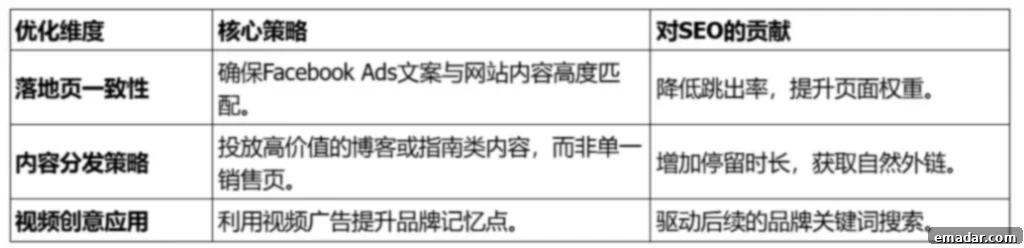
To ensure Facebook Ads truly benefits SEO, the advertising strategy needs to transition from a “pure conversion focus” to a “brand consistency orientation”:
- Consistent Branding: Ensure consistent messaging and visuals between your Facebook Ads and your website. This helps users easily recognize your brand and reinforces brand trust.
- Targeted Content: Promote blog posts, articles, and resources relevant to your target audience’s search queries.
- Optimize Landing Pages: Create dedicated landing pages for your Facebook Ads with clear calls to action and relevant content.
- Keyword Integration: Incorporate relevant keywords into your Facebook Ad copy and landing page content to improve search visibility.
- Remarketing Strategies: Use remarketing campaigns to re-engage users who have visited your website, increasing brand recall and driving more organic searches.
Instead of solely focusing on immediate sales, consider campaigns that drive awareness and engagement. This can be achieved by sharing valuable content, running contests, or creating interactive experiences that encourage users to interact with your brand. By prioritizing brand building, you’ll create a stronger foundation for long-term SEO success.
III. Environmental Strategies: Securing a Stable Technical Foundation for Facebook Ads
When simultaneously deploying Facebook Ads across multiple accounts and regions, many marketing teams overlook the critical aspect of network environment consistency. This often leads to data contamination or account association bans.
To ensure the traffic signals generated by Facebook Ads are clean and sustainable, it’s imperative to establish a robust underlying environment:
1. Achieving Geographic Location Alignment:
If your Facebook Ads target market is the United States, but your login environment indicates a different region, it’s likely to trigger platform risk control interceptions. By utilizing global static residential proxies, you can ensure each ad account possesses a clean network identity corresponding to its target market. Using a proxy server that matches the target location helps to avoid suspicion and ensures that your ads are shown to the right audience, leading to better performance and more accurate data.
2. Mitigating Multi-Account Association Risks:
When running large-scale Facebook Ads campaigns, environment isolation is a fundamental requirement. Dedicated IP resources effectively prevent “collateral” bans resulting from IP sharing. Each Facebook Ads account operates under a separate, high-reputation IP address, safeguarding the accurate accumulation of pixel data. Each account will appear as a unique user, preventing potential flags or bans associated with multiple accounts originating from the same IP address. This ensures the longevity and stability of your campaigns.
3. Enhancing the “Learning Quality” of Pixel Data:
Facebook Ads algorithms rely on authentic and stable user feedback. Employing static residential IPs with long-term connectivity capabilities simulates genuine home browsing environments, preventing campaign strategy failures caused by sudden IP changes, and thereby providing more valuable indirect behavioral data for SEO. The Facebook Pixel learns from user interactions, and using stable IPs provides a more consistent and accurate data stream for the algorithm to optimize your ads effectively.
IV. Conclusion: From Solo Operations to Global Collaboration
Facebook Ads and Google organic rankings are not mutually exclusive. In 2025, astute marketers understand how to leverage the immediate burst of power offered by Facebook Ads to pave the way for long-term SEO strategies.
By implementing strategic content distribution, optimizing user interactions, and establishing a stable and secure underlying network environment, you can not only achieve direct conversions from Facebook Ads but also build a lasting competitive moat for your brand within search engines. Integrating Facebook Ads and SEO into a cohesive strategy allows you to maximize your reach and impact. By aligning your social media and search engine optimization efforts, you can create a powerful synergy that drives brand awareness, traffic, and ultimately, conversions. Consider Facebook Ads as a means of accelerating the organic growth of your website and brand.
Think of Facebook Ads as the ignition and SEO as the engine. Facebook Ads can provide an initial spark, driving targeted traffic to your website and generating valuable user data. This data can then be used to optimize your SEO efforts, improving your website’s ranking and attracting even more organic traffic over time. The key is to use Facebook Ads strategically, focusing on building brand awareness, generating high-quality leads, and creating engaging content that resonates with your target audience. By combining these strategies, you can create a powerful marketing engine that drives sustainable growth for your business.