
Secure Your Cross-Border Payments: A Guide to Static Residential IPs
As November approaches, cross-border payment platforms like PayPal, Stripe, and Payoneer enter what’s often called “risk control season.” For cross-border sellers, this period is marked by the increased likelihood of sudden secondary verifications, risk-related freezes, delayed withdrawals, and account reviews. Navigating these challenges requires a strategic approach to IP addresses.
While you might suspect unusual transaction volumes or high-risk payment patterns as the cause, the real culprit often lies in a seemingly insignificant factor: an inconsistent IP environment. Especially for teams managing multiple accounts, consolidating funds, reconciling accounts, and initiating year-end withdrawals can trigger PayPal and Stripe’s Location Risk mechanisms, leading to immediate account scrutiny due to frequently changing dynamic IPs. To mitigate these risks, understanding the difference between static and dynamic IPs is crucial.
Let’s delve into why using long-term static residential IPs is essential during this time, how they differ from standard IPs, and how you can precisely avoid triggering risk controls. We’ll guide you through the practical aspects of safeguarding your cross-border payment accounts. The cornerstone of this strategy is maintaining an IP environment consistent with your initial registration location.

Why Cross-Border Payment Platforms Have Stricter Risk Controls at Year-End
In the official risk control models of PayPal and Stripe, the year-end is considered a high-risk period. This heightened scrutiny is due to several factors that influence the platforms’ security measures.
1. Sudden Increase in Fund Flows
Sellers typically concentrate their withdrawals, transfers, and fund consolidations during the year-end. This surge in financial activity can create abnormal funding patterns, which are flagged by the platforms’ automated review systems. High-value transactions and sudden spikes in activity are more likely to trigger security protocols.
2. Multiple Accounts with Inconsistent IPs Are Deemed “Suspicious Activity”
If a platform detects that you logged in from California one day, suddenly switched to New York in the evening, and then appeared in London the next day, it will immediately flag your account for “potential account theft.” Consistent and reliable IP addresses help avoid such red flags.
3. Maintaining a Consistent Environment When Handling Disputes (Dispute/SNAD)
PayPal’s risk control documentation explicitly states that filing appeals from different locations, uploading materials from different regions, and submitting supporting documents from different IP addresses are considered high-risk behaviors. Maintaining a consistent IP address during dispute resolution is vital.
The increased volume of complaints during the year-end means that unstable IPs can more easily trigger secondary verifications or account freezes. This is why many sellers realize at year-end that dynamic IPs are too risky to use and that switching to long-term static residential IPs is essential for account security.
Why Dynamic IPs Are a High-Risk Source of Risk Control Triggers
Dynamic IPs are not inherently unusable for cross-border operations, but they pose significant risks if employed incorrectly. The key is understanding when and how to use them effectively.
Typical Risks Include:
- Automatic IP changes every few hours.
- Frequent changes in city, state, or even country.
- Identification by PayPal/Stripe as a multi-location login risk.
If you use a dynamic IP when attempting to unbind funds, submit documents, or process large transactions, you may encounter:
- Requests to upload ID and proof of address.
- Funds frozen for 21 days.
- Withdrawal restrictions.
- Account suspension pending review.
- Repeated verification failures.
These risks are magnified several times over during the year-end risk control period, making the use of dynamic IPs in cross-border payment scenarios akin to intentionally crossing a red line. The stability of static IPs provides a safer alternative.
What Are “Long-Term Static Residential IPs”? Why Are They More Trusted by PayPal/Stripe?
If you aim to maintain long-term stability and avoid triggering any risk controls for your cross-border payment account, long-term static residential IPs are the optimal solution. These IPs offer several key advantages that enhance security and trust with payment platforms.
1. “Static” Means the IP Never Changes
Remaining unchanged for 30 days or more meets the “login consistency” requirements of payment platforms, which contributes significantly to account stability. Consistent IP addresses build trust and reduce the likelihood of triggering security alerts.
2. “Residential IP” Means It Originates from a Real Home Network
Rather than a data center or shared server room, residential IPs are associated with actual residential locations. This provides a higher level of trust and reduces the chances of being flagged as a potential fraud risk.
PayPal risk controls have a higher tolerance for this type of “genuine user environment,” recognizing it as less likely to be involved in fraudulent activities. The credibility of a residential IP is a crucial factor in avoiding unnecessary scrutiny.
3. Maintain Complete Consistency with the Initial Registration
If you use a static residential IP in the same region from the start, your account will remain more stable throughout its entire lifecycle. Using the same IP address consistently from registration onward establishes a strong and reliable profile with the payment platform.
In the cross-border community, there’s a saying: “Payment systems aren’t afraid of you using a proxy IP; they’re only afraid of IP inconsistencies.” This emphasizes the importance of maintaining a consistent IP environment to build trust and avoid account issues.

Practical Steps: How to Properly Maintain IP Consistency for Cross-Border Payment Accounts
Here are practical solutions commonly used by cross-border seller teams to ensure IP consistency:
(1) Establish Independent, Fixed “IP Ownership” for All Accounts
Bind each PayPal/Stripe account to a single, fixed IP address, and do not mix it with other business activities. Keeping your accounts separate and dedicated to their own IP addresses minimizes potential risks and ensures each account has a consistent online presence.
(2) Avoid Logging into the Same Account from Different Devices
Unless the IP address and browser fingerprint are completely consistent, it is best to stick to one dedicated device. Using multiple devices can trigger security alerts due to inconsistent login patterns.
(3) Prohibit Network Switching During Fund Collection
Avoid switching between Wi-Fi, 4G, and company networks. Inconsistent network connections can raise suspicions and trigger unnecessary verifications.
(4) Always Use a Fixed IP When Performing High-Risk Actions
For example:
- Disputes
- KYC document uploads
- Withdrawals
- Bulk transfers
When your IP address is stable, the risk of triggering fraud controls decreases significantly. Consistent IP addresses during critical transactions build trust and security.
Why “IP Quality” Is More Important Than You Think
Different proxy IPs have a significant impact on cross-border payments. The quality and reliability of your IP address are crucial for maintaining a secure and trusted online presence.
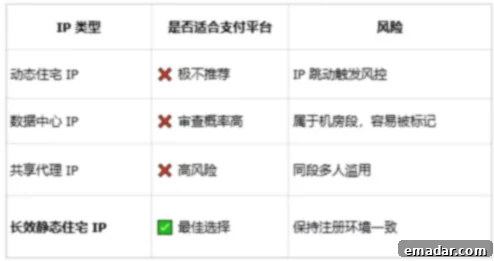
Many sellers mistakenly assume that IPs are “virtual and can be used randomly.” However, in the PayPal/Stripe risk model, the IP address and fingerprint are the primary indicators of account ownership. These platforms use sophisticated algorithms to analyze IP addresses and detect potential fraudulent activities. High-quality IPs provide a layer of protection and reduce the chances of being flagged.
What Really Determines Risk Control: Maintaining a Consistent Environment
The most important factor in avoiding risk controls is maintaining a consistent environment, from registration to transactions and disputes. Consistency in IP address, browser fingerprint, and location builds trust and reduces the likelihood of triggering security alerts.
How Cross-Border Teams Should Choose High-Quality Static Residential IPs
Based on feedback from numerous cross-border sellers from 2024-2025, when selecting static residential IPs, it’s crucial to focus on:
- Whether it is a real residential ASN (Autonomous System Number).
- Whether it remains stable and unchanged for 30-90 days.
- The login success rate.
- The account consistency score.
- Whether the IP range is clean and free from abuse.
Service providers like IPFLY, which offer long-term static residential IPs, perform multi-layer filtering of IPs. They ensure that the ASN, source region, and residential network attributes comply with PayPal/Stripe’s risk identification models. These services provide a higher level of security and reduce the chances of triggering risk controls.
Especially during the year-end risk control period, many sellers prefer to switch to stable IPs in advance before initiating fund collection and dispute resolution. This proactive approach helps minimize potential risks and ensures a smoother and more secure transaction process.
Final Recommendations for the Cross-Border Payment Year-End Risk Control Period
If you want to minimize risk control issues, follow this “golden rule”:
Always Use the Same Static Residential IP for the Same Account
It’s that simple. Seasoned cross-border professionals consistently adhere to this practice. Using a dedicated IP address for each account builds trust and reduces the likelihood of triggering security alerts. Consistent and reliable IP management is a cornerstone of account security.
If you are currently using dynamic residential IPs, data center IPs, or shared IPs, the best strategy is to quickly replace them with static residential IPs that can be bound long-term and assigned to specific regions. This switch helps minimize potential risks and ensure a more secure online presence.
For example, IPFLY’s static residential proxies can remain stable for over a month. They are ideal for PayPal/Stripe scenarios where “account consistency” is crucial, avoiding the extra verifications and freezes triggered by dynamic IPs. These proxies provide a reliable and consistent IP environment, which is essential for maintaining account security and trust with payment platforms.
Conclusion
In the cross-border payment system, a consistent IP address is more than just a “login method.” It’s the core basis for determining account ownership, user behavior, and security status. Maintaining a stable and reliable IP address is essential for building trust and reducing the risk of fraud.
During the year-end risk control period, a stable IP address means a stable account. By prioritizing IP consistency, you can reduce the likelihood of account freezes and other security issues.
If you are processing PayPal/Stripe withdrawals, disputes, or fund collections, ensure your login environment remains consistent. Using the right IP address can reduce the risk of triggering risk controls by 70%. Consistent and reliable IP management is a critical component of secure cross-border transactions.
Use IPFLY Residential Proxy IPs
IPFLY uses a self-built server + big data filtering system to provide:
- Real ISP-assigned residential IPs. This ensures that your IP address is associated with an actual residential location, providing a higher level of trust and credibility.
- Clean, unpolluted IP ranges that are non-shared and have no historical records of abuse. This minimizes the risk of being flagged as a potential fraud risk and ensures a more secure online presence.
- Support for IP detection, location filtering, and multi-country switching. This gives you the flexibility to manage your IP address and customize your online presence to meet your specific needs.
Prevent risk control and manage risks with IPFLY for IP isolation!