
Are you experiencing frequent issues with your cross-border accounts, such as login anomalies, CAPTCHA verifications, traffic limitations, failed ad placements, or increased payment risk assessments? Seventy percent of the root causes can be traced back to the IP address you are using.
Among all IP types, “US Residential IP” and “US Native IP” are often confused by cross-border sellers and social media marketers. Both can “appear as a US network environment,” but their underlying properties are completely different. Using the wrong one will not only fail to improve efficiency but can also lead you straight into risk control traps.
This guide provides a clear and practical comparison to help you understand the key differences and appropriate uses of each IP type.

What is a US Residential IP?
In a nutshell: Residential IPs originate from genuine home broadband connections, assigned by ISPs. They offer high authenticity and a natural online environment.
Key Characteristics:
- Generated from US household broadband environments (e.g., Comcast, Spectrum).
- Natural, widely distributed, and less likely to be flagged by platforms.
- Ideal for account nurturing and long-term use.
- Available in both static (stable, unchanging) and dynamic (rotating on a schedule) options.
Suitable Use Cases:
- Social Media Account Nurturing (TikTok, Facebook, Instagram): Maintaining consistent and authentic profiles.
- Cross-Border E-commerce Back-End Operations (Amazon, eBay, Etsy): Managing your business from a secure and recognized location.
- Accessing Real Estate/Ticketing Websites: Bypassing geographical restrictions and accessing local content.
- Preventing Risk Controls triggered by “Non-US Access Anomalies”: Ensuring seamless access without triggering security alerts.
Why do sellers prefer Residential IPs?
Because when platforms see this type of IP, they perceive you as “an ordinary American internet user,” resulting in naturally higher credibility. This inherent trust is crucial for avoiding unwanted scrutiny and maintaining account health.
What is a US Native IP?
In a nutshell: Native IP = From registration location to ASN (Autonomous System Number), everything is purely US-based, without any intermediaries or proxy relays. It represents the cleanest “original network identity.”
Key Characteristics:
- ASN attribution is genuinely to a US operator.
- Completely free of any proxy markers.
- Identical to the identity of local, genuine US users.
- Represents a “high level of authenticity.”
Simply put: A Native IP is the “purebred version” of a Residential IP. It offers the highest level of trust and security.
Advantages of Native IPs:
- Extremely difficult to trigger platform “proxy detection” mechanisms.
- Significantly more stable ad campaign account quality.
- Commonly used by TikTok/FB/Google Ads management teams.
- Higher success rates for registering high-value accounts.
- Essential for the “master control account” environment in multi-account matrices.
Key Differences Between Residential and Native IPs: A Summary
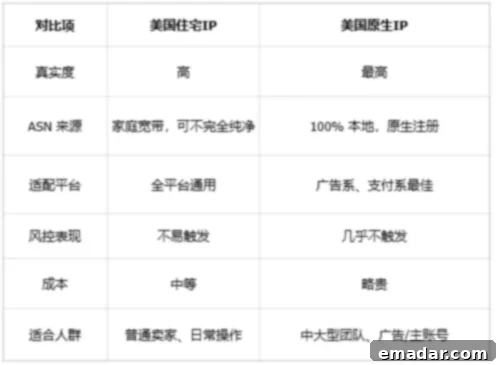
Remember this: Residential IPs are sufficient for many tasks, but Native IPs offer a “more stable, cleaner, and trustworthy” option. Native IPs offer an enhanced level of security and trustworthiness, which is particularly beneficial for sensitive operations.
Practical Usage Recommendations for Cross-Border E-commerce and Social Media
1) For Cross-Border E-commerce (Amazon/Walmart/Shopify)
- Registering a Store, Uploading Sensitive Information → Native IP is More Stable Platforms are wary of “abnormal login sources.” The purity of a Native IP (such as those offered by IPFLY) can significantly reduce account health warning flags. Using a native IP during these critical phases ensures the highest level of security and reduces the risk of account suspension.
- Daily Back-End Operations → Residential IP is Perfectly Adequate As long as it is fixed, stable, and free of pollution sources. For routine tasks, a reliable residential IP provides a cost-effective solution without compromising security.
2) For Building a TikTok/FB/Insta Matrix
- Account Nurturing / Browsing / Interaction → Residential IP is Best Social platforms value “local user traces,” and the home broadband attribute of Residential IPs feels more natural. Residential IPs simulate organic user behavior, increasing account credibility.
- Ad Placement / Store Mounting / Master Control Account → Native IP Especially for TikTok Shop and FB Ads. If you are opening an ad account overseas, using an unclean IP can easily be flagged as “proxy traffic.” Native IPs provide the cleanest environment for ad campaigns, maximizing performance and minimizing compliance issues.
3) For High-Value Transactions (Payment Activation, Sensitive Websites)
- Use Native IP Because geographical identity and credit scores are directly linked. Native IPs provide the necessary authentication and security for these critical operations.
Common Misconceptions: Why Are Many People Still Risk-Controlled Even After Purchasing “US IPs”?
Here are a few common pitfalls in the cross-border community:
❌ Misconception 1: Assuming All US IPs are the Same
Many so-called “US IPs” are actually disguised data center IPs, ASN-contaminated, or flagged shared segments. Platforms can easily identify them. These compromised IPs can lead to immediate account restrictions. Investing in quality IPs is crucial for long-term success.
❌ Misconception 2: Running Ads Using Dynamic Residential IPs
Dynamic rotation = Unstable IP = Flagged as Suspicious by the platform.
Ad systems are wary of behavior that indicates a “rapidly changing IP environment.” Stable and consistent IPs are crucial for maintaining a good reputation with ad platforms.
❌ Misconception 3: Sharing the Same Batch of IPs Across an Account Matrix
This is a common source of risk control triggered by “association.” Sharing IPs can lead to account linking and potential penalties.
Multiple accounts using the same IP segment = Platform identifies as the same entity operating them. Each account in a matrix should have its own unique IP address to avoid association and potential suspension.
❌ Misconception 4: Purchasing “Wasted IP Segments”
Many sellers recycle old IPs and resell them repeatedly, which are permanently flagged by platforms. These recycled IPs often carry a history of abuse, which can negatively impact account health.
Only agents with strict screening mechanisms can avoid this. Selecting a reputable IP provider with rigorous screening processes is critical to avoid these risks.
Practical Selection Strategy: How to Choose? How to Use?
✔ Scenario 1: You are a Small Seller / Newbie Operator
Choose: US Residential IP (Fixed)
- Cost-effective
- Sufficient authenticity
- Suitable for account nurturing, back-end operations, and daily social media operations
👉 To ensure stability and avoid issues: Use IPFLY’s fixed Residential IPs to cover 80% of scenarios. Fixed residential IPs provide a balance of cost-effectiveness and security for new businesses.
✔ Scenario 2: You are a Mid-Sized Team / Have Advertising Needs
Choose: Primarily US Native IP + Residential IP as a supplement
- Native for registration, advertising, and master accounts
- Residential for matrix building, interaction, and content operations
👉 This is the mainstream approach in the current TikTok and FB circles. Combining Native IPs for critical operations with Residential IPs for routine tasks offers optimal security and performance.
✔ Scenario 3: You are a Large Team / Multi-Account Matrix
Choose: US Native IP (Master Control) + Static Residential IP (Business Accounts)
- Native handles critical accounts
- Static Residential IPs for 100+ business matrix
- Data center IPs are only used for data collection and do not interact with the account system
Conclusion
If you simply want your account to be “usable,” a US Residential IP is already sufficient.
But if you want your account to be “more stable, more durable, and less afraid of risk control,” a Native IP is the ultimate weapon. Native IPs offer the highest level of security and trustworthiness, ensuring long-term account health and stability.
A simple summary:
- Residential IP = A secure, high-authenticity general user environment
- Native IP = A clean environment that closely mimics a genuine local US user identity
Cross-border operation is essentially “digital identity management.” The cleaner and more authentic your IP, the more stable your account weight, the healthier your ad system, and the less likely your matrix is to collapse. Prioritizing IP quality is essential for long-term success in cross-border e-commerce and social media marketing.
Use IPFLY Residential Proxy IPs
IPFLY has self-built servers + a big data screening system, providing only:
- Residential IPs assigned by genuine ISPs
- Clean, unpolluted IP segments, non-shared, with no history of abuse
- Supports IP detection, location filtering, and multi-country switching
Prevent risk control, manage risk. Use IPFLY to achieve IP isolation!