

In the dynamic realm of cross-border e-commerce, the stability and security of your network environment are paramount. They directly influence account safety, operational efficiency, and ultimately, your business’s bottom line. Two primary network solutions, Static IP and Dynamic IP, offer distinct technical characteristics and are suited for different operational needs. Understanding these differences is crucial for any e-commerce venture looking to optimize its online presence and mitigate risks.
Understanding Static IP and Dynamic IP: Foundations for Cross-Border E-commerce
Before delving into specific applications, let’s establish a clear understanding of what static and dynamic IP addresses are.
Static IP (Fixed IP Address)
- Definition: A Static IP address is a permanent, fixed internet protocol address assigned to a device or server by an Internet Service Provider (ISP). Unlike dynamic IPs, it does not change over time, remaining consistent across network connections.
- Characteristics:
- High Stability: The unchanging nature of a static IP ensures a consistent online identity, making it ideal for services that require continuous, reliable connectivity.
- Precise Location: Devices or servers with static IPs can be precisely located and accessed from anywhere, simplifying remote management and dedicated hosting.
- Enhanced Trust: Many online services, especially those sensitive to security or identity, associate a higher level of trust with static IPs due to their predictable nature.
- Examples in Practice:
- Enterprise self-hosted servers, such as those running e-commerce websites or Customer Relationship Management (CRM) systems, commonly use static IPs to ensure uninterrupted service for global customers.
- Remote work setups and Virtual Private Network (VPN) endpoints often rely on static IPs for stable and secure access to corporate networks.
- Dedicated game servers or specialized industrial control systems also benefit from the steadfast connectivity a static IP provides.
Dynamic IP (Changing IP Address)
- Definition: A Dynamic IP address is a temporary IP address automatically assigned to a device when it connects to a network. This assignment is typically managed by a Dynamic Host Configuration Protocol (DHCP) server, and the address can change each time the device connects or at regular intervals.
- Characteristics:
- High Flexibility: The ability to frequently change IP addresses offers a degree of anonymity and allows users to appear from different locations, which is beneficial for certain online activities.
- Lower Cost: ISPs often find it more resource-efficient to manage a pool of dynamic IPs, making them the standard and more affordable option for general internet users.
- Relative Instability: While perfectly adequate for casual browsing, the changing nature of dynamic IPs can pose challenges for services requiring continuous identification or stable incoming connections.
- Examples in Practice:
- Most residential broadband connections and public Wi-Fi networks utilize dynamic IPs, providing a simple and cost-effective way for many users to access the internet.
- Mobile hotspot connections and shared office networks typically assign dynamic IPs to connected devices.
- Many internet-connected devices in smart homes also receive dynamic IPs from the router.
Static IP vs. Dynamic IP: Core Differences and Strategic Implications for E-commerce
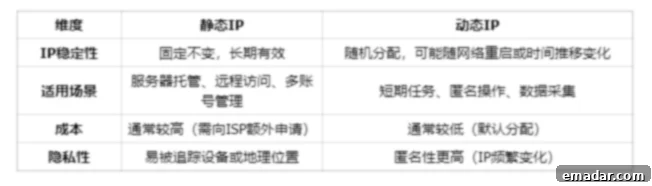
The fundamental distinction between static and dynamic IPs lies in their permanence and the control they offer. For cross-border e-commerce, these differences translate into significant strategic considerations.
Key Differentiators:
- Stability vs. Flexibility: Static IPs provide an unshakeable digital identity, crucial for services that need to be consistently reachable. Dynamic IPs offer adaptability, allowing a user’s apparent location to change, which can be advantageous for tasks requiring anonymity or bypassing geo-restrictions.
- Security and Trust vs. Anonymity and Agility: Static IPs inherently offer higher perceived security and trustworthiness for fixed services, as they are less likely to be associated with suspicious activity dueaking of their consistent nature. Dynamic IPs, by frequently changing, provide a layer of anonymity, making it harder to track a single user’s online activities over time, which is beneficial for data collection.
- Cost and Management: Static IPs typically incur a higher cost due to their dedicated nature and require more deliberate management for setup and security. Dynamic IPs are generally more cost-effective and are automatically managed by DHCP servers, requiring less user intervention.
- SEO and Reputation: Search engines tend to assign more trust and stability to websites hosted on static IPs, potentially aiding in SEO rankings. Dynamic IPs, while not directly impacting a website’s SEO, can be crucial for SEO research and competitive analysis tasks by simulating different user experiences.
Illustrative Case Study: Consider a multi-national e-commerce company operating globally. They might deploy their primary independent e-commerce website servers in the UK using a static IP. This ensures global buyers experience stable access, faster load times, and a consistent online brand presence, which is vital for search engine optimization and customer trust. Simultaneously, the company’s market research team, tasked with gathering competitive intelligence (e.g., product pricing, customer reviews, promotional strategies) from various competitor websites across different regions, would heavily utilize dynamic IPs. By rotating through numerous dynamic IPs, they can circumvent sophisticated anti-scraping mechanisms and appear as different users from various geographical locations, preventing their IP from being blocked and ensuring a continuous flow of critical data.
Critical Applications in Cross-Border E-commerce: Leveraging IP Addresses Strategically
The choice between static and dynamic IPs isn’t merely technical; it’s a strategic decision that impacts various facets of cross-border e-commerce operations.
The Indispensable Value of Static IP in E-commerce
- Multi-Account Security and Management: E-commerce platforms like Amazon, eBay, and Etsy have stringent policies against account association. Using a dedicated static IP for each separate seller account is a foundational strategy to prevent platform algorithms from linking accounts based on shared network identifiers. This significantly reduces the risk of account suspension or termination, preserving your business’s operational continuity.
- Case Example: A seasoned home goods seller manages ten distinct Amazon storefronts, each specializing in a different product niche. By meticulously configuring each storefront to operate from its own dedicated static IP address, the seller has successfully run their operation for over three years without encountering a single account association issue, maintaining a robust and diversified revenue stream. This approach isolates each account’s digital footprint, providing a clear separation that satisfies platform security protocols.
- Seamless Overseas Warehouse and Logistics System Integration: Integrating with international fulfillment centers, third-party logistics (3PL) providers, or direct fulfillment services like Fulfillment by Amazon (FBA) often involves real-time data exchange via Application Programming Interfaces (APIs). A static IP ensures a consistent point of contact for these crucial API connections, preventing communication breakdowns that could arise from fluctuating dynamic IPs. This stability is vital for accurate inventory management, order processing, and shipping updates, minimizing delays and errors.
- Enhanced Brand Independent Website Hosting and SEO: For businesses operating their own independent e-commerce websites, a static IP provides several advantages. It can contribute to faster website access speeds due to direct routing and a more stable server connection. Furthermore, search engines often view websites hosted on fixed, stable IP addresses as more trustworthy and authoritative, potentially leading to improved Search Engine Optimization (SEO) rankings and better crawlability. A static IP also facilitates the setup of secure socket layer (SSL) certificates and dedicated payment gateways, crucial for building customer confidence and ensuring transactional security.
- Secure Remote Access and VPN Endpoints: For global teams managing the e-commerce operation, static IPs are essential for setting up secure and reliable VPN connections. This allows employees to access internal systems, databases, and sensitive customer information from anywhere in the world, maintaining data integrity and compliance with security policies.
- Reliable Payment Gateway Integration: Many payment processing services and financial institutions require a static IP for secure API access. This helps them verify the origin of transactions and prevent fraud, ensuring that your customer’s payment data is handled securely and efficiently.
The Strategic Power of Dynamic IP in E-commerce
- Efficient Market Data Collection and Web Scraping: Dynamic IP addresses are invaluable for circumventing anti-bot and anti-scraping mechanisms employed by large e-commerce platforms and competitor websites. By continuously rotating IP addresses, businesses can effectively appear as multiple distinct users from various locations, allowing for the high-volume collection of critical market data such as product pricing, competitor inventory levels, customer reviews, and trending product categories. This agility is crucial for competitive analysis and staying ahead in fast-paced markets.
- Case Example: A consumer electronics (3C) seller needed to track the real-time pricing and promotional strategies of competitors during critical sales events like Prime Day. By utilizing a proxy service that rotated dynamic IPs every hour, they successfully monitored hundreds of competitor listings without detection, enabling them to adjust their own pricing and advertising in real-time and maximize sales.
- Optimized Ad Campaign Testing and Geo-Targeting: The performance of digital advertisements can vary dramatically based on geographical location, local demographics, and cultural nuances. Dynamic IPs enable e-commerce marketers to simulate user behavior from diverse regions, allowing them to test and preview how their ad creatives and landing pages appear to different audiences. This is crucial for optimizing ad spend, localizing content, and ensuring relevance across various international markets. It helps identify discrepancies in ad delivery and fine-tune targeting strategies.
- Flexible Temporary Customer Service and Operations: For distributed customer service teams or individual operators needing temporary access to e-commerce dashboards from varying locations, dynamic IPs can be a cost-effective and flexible solution. By avoiding a single, consistently used IP from an unusual location, it reduces the likelihood of triggering platform security alerts and potential account lockouts, ensuring seamless support operations even when staff are working remotely or on the go.
- Anonymous Browsing for Competitive Research: Beyond structured data scraping, dynamic IPs allow e-commerce businesses to anonymously browse competitor websites, study their user experience, investigate their product catalogs, and analyze their marketing strategies without revealing their identity or being flagged. This “undercover” research is vital for gaining an unfiltered view of the market landscape.
- Geolocation Testing for Website Localization: Dynamic IPs are excellent for testing geo-specific content delivery. An e-commerce business can use dynamic IPs to verify that their website displays the correct language, currency, product availability, and shipping options for visitors from different countries, ensuring a truly localized and optimal customer experience.

How Cross-Border E-commerce Businesses Should Choose Between Static and Dynamic IP
The decision isn’t always an either/or; often, a hybrid approach yields the best results. However, specific scenarios clearly favor one type over the other.
When to Opt for Static IP
- Long-Term Operation of Multiple Stores or Accounts: If your strategy involves managing numerous seller accounts on platforms like Amazon, eBay, or Walmart, each requiring a distinct and consistent digital identity to prevent association and ensure security, static IPs are non-negotiable.
- Building and Maintaining Core Technical Infrastructure: For businesses that host their own independent e-commerce websites, backend ERP (Enterprise Resource Planning) systems, CRM platforms, or dedicated databases, a static IP provides the necessary stability, security, and consistent accessibility.
- High-Frequency and Sensitive API Calls: Any critical business operation that relies on constant, reliable communication with external services—such as payment gateways, real-time logistics tracking APIs, inventory synchronization with suppliers, or fraud detection systems—demands the unwavering identity offered by a static IP.
- Secure Remote Access for Teams: When employees need to securely access internal company networks or sensitive data from various remote locations, a static IP can be used for setting up reliable VPN servers and ensuring consistent authentication.
When to Choose Dynamic IP
- Short-Term, High-Volume Data Collection Tasks: For rapid competitive analysis, scraping Best Seller lists, monitoring social media sentiment, or gathering product reviews across multiple platforms, dynamic IPs provide the necessary agility to bypass detection and collect vast amounts of data efficiently.
- Multi-Region Market Testing and Localization Checks: If you need to test how your listings, advertisements, or website content appears to users in different countries or regions, dynamic IPs allow you to simulate diverse geographic origins without incurring the cost of numerous static IPs.
- Cost-Effective Anonymity for Ad-Hoc Tasks: For temporary or infrequent tasks where a degree of anonymity is preferred, such as a customer service agent logging into an account from an unusual location to resolve an urgent ticket, dynamic IPs can offer a flexible and budget-friendly solution without raising immediate red flags.
- Brand Protection and Counterfeit Monitoring: Using dynamic IPs to anonymously browse various marketplaces and websites helps in identifying unauthorized sellers or counterfeit products without revealing your business’s investigative activities.
Common Misconceptions and Strategic Risk Avoidance
Navigating the complexities of IP management requires an understanding of common pitfalls and best practices.
Misconception One: Dynamic IP Equals Complete Anonymity and Untraceability
- The Reality: While a dynamic IP helps obscure your true location by frequently changing, it does not guarantee complete anonymity. Advanced tracking techniques, such as browser fingerprinting (collecting unique attributes of your browser and device), tracking cookies, local storage, and even WebRTC leaks, can still potentially link your online activities across different IP addresses.
- Strategic Solution: To achieve a higher level of anonymity and prevent comprehensive tracking, dynamic IPs should be used in conjunction with other privacy-enhancing tools. This includes dedicated anti-detect or fingerprint browsers that spoof device characteristics, regularly clearing cookies and cache, using secure VPNs for an additional layer of encryption, and being mindful of your digital footprint.
Misconception Two: A Single IP Type Can Satisfy All E-commerce Needs
- The Reality: The diverse operational demands of cross-border e-commerce rarely align perfectly with a single IP strategy. Attempting to force one type of IP onto all business modules can lead to either unnecessary costs, security vulnerabilities, or operational inefficiencies.
- Strategic Solution: A sophisticated cross-border e-commerce operation necessitates a nuanced and modular approach to IP management.
- Account Management & Core Infrastructure: Clearly define areas requiring high stability and security, such as managing multiple seller accounts, hosting your independent website, or integrating with logistics and payment APIs. These are prime candidates for **Static IPs**.
- Market Research & Testing: Isolate tasks that benefit from anonymity and flexibility, like extensive market data collection, competitive intelligence gathering, or geo-specific ad testing. These operations are best suited for **Dynamic IPs** and often require a robust proxy network.
- Hybrid Strategy: The most successful cross-border e-commerce businesses implement a hybrid strategy, leveraging the unique strengths of both static and dynamic IPs. This ensures optimal performance, security, and cost-efficiency across all operational fronts.
Additional Risk Avoidance – IP Quality and Provider Selection:
- IP Purity: Regardless of whether you choose static or dynamic, the quality and ‘purity’ of the IP addresses are critical. Using IPs that have previously been blacklisted or associated with malicious activity can lead to immediate blocks on e-commerce platforms or search engines. Always choose reputable IP providers (e.g., those mentioned like IPFLY, or other well-known proxy services) that offer clean, ethically sourced IP addresses and robust infrastructure.
- Geolocation Accuracy: Ensure that the geolocation data associated with your chosen IPs (especially dynamic ones for market testing) is accurate. Inaccurate geolocation can lead to skewed data or ineffective geo-targeting.
- Reliable Support and Uptime: Select a provider that offers excellent customer support and guarantees high uptime for their IP services, as any disruption can have significant financial implications for your e-commerce operations.
Conclusion: Crafting a Smart IP Strategy for Cross-Border Success
The core distinction between Static IP and Dynamic IP lies in a fundamental balance: **stability and security versus flexibility and anonymity**. For the discerning cross-border e-commerce seller, understanding and strategically applying these concepts is not just good practice, but a prerequisite for sustainable growth.
- For **long-term, high-security, and high-trust tasks** such as multi-account management, hosting essential infrastructure, or integrating critical APIs, prioritizing **Static IP** is the clear and wise choice.
- For **short-term, high-anonymity, and agile tasks** like extensive market data collection, competitive intelligence, or geo-specific ad testing, prioritizing **Dynamic IP** provides the necessary tools to navigate complex online environments.
In real-world cross-border e-commerce operations, the most effective strategy almost always involves a thoughtful combination of both IP types. By segmenting your business activities and assigning the appropriate IP solution to each module, you can significantly mitigate operational risks, ensure compliance with platform policies, enhance data integrity, and boost your overall efficiency. Investing in reliable IP resources and selecting a trusted service provider (such as IPFLY or similar industry leaders known for their clean IP pools and robust technical support) is paramount. Through the scientific configuration of your network environment, e-commerce sellers can not only reduce inherent risks but also markedly elevate their competitive edge in the vast and ever-evolving global marketplace.