
Imagine the internet as an expansive, bustling global metropolis, where every connected device is a unique inhabitant. Without a robust and reliable identification system, this digital city would descend into utter chaos – data packets endlessly wandering, unable to find their correct destinations. This is precisely where the Internet Protocol (IP) address steps in, acting as the indispensable digital passport for every device, ensuring order and seamless communication across the vast network.
For many, the string of numbers that constitutes an IP address remains an abstract, background detail of their online experience. Yet, this unassuming identifier plays a crucial, often unsung, role in safeguarding your privacy, facilitating global commerce, and powering your everyday digital interactions. Understanding the nuances of IP addresses is not merely an exercise in technical knowledge; it empowers you to navigate the digital world with greater awareness, security, and efficiency.
Decoding the Core Essence of an IP Address: Your Digital Identity and Location
At its fundamental level, an IP address, short for Internet Protocol Address, serves as the unique numerical label assigned to every device connected to a computer network that uses the Internet Protocol for communication. Think of it as a combined street address and house number for your device within the internet’s expansive infrastructure. This unique identifier doesn’t just mark your presence; it is the linchpin that ensures data packets are accurately directed and delivered to their intended recipient.
To illustrate, consider the simple act of streaming a video online. When you click play, your device initiates a request, essentially “calling out” to the video server: “Hello, I am at this specific IP address, please send me the video content!” The server, upon receiving this request, uses your IP address to precisely route the video data back to your device. Without this critical identification system, your data would be akin to a lost letter, circulating aimlessly without a definitive delivery point, making all online interactions impossible.
On a deeper technical stratum, IP addresses are integral to the Internet Protocol (IP protocol) itself, which defines the rules for addressing and routing data across networks. The IP protocol is responsible for encapsulating data into packets, assigning them the correct source and destination IP addresses, and then facilitating their journey from the origin to the destination across various interconnected networks. For example, when you send a message via a messaging app, your IP address assists your router in guiding that message through the internet’s intricate pathways. Similarly, during online shopping, your IP address can verify your geographical location, helping to prevent fraud or enforce region-specific content and product availability.
The implications of your IP address extend far beyond mere technicalities; they directly influence your online freedom and experience. If your IP address becomes associated with certain online activities or is flagged by particular websites, you might find yourself blocked from accessing specific content or subjected to an onslaught of targeted advertisements. In a lighthearted sense, your IP address is your network’s “social security number” – too public, and it might attract unwanted attention; too obscure, and you could miss out on legitimate opportunities. It’s a critical component of how you interact with, and are perceived by, the vast digital landscape.
The Evolution of IP Addresses: From IPv4’s Constraints to IPv6’s Limitless Horizon
The world of IP addresses is not static; it has undergone significant evolution, much like operating systems upgrading from one version to the next. Currently, two primary versions dominate the internet landscape: IPv4 and its successor, IPv6, each with distinct characteristics and capabilities.
IPv4, the “old veteran,” has been the backbone of the internet for decades. It utilizes a 32-bit address space, conventionally represented as four decimal numbers separated by periods (e.g., 192.168.1.1). This architecture allows for approximately 4.3 billion unique IP addresses. While this number once seemed monumental, the explosion of smart devices, including smartphones, smart home appliances, and the burgeoning Internet of Things (IoT), has rapidly consumed this finite pool. IPv4 addresses, once abundant, have become a scarce commodity, akin to highly sought-after tickets for a sold-out global concert.
The dwindling supply of IPv4 addresses compelled Internet Service Providers (ISPs) and network administrators to implement various ingenious workarounds, most notably Network Address Translation (NAT). NAT allows multiple devices within a private network to share a single public IPv4 address. While this temporarily alleviated the address shortage, it introduced new complexities and bottlenecks. For instance, NAT can complicate direct peer-to-peer communication, requiring port forwarding configurations, and it can introduce latency issues in applications like video conferencing, as packets need to be translated back and forth, potentially degrading real-time performance.
Enter IPv6, the “new generation” IP address. Designed with a colossal 128-bit address space, IPv6 offers an unimaginably vast number of unique addresses – enough to assign an IP address to every grain of sand on Earth, and then some! IPv6 addresses are expressed as eight groups of four hexadecimal digits, separated by colons (e.g., 2001:0db8:85a3:0000:0000:8a2e:0370:7334). This monumental expansion fundamentally resolves the address scarcity issue, ensuring that the internet can continue to grow and accommodate billions of new devices without limitations.
Beyond merely solving the address shortage, IPv6 brings substantial improvements in other critical areas. It features built-in security enhancements, such as mandatory end-to-end encryption through IPSec, offering a more secure communication framework from the outset. Furthermore, IPv6 boasts more efficient routing capabilities due to a simplified header format, which allows routers to process packets faster. It also supports stateless autoconfiguration, enabling devices to generate their own IP addresses without a central server, simplifying network management.
The transition to IPv6 is an ongoing global trend, poised to become the dominant protocol, especially as technologies like 5G, artificial intelligence, and advanced IoT solutions proliferate. In smart city initiatives, for example, IPv6 enables countless sensors and devices to interact seamlessly and in real-time, a scale that would be impossible to manage and address with the limitations of IPv4. IPv6 is not just an upgrade; it’s the foundational infrastructure for the next era of the internet, promising unparalleled connectivity, security, and efficiency.
Navigating the Digital Divide: Public vs. Private IP Addresses
Beyond their version, IP addresses are also categorized by their scope of use: public IP addresses and private IP addresses. This distinction is akin to the difference between a globally recognized city address and a local apartment number within a specific building; one is accessible to the entire world, while the other is confined to a localized domain.
A **public IP address** is a unique, globally routable address assigned to your network by your Internet Service Provider (ISP). It is your network’s singular “passport” to the entire internet. Devices with a public IP can directly communicate with other devices across the wide area network (WAN), making it essential for scenarios requiring external access. For instance, if you host a website server, a public IP address ensures that visitors from anywhere in the world can find and access your content. Similarly, in remote work environments, a public IP allows employees to connect securely to company resources from any location globally. The advantages are clear: strong independence and direct connectivity. However, this global accessibility also comes with increased privacy exposure, as a public IP is easier for malicious actors to trace and target, posing potential security risks like direct cyberattacks or data breaches.
Conversely, a **private IP address**, also known as an internal IP, is only valid and unique within a local area network (LAN), such as your home or office network. These addresses are drawn from specific reserved ranges, commonly including 192.168.0.0 to 192.168.255.255, 172.16.0.0 to 172.31.255.255, or 10.0.0.0 to 10.255.255.255. Multiple private networks worldwide can reuse these addresses without causing conflicts on the global internet, as they are not directly routable over the WAN. This system is exceptionally practical for residential Wi-Fi networks or corporate offices: your router assigns private IP addresses to your smartphones, computers, smart TVs, and printers, enabling them to communicate seamlessly internally while remaining “invisible” to the outside world. For example, a company uses private IP addresses for internal file sharing, ensuring both efficiency and enhanced security by isolating sensitive data from the public internet. However, if you wish to access your home server or office resources from an external location, you would typically need a Virtual Private Network (VPN) to bridge the gap and establish a secure connection over your public IP. The beauty of private networks lies in their ability to function as a “secret club”—members can interact freely, while outsiders remain largely unaware of their internal activities, providing a layer of inherent security and organizational simplicity.
Dynamic vs. Static IP: Flexibility Meets Stability
Further categorizing IP addresses by their assignment attribute reveals two types: dynamic and static, much like human personalities—one adaptable and ever-changing, the other steadfast and unyielding.
A **dynamic IP address** is the most prevalent type, automatically assigned by your ISP each time your device connects to the internet or at regular intervals. This means your IP address can change frequently, often every time you reconnect to the network, restart your router, or even after a certain period. The primary advantage of dynamic IPs is resource efficiency; ISPs can recycle and reallocate unused addresses, optimizing their available pool. From a security standpoint, dynamic IPs offer a degree of anonymity as they are harder to persistently track over long periods, akin to trying to play hide-and-seek with someone who constantly changes their location. However, this instability is also its main drawback. While perfectly suitable for everyday browsing and general internet use, dynamic IPs are not ideal for tasks requiring a consistent identifier. For instance, online gamers might experience disconnections if their IP changes mid-game, turning them from a triumphant hero into a “lagging disconnect.” Similarly, hosting a server or providing a consistent remote access point becomes challenging with a constantly shifting address.
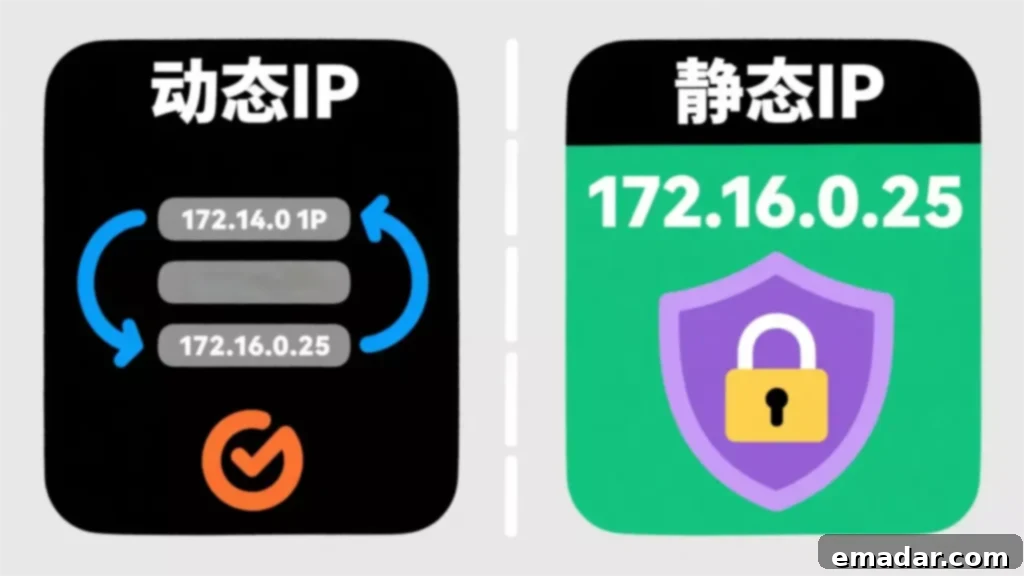
In contrast, a **static IP address** is permanently assigned to a device and remains constant, never changing unless manually reconfigured. Obtaining a static IP typically requires a special request to your ISP and often involves an additional fee, reflecting the premium placed on its stability. The paramount benefit of a static IP is its unwavering reliability, making it indispensable for specific applications. It is ideal for hosting websites, maintaining persistent video surveillance systems, or enabling consistent remote desktop access, as the fixed address simplifies configuration and ensures uninterrupted connectivity. For example, if you operate a personal blog from your home server, a static IP ensures that your domain name always resolves to the correct, unchanging address. However, this permanence also introduces heightened privacy risks, as a static IP acts like a permanent signboard, making it easier for unwanted parties to monitor and track your online activities over time. In essence, the choice between a dynamic and a static IP depends entirely on your “network lifestyle”—whether you prioritize flexibility and cost-effectiveness for casual use, or unwavering reliability and dedicated access for professional or specific technical needs.
Proxy IPs: Extending the Reach and Securing the Digital Frontier
In practical applications, many users opt not to directly expose their own IP address when navigating the internet. Instead, they leverage the power of **proxy IPs**, acting as an intermediary or a “digital go-between.” Why? Because revealing your true IP address can be akin to broadcasting your home address on a billboard, making you vulnerable to unwanted attention, targeted attacks, or tracking. A proxy IP effectively serves as a “forwarding station,” routing your internet requests through another server with a different IP address, essentially allowing you to browse the web wearing a “digital mask.” This not only significantly enhances privacy but also unlocks a multitude of advanced use cases across various industries.
In the realm of global trade and e-commerce, services like IPFLY, which specialize in proxy IPs, are instrumental in achieving critical IP and environment isolation. Cross-border e-commerce professionals often manage multiple merchant accounts on platforms like Amazon, eBay, or Shopify. If all these accounts operate from the same genuine IP address, platform algorithms can easily detect the connection, potentially leading to account suspension or blacklisting due to perceived policy violations. By utilizing distinct proxy IPs for each account, users can simulate independent operating environments, effectively preventing unwanted association. For instance, an Amazon seller might use a static residential proxy from IPFLY to obtain a fixed “local” IP address in the target marketplace (e.g., a US IP for a US store), ensuring stable account operation and allowing them to browse inventory and competitor reviews as if they were a local customer.
Live streaming, particularly on platforms like TikTok, represents another popular application for proxy IPs. Successful live broadcasts demand ultra-low latency connections to prevent buffering and viewer drop-offs. High-quality native proxy IPs, such as those offered by IPFLY, allow streamers to acquire an IP address in the target audience’s region, significantly optimizing the streaming path. Imagine you are broadcasting from China to an audience in Europe or North America; using a proxy with low-latency characteristics ensures your video stream is smooth and uninterrupted. Without it, viewers might experience frustrating delays, leading to comments like, “Is this a slow-motion replay?” and a rapid decline in audience engagement.
Data collection and web scraping are fields where proxy IPs are not just beneficial, but often indispensable. When conducting bulk data scraping from websites, using a single, fixed IP address almost guarantees detection and subsequent blocking by anti-bot systems. However, dynamic rotating proxies, which automatically switch IP addresses with each request or at set intervals, allow each request to appear as if originating from a different individual user. This cloaking mechanism enables comprehensive data acquisition without triggering security alerts. For example, a business monitoring competitor prices across various e-commerce sites can deploy dynamic proxies to collect data from different geographical locations, ensuring a complete and untraceable dataset for market analysis.
IPFLY excels in these applications, offering an extensive network of over 90 million IP resources, including static residential, dynamic residential, and data center proxies. Covering more than 190 countries and regions, these proxies are built on proprietary servers and meticulously filtered using big data analytics, guaranteeing reliable and high-performance connections essential for demanding tasks. Their robust infrastructure ensures users have access to clean, exclusive IPs that are critical for maintaining anonymity and operational efficiency.
Conclusion: The Unseen Architect of Your Digital World
The IP address is far more than a mere sequence of numbers; it is the fundamental cornerstone of internet order and connectivity. From the foundational simplicity of IPv4 to the virtually boundless possibilities offered by IPv6, and from the globally accessible public IP to the secure confines of a private network, through the adaptive nature of dynamic IPs and the unwavering stability of static IPs—these classifications collectively define and shape our intricate online world. Furthermore, with the strategic application of proxy IPs, its utility extends dramatically into realms of enhanced privacy protection, secure business operations, and profound innovation, proving indispensable in sectors such as cross-border e-commerce, live streaming, and advanced data analytics.
The next time you venture online, take a moment to consider the silent, tireless work of your IP address in the background. It functions much like a reliable, vigilant steward, ensuring that every digital interaction unfolds smoothly and precisely. Yet, much like a seasoned operative, it occasionally requires a “disguise” in the form of a proxy to effectively navigate challenges and maintain operational integrity. A comprehensive understanding of these underlying mechanisms empowers you to operate with greater confidence and proficiency in the digital era. After all, in this grand digital “party,” who wouldn’t want to feel both secure and effortlessly connected?
IPFLY – Your Dedicated Professional Proxy Service Provider for Cross-Border Industries:
- ✔ Global coverage in 190+ countries;
- ✔ Supports Static/Dynamic Residential Proxies + Native IPs + Data Center Proxies;
- ✔ Provides exclusive clean IPs for dedicated use;
- ✔ No logs, high anonymity, supports integration with anti-detect browsers;
- ✔ Supports API integration for easier batch configuration.
👉 Claim Your Discount and Get Premium IPs Today!