
In our daily online interactions, we frequently encounter those subtle yet essential tests designed to confirm our humanity. Whether it’s deciphering distorted text, selecting specific images, or solving a quick puzzle, these challenges are integral to modern web security. Among the various methods, the mathematical CAPTCHA stands out for its elegant simplicity and effectiveness. But what exactly is a mathematical CAPTCHA, why is it so prevalent, and what crucial role does it play in the ever-evolving landscape of online protection against automated threats?
This comprehensive guide delves deep into the mechanics of mathematical CAPTCHAs, shedding light on how they effortlessly distinguish legitimate human users from malicious bots. We’ll explore their fundamental design, the benefits they offer, and critically, why you might encounter them more frequently when utilizing proxy services. We’ll also examine the intricate relationship between various proxy types—such as reliable residential proxies and more commonly flagged datacenter IPs—and how your choice of proxy can profoundly influence your experience with CAPTCHA challenges, ultimately affecting your browsing and automation efficiency.
What Is a CAPTCHA? Unraveling the Human Verification Test
At its core, a CAPTCHA—an acronym for “Completely Automated Public Turing test to tell Computers and Humans Apart”—is a sophisticated security measure. Its primary function is to serve as a digital gatekeeper, protecting websites and online services from the incessant barrage of automated scripts and bots. By presenting challenges that are designed to be easily solvable by humans but notoriously difficult for machines, CAPTCHAs effectively ensure that interactions on a website are truly human-initiated, thereby preserving the integrity and security of online platforms.
The concept behind CAPTCHA draws inspiration from the famous Turing Test, which assesses a machine’s ability to exhibit intelligent behavior indistinguishable from that of a human. In the digital realm, CAPTCHAs apply this principle by offering various forms of interactive puzzles. These diverse types cater to different scenarios and levels of security, adapting to the ever-evolving tactics of bot developers:
- Text-based CAPTCHA: This classic method requires users to accurately transcribe distorted, obscured, or overlaid characters presented within an image. The visual ambiguity makes it challenging for optical character recognition (OCR) software used by bots.
- Visual CAPTCHA: These challenges ask users to identify specific objects or patterns within a grid of images, such as clicking all squares containing traffic lights, bicycles, or storefronts. While intuitive for humans, interpreting visual context remains a complex task for bots.
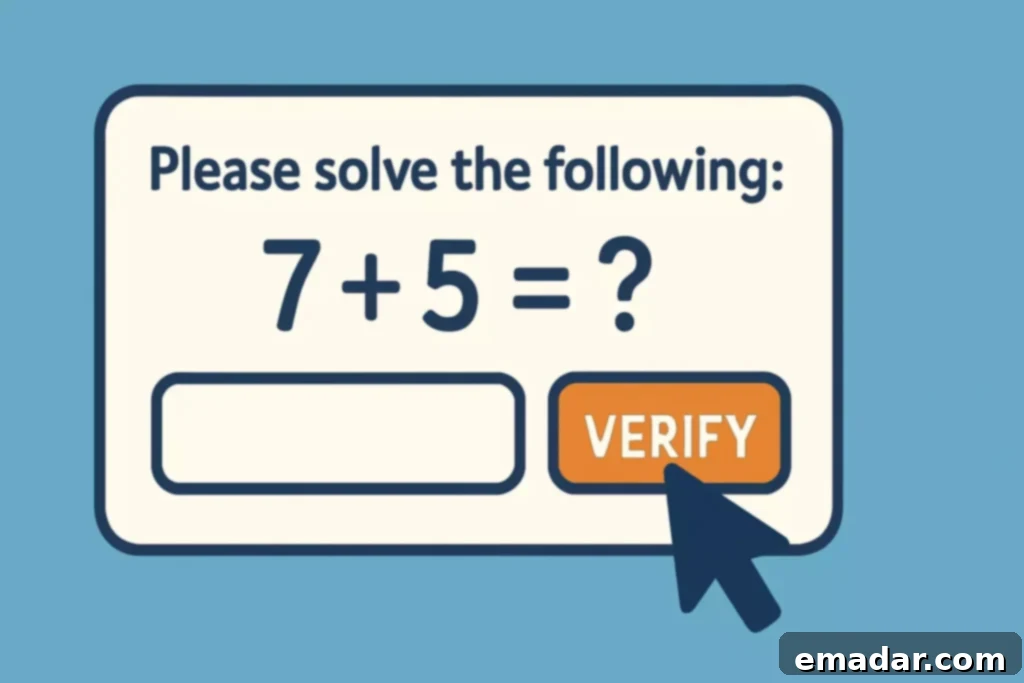
- Mathematical CAPTCHA: As our focus, this type presents a simple arithmetic problem for the user to solve. Its straightforward nature makes it highly accessible while still posing a barrier to basic automated scripts.
- Audio CAPTCHA: Designed for visually impaired users, audio CAPTCHAs play an audio clip of letters or numbers, which the user must then type into a field. Bots struggle with distinguishing human speech and background noise.
- Behavioral or Invisible CAPTCHA: These advanced systems operate discreetly in the background, analyzing user behavior patterns such as mouse movements, scrolling speed, typing rhythm, and time spent on a page. Often, they determine human presence without requiring any visible input from the user, only presenting a challenge if suspicious activity is detected.
Understanding Mathematical CAPTCHAs: Simplicity Meets Security
Mathematical CAPTCHAs represent one of the most user-friendly and universally understood forms of human verification. Instead of complex image recognition or deciphering convoluted text, they present users with a basic arithmetic question, typically involving addition, subtraction, or simple multiplication. Examples include questions like:
- “What is 7 + 2?”
- “Solve: 10 – 4 = ?”
The elegance of these challenges lies in their simplicity. For a human, these are trivial calculations that require minimal cognitive effort and can be solved almost instantaneously. For bots, however, especially older or less sophisticated ones, processing an image of a mathematical equation, extracting the numbers and operators, performing the calculation, and then inputting the correct answer is a multi-step process that can be difficult to automate reliably. This makes them a surprisingly effective deterrent for a significant portion of automated traffic.
Beyond their anti-bot capabilities, mathematical CAPTCHAs offer several distinct advantages that contribute to a positive user experience:
- Quick to Complete: The ease of solving basic arithmetic means users can clear these CAPTCHAs in mere seconds, minimizing friction and frustration during online interactions. This speed is crucial for maintaining user engagement and reducing bounce rates.
- Low Visual Strain and High Accessibility: Unlike distorted text or complex image grids, mathematical problems are generally clear and require less visual deciphering. This makes them highly accessible for users with visual impairments who rely on screen readers, as the numbers and operators can be easily converted into speech. They also perform exceptionally well on mobile devices where screen real estate is limited.
- Universal Understanding: Basic arithmetic transcends language barriers and cultural contexts, making mathematical CAPTCHAs globally understood and effective for a diverse user base.
- Effective When Paired with Other Bot Detection Tools: While simple, mathematical CAPTCHAs act as an excellent initial filter. When combined with other detection layers like IP reputation analysis and behavioral monitoring, they contribute to a robust, multi-layered security strategy.
The Indispensable Role: Why CAPTCHAs Are Necessary for Online Security
In today’s interconnected digital world, the threat posed by automated bots is omnipresent and constantly evolving. These malicious programs can mimic human behavior at scale, performing nefarious activities that range from nuisance to severe financial and reputational damage. CAPTCHAs, therefore, serve as an indispensable frontline defense, protecting websites and their users from a wide spectrum of online threats:
- Spam Submissions in Comments or Forms: Bots are frequently used to flood comment sections, forums, and contact forms with unsolicited advertisements, phishing links, or malicious content, degrading user experience and site credibility.
- Automated Account Creation: Bots can create thousands of fake user accounts for various purposes, including spreading misinformation, manipulating online reviews, generating spam emails, or even conducting identity theft.
- Brute-Force Login Attempts: Malicious bots attempt to gain unauthorized access to user accounts by rapidly trying countless combinations of usernames and passwords until they find a match. CAPTCHAs can significantly slow down or halt these attacks.
- Data Scraping from Websites: Competitors or malicious entities often deploy bots to illicitly scrape large volumes of data—such as pricing information, product catalogs, customer data, or proprietary content—which can lead to unfair competition or data breaches.
- Fake Transactions or Checkout Abuse: In e-commerce, bots are used to hoard limited-edition products, purchase tickets for resale at inflated prices (scalping), or conduct fraudulent transactions, causing financial losses and frustrating legitimate customers.
Mathematical CAPTCHAs, in particular, provide a lightweight yet potent method to ensure human presence without imposing a heavy burden on the user. Their minimal invasiveness makes them ideal for high-traffic areas or as a preliminary check, preventing the majority of unsophisticated bots while allowing legitimate users to proceed unhindered. This balance of security and usability is critical for maintaining an efficient and safe online environment.
How Proxies Influence CAPTCHA Frequency: The IP Reputation Factor
The choice of proxy server can significantly impact how often you encounter CAPTCHA challenges. When users connect to websites through a proxy, particularly those utilizing shared or datacenter IPs, they often find themselves facing CAPTCHA screens with greater frequency. This heightened scrutiny stems from the way websites identify and flag IP addresses that exhibit characteristics associated with automated or suspicious activity.
Several common proxy-related triggers lead to increased CAPTCHA encounters:
- Fast, Repetitive Form Submissions: If multiple users or automated scripts are sending numerous requests or submitting forms too quickly from the same IP address, websites perceive this as non-human behavior, triggering defenses.
- IP Addresses Associated with Previous Bot Activity: Datacenter IPs, by their nature, are often shared among many users and are frequently utilized for server hosting, VPNs, and automation tasks. If an IP has a history of being used by bots for spamming, scraping, or other malicious activities, it will be added to various blacklists and flagged for intense scrutiny by web security systems.
- IPs from Subnets Known for Automation Use: Entire ranges or subnets of IP addresses that belong to datacenter providers are often profiled as non-residential. Websites prioritize human-like traffic, and any connection originating from a known datacenter range can be automatically deemed suspicious.
In stark contrast, high-quality residential proxies, such as those offered by reputable providers like IPFLY, tend to perform significantly better in these scenarios. Residential proxies route user traffic through legitimate, real-user IP addresses provided by Internet Service Providers (ISPs) to residential homes. This makes the traffic appear as if it originates from a typical home internet connection, mimicking real user behavior. As a result, residential proxies are far less likely to be flagged by sophisticated CAPTCHA systems and bot detection algorithms, drastically reducing the frequency of frustrating verification challenges and allowing for smoother, uninterrupted browsing or automation tasks.
CAPTCHA and Proxy Detection: A Multi-Layered Security Strategy
Modern web security is not a single line of defense but a complex, multi-layered ecosystem designed to identify and thwart automated threats. Websites today employ sophisticated detection strategies that integrate various tools and analyses, with CAPTCHA systems working in concert with other technologies to form a robust shield. This includes:
- CAPTCHA Systems: As discussed, these present interactive challenges to verify human interaction.
- IP Reputation Scoring: Every IP address carries a “reputation score” based on its historical behavior. Databases track if an IP has been associated with spam, malware distribution, botnet activity, or unusual traffic patterns. A low reputation score from a shared or datacenter IP immediately raises a red flag.
- Browser Fingerprinting: This technique gathers unique identifiable information from a user’s web browser, such as the user-agent string, installed fonts, browser plugins, screen resolution, operating system, and WebGL capabilities. A bot-controlled browser often presents an inconsistent, incomplete, or highly standardized fingerprint, making it easier to detect.
- Behavioral Analysis: Websites meticulously analyze user interaction patterns. This includes mouse movements (human-like curves versus linear bot paths), typing speed (natural pauses and errors versus instantaneous input), scroll patterns, time spent on pages, and even how often a user hovers over elements. Any deviation from typical human behavior can trigger an alert.
When these systems work together, they create a formidable defense. For instance, if a system detects an IP address with a poor reputation score (perhaps a known datacenter IP), coupled with abnormal behavioral patterns (like solving a mathematical CAPTCHA too quickly without natural pauses), it may trigger an immediate, more complex CAPTCHA or escalate the challenge level significantly. In many cases, a simple math CAPTCHA is utilized as an initial, low-friction check. If a user passes this initial test but other behavioral or IP reputation signals still suggest questionable activity, more advanced and challenging CAPTCHAs, such as intricate image recognition puzzles, may subsequently follow to ensure thorough verification.
Minimizing CAPTCHA Triggers: Actionable Strategies for Smoother Interactions
Encountering frequent CAPTCHA screens can be a significant bottleneck, particularly if your workflows involve automation, web scraping, market research, or managing multiple online accounts. Fortunately, there are several proactive strategies you can adopt to significantly reduce the likelihood of triggering these verification challenges and ensure a smoother online experience:
- Avoid Public or Free Proxies with Poor IP Reputations: These proxies are almost universally overused, often blacklisted, and their IP addresses are well-known to security systems. While they may seem cost-effective, they are a primary cause of constant CAPTCHA interruptions and potential IP bans.
- Utilize Rotating Residential Proxies from Reputable Providers: This is perhaps the most effective strategy. High-quality rotating residential proxies, like those offered by IPFLY, provide access to a vast pool of legitimate, geographically diverse IP addresses. The “rotating” aspect means you get a fresh IP address at set intervals or with each new request, preventing any single IP from accumulating suspicious activity. These IPs mimic genuine user traffic, making them highly effective at evading detection.
- Limit Aggressive Browsing Behaviors: Automated scripts often make requests at unnatural speeds, submit forms instantly, or navigate through pages without human-like delays. Implement natural delays and human-like interaction patterns in your automation scripts. Avoid excessively fast, repetitive form submissions or instantaneous interactions that can flag your activity as robotic.
- Configure Browser Headers and Fingerprinting Settings: Ensure that your browser’s user-agent string, referrer headers, and other fingerprinting attributes appear consistent and legitimate. Bots often neglect these details or use generic, easily identifiable ones. Mimicking common browser configurations can help you blend in.
IPFLY’s proxy services are specifically engineered to address these challenges. They offer robust options tailored for a variety of demanding tasks, including sophisticated web scraping, ad verification, efficient social media management, and other high-frequency operations. By leveraging clean, ethically sourced IP pools and advanced IP rotation logic, IPFLY helps users minimize unwanted CAPTCHA interruptions, allowing critical tasks to run efficiently and without the constant need for manual human verification.
Examples of CAPTCHA in Use: A Glimpse into Common Challenges
To further illustrate the diversity of CAPTCHA solutions, here are some practical examples you are likely to encounter across various websites. Each type is meticulously calibrated to measure specific human behaviors and differentiate them from automated scripts:
- Text CAPTCHA: You might see an image displaying characters that are warped, overlapping, or set against a noisy background, accompanied by the instruction: “Type the characters you see: 9HD73”. Bots struggle with optical character recognition on such distorted images.
- Visual CAPTCHA (Image Recognition): A common challenge presents a grid of nine images and asks you to select specific objects: “Click all images with buses.” Or “Select all squares containing a street sign.” This tests a human’s ability to interpret visual context and patterns.
- Mathematical CAPTCHA: As discussed, these are straightforward arithmetic problems: “What is 4 + 5?” The simplicity ensures quick human resolution while still posing a barrier to basic automation.
- Checkbox CAPTCHA (Invisible reCAPTCHA): Often seen as a simple checkbox, “I am not a robot.” This seemingly effortless interaction typically triggers a complex behavioral analysis in the background. If your activity seems human, the checkbox is instantly marked. If suspicious behavior is detected, a more challenging visual or text CAPTCHA may be presented.
It’s important to note that many sites dynamically adjust the challenge type and difficulty based on various factors, including the user’s connection source (e.g., whether a proxy is detected), the historical reputation of the IP address, and the observed behavioral patterns. This adaptive approach ensures optimal security without unnecessarily burdening legitimate users.
Can CAPTCHA Be Bypassed? The Ethical and Practical Considerations
The “cat and mouse” game between website security and those attempting to circumvent it is ongoing. Some individuals and developers explore methods to bypass CAPTCHA tests, often by tweaking browser headers, utilizing specialized software to automate browser actions, or even employing CAPTCHA-solving services. However, attempting to bypass CAPTCHAs is fraught with ethical and practical issues. Doing so often violates a website’s terms of service, which can lead to severe consequences such as having your IP address blocked, user accounts banned, or even legal repercussions in some cases. Furthermore, as CAPTCHA technology continues to evolve, automated bypassing becomes increasingly difficult and often unsustainable in the long term.
Rather than focusing on bypassing CAPTCHAs, a far more effective and ethical long-term strategy is to leverage high-quality, legitimate tools that minimize the *need* for CAPTCHA challenges altogether. For instance, reputable proxy providers like IPFLY offer advanced residential proxy networks specifically designed to mimic typical, human-like browsing patterns. By routing your traffic through real residential IP addresses and employing sophisticated rotation mechanisms, these proxies drastically lower the chance of triggering security challenges. This approach ensures compliance with website terms of service while still allowing for efficient automation and data collection without the constant interruption of CAPTCHA verification.
Final Thoughts: The Synergy of Mathematical CAPTCHA and Smart Proxy Solutions
Mathematical CAPTCHAs, despite their apparent simplicity, are a cornerstone of modern online security. They provide an accessible yet effective barrier against automated threats, playing a pivotal role in the larger ecosystem of bot detection tools. When integrated with advanced IP analysis, sophisticated browser fingerprinting, and real-time behavioral monitoring, mathematical CAPTCHAs contribute to a robust, multi-layered defense that reliably protects websites from various forms of automation abuse, from spam and fake account creation to data scraping and fraudulent transactions.
For individuals and businesses whose workflows involve extensive automation, precise web scraping, or the meticulous management of multiple online accounts, a deep understanding of the intricate relationship between proxies and CAPTCHA frequency is not just beneficial, but absolutely essential. The strategic choice of a superior proxy solution—such as the dynamic and clean rotating residential proxies offered by IPFLY—can profoundly impact operational efficiency. By selecting proxies that mimic genuine human traffic and boast high IP reputations, you can significantly mitigate the number of interruptions caused by CAPTCHA challenges, allowing your critical tasks to run smoothly, reliably, and without the constant demand for human verification, ultimately boosting productivity and maintaining a competitive edge in the digital landscape.
Frequently Asked Questions (FAQ) About CAPTCHA and Proxies
What exactly is a CAPTCHA?
A CAPTCHA, or “Completely Automated Public Turing test to tell Computers and Humans Apart,” is a security test deployed by websites to differentiate between human users and automated bots. It presents challenges that are easy for humans to solve but difficult for machines.
What is a mathematical CAPTCHA specifically?
A mathematical CAPTCHA is a type of CAPTCHA that asks users to solve a basic arithmetic problem, such as “What is 5 + 2?” or “Solve: 10 – 3 = ?”. Its simplicity makes it user-friendly while still effectively deterring many automated scripts.
Why do I frequently encounter CAPTCHAs when using proxies?
You might see CAPTCHAs more often when using proxies, especially public, free, or datacenter proxies, because their IP addresses are frequently shared among many users and often get flagged by websites due to a history of suspicious activity, spam, or association with automated tools. This causes security systems to scrutinize traffic from these IPs more heavily.
How can I effectively reduce the frequency of CAPTCHA triggers?
To minimize CAPTCHA encounters, it is highly recommended to switch to high-quality, clean, and rotating residential proxies from reputable providers like IPFLY. Additionally, adopt human-like browsing behaviors, such as introducing natural delays between actions and avoiding overly aggressive request patterns, to appear less like a bot.
Do all types of proxies trigger CAPTCHAs with the same frequency?
No, not all proxies trigger CAPTCHAs equally. High-quality residential proxies, which route traffic through genuine home internet connections, are far less likely to be flagged by bot detection systems compared to datacenter or shared proxies. Well-maintained proxy networks, such as IPFLY’s residential proxies, prioritize IP cleanliness and rotation to minimize CAPTCHA interruptions.
Are mathematical CAPTCHAs accessible for all users?
Mathematical CAPTCHAs are generally considered more accessible than many other types, especially for users with visual impairments who rely on screen readers. Since the questions involve numbers and basic operators, screen readers can typically interpret them more accurately than distorted text or complex images, making them a good option for universal access.