
In the dynamic and ever-evolving realms of cross-border e-commerce, social media marketing, and online advertising, you’ve likely encountered two terms that frequently come up in discussions about digital infrastructure: “Native IP” and “Broadcast IP.” For many, the distinctions between these two types of IP addresses remain hazy, leading to confusion about which is more beneficial for critical operations such as account security, platform stability, and the effectiveness of advertising campaigns. This comprehensive guide aims to demystify these concepts, providing a clear understanding of their differences, how to identify them, and why their purity has become increasingly vital for anyone operating in the global digital landscape.
Understanding the nuances of IP addresses is no longer a technicality reserved for IT professionals; it’s a strategic imperative for businesses and individuals engaged in any form of international online activity. From managing multiple e-commerce stores across different regions to orchestrating intricate social media marketing campaigns or ensuring the authenticity of ad verification processes, the underlying IP infrastructure plays a foundational role. Ignoring the quality of your IP can lead to frustrating setbacks, including account suspensions, reduced visibility, and wasted advertising spend. This article will thoroughly explore:
- What exactly are Native IP and Broadcast IP addresses?
- What are the critical distinctions that set them apart?
- Practical methods for querying and identifying your IP type.
- The escalating sensitivity towards IP addresses among cross-border operators and digital marketers.
✅ Understanding Native IP: The Foundation of Digital Trust
A Native IP, often referred to as a Residential IP, is an internet protocol address that has been legitimately assigned by a local Internet Service Provider (ISP) directly to an end-user. This means the IP address is intrinsically linked to a physical, residential location and is typically used by a home internet connection. The core characteristic of a Native IP is its authenticity and the organic way it is integrated into the internet ecosystem.
- Direct Assignment: Unlike other IP types, Native IPs are originally allocated by a legitimate ISP (such as Comcast, AT&T, NTT, or Telekom) to a specific household or business for their regular internet usage. They are not routed through data centers or commercial proxy networks, making them appear as genuine local users.
- Untainted History: A key advantage of Native IPs is their pristine usage history. They have typically not been previously used by data centers, proxy providers, or third-party platforms for potentially nefarious or high-volume activities. This “clean slate” significantly reduces the likelihood of triggering automated fraud detection systems.
- High Authenticity: Because a Native IP corresponds to a real-world residential or legitimate business location, it perfectly simulates the behavior of a genuine local user. This high level of authenticity is crucial for platforms that meticulously scrutinize user origins and activities to prevent abuse.
In essence, a Native IP embodies a combination of local identity, an unblemished record, and a clean background. For operations highly sensitive to environmental factors, such as building a strong presence on TikTok, registering multiple Amazon seller accounts, managing extensive social media matrices, or deploying targeted advertising campaigns, Native IPs represent the gold standard for security and reliability. They help bypass stringent platform safeguards that are designed to flag suspicious or automated behavior, allowing your digital activities to blend seamlessly with genuine user traffic.
Platforms like TikTok are particularly vigilant about distinguishing real users from automated bots or fraudulent accounts. A Native IP provides the necessary digital footprint to appear as a legitimate local user, essential for “warming up” accounts and ensuring content reaches its intended audience without being throttled or flagged. Similarly, e-commerce giants like Amazon rely on IP reputation to protect their marketplace integrity. Using a Native IP for account registration and management can mitigate risks of suspension, providing a stable and trustworthy environment for your business operations.

✅ Understanding Broadcast IP: The Risks of Shared Digital Spaces
In contrast to Native IPs, Broadcast IPs are typically public IP addresses that are dynamically assigned from a shared pool, often by data centers, hosting providers, or commercial VPN services. The term “broadcast” here can sometimes be misleading; it refers more to the broad distribution and shared nature of these IPs rather than a direct broadcasting mechanism in the network sense. These IPs are not directly tied to a unique residential or business location in the same way Native IPs are, making them inherently less trustworthy to sophisticated online platforms.
The characteristics of Broadcast IPs present several challenges and potential risks for serious online operations:
- Shared Usage: A Broadcast IP can be, and often is, used by numerous users or devices concurrently or in rapid succession. This multi-tenant nature means you are sharing an IP’s reputation with an unknown number of other entities, some of whom may engage in activities that tarnish the IP’s standing.
- Frequent Changes and Mixed History: Given their dynamic and shared nature, Broadcast IPs can change frequently. More critically, their usage history is often a mixed bag, potentially containing records of abnormal behaviors, spamming, or other activities that are red flags for platform risk management systems.
- High Risk of Flagging: Due to their association with data centers, their shared nature, and often dubious pasts, Broadcast IPs are highly susceptible to triggering platform fraud detection systems. They are frequently identified as “suspected proxies,” “risk users,” or “non-local operators,” leading to immediate scrutiny or outright blocking.
Many low-quality VPNs, free proxy services, and inexpensive IP providers rely heavily on Broadcast IP pools. The fundamental problem with these services is the inherent lack of transparency and control. You can never ascertain how many other users have previously utilized a given IP, nor can you determine the nature of their past activities. This anonymity, intended to protect the user, ironically works against you when platforms are trying to verify legitimate activity. For instance, if a Broadcast IP was recently used for a spam campaign or to create multiple fraudulent accounts, and you subsequently use it for your legitimate business, your account will immediately inherit that negative reputation, regardless of your intentions. This makes Broadcast IPs a high-risk choice for any operation where trust and authenticity are paramount.
✅ Native IP vs. Broadcast IP: The Core Distinctions
The fundamental differences between Native IPs and Broadcast IPs lie in their origin, purity, stability, and the level of trust they command from online platforms. Understanding these distinctions is crucial for anyone involved in cross-border e-commerce, digital marketing, or any activity requiring a genuine online presence.
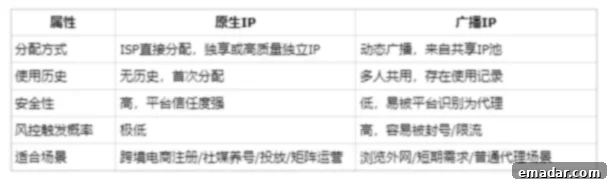
Let’s elaborate on the critical contrasts:
- Source and Assignment: Native IPs are directly assigned by local ISPs to end-users (residential or legitimate business connections). They are part of the genuine local network infrastructure. Broadcast IPs, conversely, are typically sourced from data centers, hosting providers, or commercial proxy services. They are not directly linked to a specific physical end-user location but rather to a server farm or network hub.
- Purity and Usage History: Native IPs boast a generally clean and untainted history because they haven’t been widely shared or used for high-volume or potentially abusive activities. Their usage patterns reflect normal human behavior. Broadcast IPs, especially those from shared pools, often come with a mixed or even “blacklisted” history, having been used by various individuals or automated systems for diverse purposes, some of which may have triggered platform flags.
- Trust Level from Platforms: Online platforms and their sophisticated fraud detection systems inherently assign a higher trust score to Native IPs. They are perceived as originating from real individuals in legitimate locations. Broadcast IPs, on the other hand, are often viewed with suspicion, frequently flagged as proxies, VPNs, or data center traffic, which are commonly associated with automated bots, account manipulation, and other policy violations.
- Stability and Consistency: While some Native IPs can be dynamic, they generally offer greater stability and consistency in their location and identity over time, particularly dedicated residential IPs. Broadcast IPs, especially those from large, shared pools, can change frequently and unpredictably, making it challenging to maintain a consistent digital identity across sessions or platforms.
- Use Cases and Risk Profile: Native IPs are ideal for highly sensitive operations requiring authenticity, such as account registration, social media management, targeted advertising, and e-commerce store administration. They significantly reduce the risk of account suspension or content throttling. Broadcast IPs, while suitable for general web browsing or less sensitive tasks, carry a high risk for any activity that requires a genuine user identity and reputation, often leading to immediate flags and restrictions.
Choosing between these two IP types boils down to understanding the nature of your online activities and the level of trust and authenticity required. For anything beyond casual browsing, the advantages of a Native IP become overwhelmingly clear, providing a robust and secure foundation for your digital endeavors.
✅ How to Query and Identify Your IP Type
Verifying whether your IP address is a Native IP or a Broadcast IP is a crucial step in ensuring your online operations are built on a solid foundation. Several tools and methods can help you determine the characteristics of your IP address. This process involves checking its origin, the assigning ISP, and its declared type.
Here’s how you can typically query and identify your IP type:
1. Utilize Professional IP Detection Tools:
Tools like IPinfo are invaluable for comprehensive IP analysis. When you visit such a site, it automatically detects your current IP address and provides a wealth of information. Key data points to look for include:
- IP Address: Your current public IP.
- Geolocation: The approximate physical location associated with the IP (city, region, country).
- ISP (Internet Service Provider): The organization that owns and assigned the IP address.
- Organization/ASN (Autonomous System Number): More granular detail about the network owner.
- Type: This is often a critical indicator, categorizing the IP as Residential, Business, Mobile, Data Center, VPN, or Proxy.
2. Check the “ISP” and “Organization” Information for Residential Indicators:
One of the strongest indicators of a Native IP is the ISP information. If the ISP or Organization field displays names of well-known local home broadband operators such as Comcast, AT&T, Verizon, NTT, Telecom Italia, Orange, BT, Vodafone, Spectrum, or Charter Communications, it is highly likely that you are using a Native Residential IP. These are legitimate telecommunication companies that provide internet services directly to homes and small businesses.
3. Identify Shared or Data Center IP Indicators:
Conversely, if the IP detection tool shows the ISP or Organization as a cloud hosting provider, a data center, or explicitly labels it as a VPN/Proxy service, then it’s likely a Broadcast IP or a data center IP. Look out for names such as:
- Cloud Providers: Amazon Web Services (AWS), Google Cloud, Microsoft Azure, Alibaba Cloud.
- Hosting Companies: DigitalOcean, Linode, Vultr, OVHcloud, Hetzner.
- VPN/Proxy Services: If the “Type” field explicitly states “VPN,” “Proxy,” or “Hosting,” this is a clear sign.
Data center IPs, while not always “broadcast” in the sense of being widely shared in real-time, are fundamentally different from residential IPs in how platforms perceive them. They are typically used for servers, cloud infrastructure, and commercial VPNs, and are therefore often treated with suspicion by anti-fraud systems. Additionally, some tools provide an “Abuse Score” or “Threat Score” – a higher score here can indicate a problematic IP history.
By diligently checking these details, you can gain a clear picture of your IP’s nature and make informed decisions about its suitability for your specific online activities.
✅ Why Cross-Border Operators are Increasingly IP-Sensitive
The digital landscape for cross-border e-commerce, social media marketing, and online advertising has become increasingly sophisticated and fraught with risk. In this environment, your IP environment is not merely an address; it is a critical determinant of your account’s longevity, operational stability, and overall success. The sensitivity towards IP addresses among cross-border operators has intensified because a compromised IP can lead to devastating consequences.
Here’s why IP purity is paramount:
- Account Suspensions and Bans: A staggering majority of account suspensions (often cited as 80% or more) across various platforms are directly linked to an unclean or suspicious IP environment. Platforms like TikTok, Instagram, and Facebook employ advanced AI-driven systems to detect anomalous behavior. If your IP is associated with known proxy networks, data centers, or a history of policy violations, your accounts are at severe risk of being flagged and banned, regardless of your actual activities.
- E-commerce Store Blacklisting: For platforms like Amazon or eBay, your IP’s reputation directly impacts your seller account’s health. If your IP appears on blacklists due to past abusive activities by others, your store could be instantly “ghosted” or even permanently suspended. This can result in significant financial losses and damage to your business reputation.
- Advertising Rejection and Ineffectiveness: Running ad campaigns across borders requires meticulous IP management. Ad platforms are highly sensitive to the origin of ad accounts and the IP addresses used to manage them. If the platform identifies your IP as non-local, a proxy, or from a data center, your ad account might be suspended, or your ads could be consistently rejected. This happens because platforms strive to ensure ad authenticity and prevent geo-spoofing or malicious ad practices.
- Content Shadowbanning and Limited Reach: For social media marketers, an unclean IP can lead to “shadowbanning” or severe content limitations. Platforms interpret suspicious IP usage as abnormal behavior, indicating potential spam or automated activity. Consequently, your content’s reach is severely curtailed, followers don’t see your posts, and engagement plummets, rendering your marketing efforts ineffective.
- Platform-Specific Risk Control: Platforms like TikTok, Facebook, Instagram, and even Google and Amazon, heavily rely on IP data for user profiling, behavior analysis, and robust risk control. They build intricate trust scores around IPs. A Native IP aligns perfectly with their expectation of genuine user behavior, whereas a Broadcast IP immediately raises red flags, disrupting the trust ecosystem these platforms depend on. Your IP literally serves as your digital fingerprint and passport; if it’s inconsistent or appears fraudulent, your activities will be scrutinized heavily.
In simpler terms: If your IP isn’t right, everything else falls apart. You could have the most optimized campaigns, compelling content, and perfectly set-up accounts, but a single dirty IP can undo all your hard work and investment, leading to an insurmountable uphill battle against automated detection systems.
✅ Choosing the Right IP for Cross-Border Operations
Given the critical importance of IP quality in today’s digital landscape, cross-border operators must be discerning in their choice of IP addresses. If your operations involve sensitive activities such as managing multiple TikTok accounts, orchestrating extensive social media matrices, registering and running Amazon seller stores, deploying Facebook ad campaigns, or building international websites, then bypassing Broadcast IPs and opting for high-purity Native Residential IPs is not just recommended, it’s essential.
A Native Residential IP offers the closest simulation of a real local user, providing the authenticity and trustworthiness required to navigate stringent platform policies and avoid triggering automated risk detection systems. These IPs are genuinely assigned by local ISPs to residential users, making them virtually indistinguishable from regular home internet connections.
💡 For those seeking robust and reliable IP solutions, we recommend exploring services like IPFLY Native Proxy IP. These services are designed to meet the rigorous demands of cross-border operations:
- Extensive Global Coverage: IPFLY offers access to a vast network of IPs spanning over 190+ countries and regions worldwide. This extensive coverage allows you to target specific markets and appear as a local user in virtually any desired location, crucial for geo-targeting and localization strategies.
- Strategic Core Region Support: The service provides strong IP coverage in key strategic regions for cross-border e-commerce and digital marketing, including the United States, Japan, Hong Kong, Taiwan, Singapore, and the United Kingdom. These are often primary markets for global businesses, where a local IP presence is invaluable.
- Guaranteed Purity Detection: All IPFLY IPs undergo rigorous purity detection to ensure they are clean, unblacklisted, and free from any suspicious usage history. This proactive vetting minimizes the risk of your activities being flagged by platforms.
- Exclusive Dedicated Static IPs: Unlike shared Broadcast IPs, IPFLY offers dedicated static IPs. This means the IP address you use is exclusively yours and remains consistent, providing a stable and trustworthy digital identity that is not shared with other users. This exclusivity is a game-changer for maintaining account integrity and avoiding the negative ripple effects of others’ actions.
- Unparalleled Stability, Security, and Ease of Access: The service prioritizes stability, ensuring uninterrupted connectivity and consistent performance for your operations. Coupled with robust security protocols, your data and activities remain protected. Furthermore, IPFLY is designed for convenient and seamless integration into your existing workflows, making deployment straightforward and user-friendly.
Choosing a reliable Native IP provider like IPFLY equips you with the fundamental digital infrastructure needed to scale your operations securely, maintain high account health, and maximize the effectiveness of your international marketing and sales efforts.
✅ Conclusion: IP Purity is the Digital Passport to Success
In the fiercely competitive and heavily regulated world of cross-border digital commerce, social media, and advertising, the message is unequivocally clear: an unclean IP environment can render all your efforts futile. You might have meticulously optimized your accounts, crafted compelling content, and implemented cutting-edge strategies, but if you’re operating on a compromised or “Broadcast IP,” you risk triggering immediate risk control mechanisms, leading to account bans, content throttling, or outright rejection of your campaigns. All your invested time, resources, and innovation could simply go to waste.
Therefore, it is imperative to remember these critical principles:
- A Good IP is Your Account’s Moat: Think of a high-quality, Native IP as the impenetrable fortress protecting your valuable digital assets. It shields your accounts from the constant onslaught of platform scrutiny and automated fraud detection systems.
- Native IP is Your Cross-Border Identity: For any international operator, a Native IP functions as your legitimate “digital passport.” It authenticates your presence as a genuine local user in your target regions, fostering trust with platforms and allowing you to operate seamlessly across geographical boundaries.
The choice of your IP address is not a minor technical detail; it is a strategic decision that directly impacts your success. Using the right IP will amplify your efforts, leading to greater efficiency, higher trust scores, and enhanced operational longevity. Conversely, choosing the wrong IP can lead to a cascade of problems, potentially resulting in complete failure and loss of investment. Prioritize IP cleanliness, invest in reliable Native IP solutions, and lay a secure foundation for your global digital ambitions.
Unsure which IP solution best suits your specific business needs? Register now and consult with our experts for personalized guidance and support!