
In the vast and ever-evolving landscape of online operations, where data collection, web scraping, and digital automation are paramount, the role of proxies cannot be overstated. These crucial tools serve as intermediaries, enabling users to maintain anonymity, circumvent geographical content restrictions, and ensure uninterrupted access to target websites. Among the myriad proxy types available, Residential Proxies and ISP Proxies stand out as two of the most effective and widely utilized solutions. While both are designed to mask a user’s true IP address, offering a shield against detection, they possess distinct characteristics in terms of their origin, performance capabilities, and the specific use cases for which they are best suited. Understanding these fundamental differences is key to selecting the optimal proxy solution for your unique digital needs.
Understanding Residential Proxies: The Authentic Digital Footprint
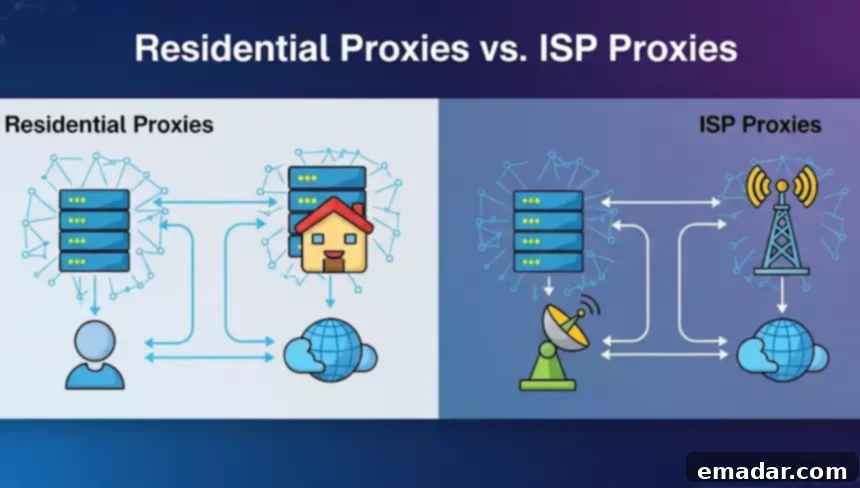
Residential proxies are highly coveted in the digital world for their unparalleled authenticity. These are genuine IP addresses that are assigned to real residential devices – such as computers, smartphones, and tablets – by Internet Service Providers (ISPs) to legitimate home users. When you utilize a residential proxy, your internet traffic is routed through one of these real users’ devices. This mechanism makes your online activity appear as though it’s originating from a standard household internet connection, rather than a data center or a suspicious network.
The core strength of residential proxies lies in this inherent legitimacy. Websites and their sophisticated anti-bot systems are primarily designed to detect and block traffic from known data center IP ranges or suspicious patterns indicative of automated activity. Because residential IPs are indistinguishable from those of regular internet users, they are remarkably effective at bypassing even the most advanced anti-bot measures, making them ideal for tasks requiring high anonymity and a low detection risk. Furthermore, their global distribution, stemming from a vast network of real user devices across numerous locations, provides extensive geographic flexibility.
Key Features of Residential Proxies:
- Real User IPs for Unmatched Authenticity: Your traffic appears to originate from an actual residential internet user, making it exceedingly difficult for target websites to identify it as proxy traffic. This authenticity is crucial for evading sophisticated detection systems.
- Superior Anonymity and Reduced Detection Risk: Due to their genuine nature, residential proxies offer a very high level of anonymity. Websites are far less likely to flag or block requests coming from residential IPs, leading to higher success rates for your operations.
- Extensive Global Reach and IP Diversity: Residential proxy networks boast access to a vast and diverse pool of IP addresses spanning numerous countries and cities worldwide. This enables users to target specific geographical locations with precision and switch between IPs frequently to avoid detection and access geo-restricted content effectively.
Primary Use Cases for Residential Proxies:
- Advanced Web Scraping and Data Collection: Ideal for gathering large volumes of data from websites without triggering anti-bot defenses, CAPTCHAs, or IP bans. The authenticity of residential IPs ensures a smooth and continuous scraping process, even on highly protected sites.
- Ad Verification and Brand Protection: Businesses can use residential proxies to verify that their advertisements are being displayed correctly in different geographical regions and on various platforms. They also help monitor for brand infringement and ensure a consistent brand image globally.
- Accurate Price Comparison and Market Research: Monitoring competitor pricing strategies, product availability, and promotional offers in real-time across different regions becomes seamless. Residential proxies provide an unbiased view of localized market conditions without revealing your identity.
- Accessing Geo-Restricted Content: Bypass geographical restrictions to access region-locked content, services, or websites from anywhere in the world, essential for market analysis, content testing, or streaming.
- Social Media Management: Manage multiple social media accounts without triggering security alerts, as each account can be associated with a unique, legitimate-looking IP address.
Exploring ISP Proxies: The Best of Both Worlds
ISP proxies represent a unique and powerful hybrid solution, skillfully blending the best attributes of both traditional datacenter proxies and residential proxies. These proxies utilize IP addresses that are officially provided and registered with Internet Service Providers, just like residential IPs. However, unlike residential proxies which route traffic through individual home devices, ISP proxies are hosted on high-performance servers within secure data centers.
This innovative combination offers significant advantages. By being registered with ISPs, these IPs carry a high degree of legitimacy, similar to residential IPs, making them less likely to be flagged as suspicious by websites. Simultaneously, being hosted in data centers imbues them with the superior speed, reliability, and stability typically associated with traditional datacenter proxies. This makes ISP proxies an excellent choice for tasks that demand both high performance and a low detection risk, striking a balance that many online operations require.
Key Features of ISP Proxies:
- ISP-Provided and Registered IPs for Credibility: The IP addresses are sourced directly from ISPs, granting them a legitimate status that significantly reduces the likelihood of detection. They are perceived as genuine residential connections by most target websites.
- Exceptional Speed and Unwavering Stability: Hosted within robust data center infrastructures, ISP proxies deliver consistently high speeds and unparalleled stability. This ensures reliable performance for demanding tasks, minimizing latency and connection drops.
- Significantly Reduced Detection Risk Compared to Datacenter Proxies: While not identical to genuine residential IPs, their ISP registration provides a layer of credibility that sets them apart from standard datacenter IPs, making them less prone to being flagged by website security systems.
- Static IP Addresses: Many ISP proxies offer static IPs, meaning the IP address remains constant for an extended period, which is beneficial for tasks requiring persistent sessions or continuous access from the same location.
Primary Use Cases for ISP Proxies:
- Efficient SEO Monitoring and Rank Tracking: Track search engine rankings, analyze SERP data, and monitor competitor SEO strategies without encountering geo-restrictions or IP bans. The speed and stability ensure accurate and timely data collection for SEO purposes.
- Seamless Account Management and Multi-Account Operations: Safely manage multiple online accounts across various platforms (e.g., e-commerce, social media, ticketing) without raising suspicion. The legitimate nature of ISP IPs helps prevent account flags or bans.
- In-depth Market Research and Competitive Intelligence: Gather competitive intelligence, perform sentiment analysis, and conduct extensive market research without triggering anti-bot measures. The consistent performance allows for large-scale data acquisition.
- Online Gaming and Sneaker Copping: For activities requiring high speed and low latency, such as online gaming or purchasing limited-edition items (sneaker copping), ISP proxies offer the necessary performance edge combined with a reduced risk of detection.
- Ad Testing and Campaign Verification: Verify ad placements and performance across various platforms and geographies with reliable speed, ensuring campaigns are delivered as intended without being blocked.
Residential vs. ISP Proxies: A Comprehensive Comparative Overview
While both residential and ISP proxies are excellent choices for bypassing restrictions and maintaining anonymity, their distinct characteristics cater to different operational demands. Understanding these differences is paramount for strategic deployment.
| Feature | Residential Proxies | ISP Proxies |
| Origin | Real user devices via legitimate ISPs globally | ISP-assigned IP addresses hosted on dedicated data center servers |
| Speed | Variable; depends heavily on the individual user’s connection speed and stability | Consistently high; benefits from data center infrastructure and dedicated bandwidth |
| Stability | Can be inconsistent; prone to fluctuations as real users may disconnect or experience network issues | Highly stable and reliable; powered by robust data center hardware and network |
| Anonymity | Very high; traffic appears indistinguishable from regular user activity | High; recognized as legitimate ISP IPs, offering strong protection against detection |
| Detection Risk | Extremely low; highly effective at bypassing even advanced anti-bot systems | Low to medium; generally safe, but exceptionally sophisticated systems might differentiate from real home users |
| IP Pool Size | Typically very large; millions of IPs across a vast number of locations | Smaller than residential pools, but still substantial and diverse |
| Cost | Generally higher, due to the complexity and ethical considerations of sourcing and maintaining real user IPs | Moderate; offers a balanced cost-to-performance ratio, often more affordable than premium residential options |
| Static/Rotating | Primarily rotating; IPs change frequently to mimic diverse user behavior (static options exist but are less common) | Often static; ideal for maintaining consistent sessions, though rotating options are also available |
As illustrated in the table above, the choice between these two powerful proxy types often boils down to a trade-off between absolute authenticity and consistent performance. Residential proxies offer the highest level of trust from target websites due to their direct association with real users, but this can come at the cost of variable speed and higher pricing. ISP proxies, on the other hand, provide a compelling blend of speed, stability, and legitimate IP addresses, making them a cost-effective alternative for many demanding operations.
Advantages and Disadvantages in Detail
A deeper look into the pros and cons of each proxy type can further guide your decision-making process, ensuring you leverage their strengths while mitigating potential weaknesses.
Residential Proxies
Advantages:
- Unmatched Authenticity and Trust: The primary advantage is their ability to mimic genuine user behavior almost perfectly. This makes them extremely difficult for websites to detect as proxy traffic, leading to significantly higher success rates for sensitive tasks and avoiding CAPTCHAs or blocks.
- Extensive and Diverse IP Pool: Residential networks typically boast millions of IP addresses across almost every country and city imaginable. This vast diversity allows for highly granular geo-targeting and IP rotation, crucial for large-scale data collection or accessing specific regional content.
- Ideal for Highly Sensitive and Evasive Tasks: They are the go-to choice for scenarios demanding the highest level of anonymity and for bypassing the most sophisticated anti-bot measures, such as on e-commerce sites, social media platforms, or ticketing websites.
- Full Geo-Targeting Capabilities: With IPs from virtually every location, residential proxies offer unparalleled ability to target specific regions, cities, or even ZIP codes, essential for localized market research and content testing.
Disadvantages:
- Variable Performance and Speed: Because traffic is routed through real users’ devices, performance can fluctuate significantly. Connection speeds are dependent on the user’s internet plan, network congestion, and device activity, potentially leading to slower request times or inconsistent stability.
- Higher Cost Per GB/Port: Due to the complex infrastructure required to source and maintain a network of real user IPs, residential proxies are generally more expensive than other proxy types. This cost can be a significant factor for budget-conscious operations.
- Potential for Slower Response Times: The extra hop through a residential device can sometimes introduce higher latency compared to the direct routes offered by data center-hosted proxies.
ISP Proxies
Advantages:
- Consistent High Performance and Reliability: Being hosted in data centers means ISP proxies benefit from robust infrastructure, high bandwidth connections, and dedicated resources, resulting in excellent speed and unwavering stability for all your operations.
- Legitimate IP Status with Reduced Detection: Their association with real ISPs gives them a higher level of credibility than pure data center proxies. They are less likely to be flagged by websites while still offering superior performance.
- Cost-Effective Balance of Speed and Legitimacy: ISP proxies offer a powerful middle-ground, providing much of the legitimacy of residential IPs with the speed and stability of data centers, often at a more affordable price point than premium residential options.
- Ideal for Static IP Needs: Many ISP proxy providers offer static IP addresses that remain consistent over time, which is invaluable for maintaining continuous sessions, managing accounts, or activities where IP consistency is preferred.
Disadvantages:
- Limited IP Pool Compared to Residential Proxies: While their IP pools are substantial, they are generally smaller and less geographically diverse than those offered by large residential networks. This might slightly limit very specific geo-targeting capabilities.
- Potential for Advanced Detection: While significantly better than traditional data center proxies, extremely sophisticated anti-bot systems might still be able to differentiate ISP proxies from genuine, random residential users, albeit with much greater difficulty.
- Less Suitable for Highly Dynamic, Large-Scale Rotating Needs: For operations that require extremely frequent IP rotation across a massive, diverse pool of IPs to avoid detection on highly sensitive targets, residential proxies might still offer a slight edge.
Choosing the Right Proxy for Your Specific Needs
The decision between residential and ISP proxies is not about which is inherently “better,” but rather which is “better suited” for your specific operational goals, budget, and the nature of your target websites. A clear understanding of your requirements will lead to the most efficient and successful proxy deployment.
- Opt for Residential Proxies if your tasks primarily involve:
- Accessing highly geo-restricted content where absolute regional authenticity is critical.
- Bypassing sophisticated anti-bot measures and CAPTCHAs on websites known for aggressive proxy detection, such as sneaker sites, ticketing platforms, or social media networks.
- Conducting highly sensitive data collection that demands the highest level of anonymity and a footprint that is virtually indistinguishable from a real user.
- Large-scale web scraping across diverse, frequently changing targets where IP diversity and rotation are paramount.
- Managing a high number of social media accounts or e-commerce accounts where each needs a unique, legitimate-looking IP.
- Opt for ISP Proxies if your tasks involve:
- High-speed data collection and large-scale scraping operations where consistent performance and reliability are non-negotiable.
- Managing multiple online accounts simultaneously without detection, particularly for long-term sessions where a static IP is beneficial.
- SEO monitoring, rank tracking, and market research, where reliable and fast access to search engines and competitor sites is essential.
- Online gaming, streaming, or other latency-sensitive applications where speed and stability are prioritized alongside reduced detection risk.
- Budget-conscious projects that still require a high degree of legitimacy and performance, offering an excellent value proposition.
- Tasks where maintaining a consistent IP address over time (static proxies) is more important than frequent rotation.
In many advanced scenarios, a hybrid approach might even be the most effective strategy, leveraging residential proxies for initial access or highly sensitive targets, and ISP proxies for subsequent high-speed data extraction or long-term monitoring.
How IPFLY Supports Both Proxy Types for Optimal Performance

IPFLY stands as a leading provider in the proxy market, offering a robust and expansive global proxy network specifically engineered to meet the demanding requirements of web scraping, e-commerce intelligence, and enterprise-level data collection. IPFLY understands the nuanced needs of modern digital operations and provides tailored solutions for both residential and ISP proxy types, ensuring businesses can achieve their objectives with speed, security, and scalability.
IPFLY’s comprehensive proxy infrastructure is designed with key features that empower users:
- Extensive and Diverse IP Pool: With access to over 90 million IPs distributed across 190+ countries, IPFLY provides unparalleled global coverage. This massive pool ensures that users can target virtually any location and maintain a diverse range of IPs for all their tasks.
- Flexible Rotating and Static Options: IPFLY offers both residential proxies, primarily for large-scale, highly anonymous web scraping and data aggregation requiring frequent IP rotation, and ISP proxies, ideal for high-speed, consistent performance tasks that may benefit from static IP addresses.
- Unwavering Reliability and High Success Rates: IPFLY’s meticulously maintained network is optimized for high success rates, boasting minimal block rates, CAPTCHA occurrences, or connection failures. This reliability is crucial for uninterrupted data flow and operational efficiency.
- Scalable Infrastructure for Enterprise Needs: Built to support thousands of concurrent requests, IPFLY’s scalable infrastructure can effortlessly handle the demands of global operations, making it suitable for businesses of all sizes from startups to large enterprises.
- Robust Security and Compliance Measures: IPFLY prioritizes user privacy and data security, offering a secure and compliant platform that ensures uninterrupted access while adhering to industry best practices and ethical standards.
- User-Friendly Dashboard and API Integration: IPFLY provides an intuitive user dashboard and seamless API integration, allowing for easy management, monitoring, and integration of proxy services into existing workflows.
By leveraging IPFLY’s advanced infrastructure, businesses gain the flexibility to combine the unique strengths of both residential and ISP proxies. Whether the task involves complex web scraping on highly protected sites, meticulous market research across diverse geographies, or rigorous e-commerce monitoring for competitive advantage, IPFLY delivers a fast, secure, and reliable foundation for all data operations.
Best Practices for Effective Proxy Utilization
Maximizing the benefits of residential and ISP proxies requires strategic implementation and adherence to best practices:
- Select the Right Proxy Type for Each Task: Do not use a one-size-fits-all approach. Choose residential proxies for tasks requiring maximum authenticity and anti-bot evasion, and ISP proxies for speed-critical operations and consistent performance.
- Implement Smart IP Rotation for High-Volume Requests: For web scraping and intensive data collection, regularly rotating your IP addresses significantly reduces the risk of detection, IP bans, and rate limiting by target websites.
- Leverage Automation and Parallel Processing Effectively: Utilize automation tools and parallel processing techniques to manage multiple requests concurrently, dramatically increasing the efficiency and speed of your data collection efforts.
- Continuously Monitor Proxy Performance and Health: Regularly track key metrics such as latency, connection success rates, and the number of blocked requests. This helps identify underperforming proxies and allows for timely adjustments to your strategy.
- Use Trusted and Reputable Proxy Providers: Partner with a provider like IPFLY that offers reliable, secure, and scalable proxy solutions with a proven track record. Quality infrastructure and responsive support are invaluable.
- Respect Website Terms of Service (ToS): Always strive to operate ethically and adhere to the terms of service of the websites you are interacting with. Abusive scraping can lead to legal issues and permanent bans.
- Implement User-Agent and Header Rotation: Beyond just IP rotation, mimicking legitimate browser behavior by rotating user-agents and other HTTP headers can further reduce detection risks.
- Manage Session Continuity Wisely: For tasks requiring persistent sessions (e.g., account login), consider static ISP proxies. For dynamic scraping, ensure your residential proxies support session management if needed.
Conclusion: Empowering Your Digital Strategy with the Right Proxy Choice
In the dynamic world of online data acquisition and automation, both Residential Proxies and ISP Proxies offer distinct and powerful advantages, each tailored to specific operational requirements. Residential proxies stand out for their unparalleled authenticity, making them the superior choice for navigating the most stringent anti-bot defenses and accessing geo-restricted content with absolute anonymity. Conversely, ISP proxies excel in delivering consistent high speed and unwavering stability, ideal for tasks where performance is critical and a legitimate, static IP is beneficial.
The ultimate key to success lies in understanding these fundamental differences and strategically aligning them with your unique project needs and budgetary considerations. Whether your objectives demand the genuine footprint of residential IPs for sensitive evasive actions or the robust performance of ISP-assigned IPs for high-throughput tasks, making an informed proxy selection is pivotal for achieving optimal efficiency and safeguarding your online operations.
By partnering with a leading provider such as IPFLY, businesses gain access to a comprehensive and global network encompassing both residential and ISP proxies. This enables the strategic combination of these powerful proxy types, ensuring fast, secure, and scalable data operations across various applications, from intricate web scraping and precise market research to vigilant e-commerce monitoring. Embrace the right proxy solution to unlock your full digital potential and stay ahead in the competitive online landscape.
👉 Join theIPFLY Telegram community to stay updated on the latest strategies for proxy solutions, web scraping, and e-commerce optimization.