
In the vast and dynamic digital landscape, a powerful yet often misunderstood skill exists: web scraping. It’s the art of programmatically extracting data from websites, allowing you to gather valuable information such as product prices, news articles, social media comments, and much more, without the tedious manual labor of copying and pasting. However, the path to advanced web scraping is seldom smooth. One of the most significant hurdles aspiring and experienced scrapers face is the persistent challenge of IP blocking.
As you venture into the world of automated data extraction, you’ll quickly realize that websites aren’t always keen on having their content scraped. They employ various sophisticated anti-scraping mechanisms designed to protect their data and server resources. Overcoming these defenses, especially IP-based blocks, is crucial for any successful scraping operation. This is where proxy IPs enter the scene, transforming from a mere option into an essential tool for robust and efficient web scraping.
Why Web Scrapers Absolutely Need Proxy IPs for Effective Data Collection
When your automated script or bot accesses a website, it does so using your computer’s unique Internet Protocol (IP) address. If this single IP address sends an unusually high number of requests within a short period, or if its behavior deviates from that of a typical human user (e.g., extremely fast navigation, no mouse movements, or a suspicious user agent string), target websites will almost certainly trigger their anti-scraping strategies. These defenses are designed to protect their servers, prevent data theft, and ensure fair usage.
Common anti-scraping measures include:
- IP Address Blocking: The most direct and common response is to simply ban your current IP address, preventing any further access from it.
- Request Interception and Denial: Your requests might be silently dropped, or you could receive error messages indicating that access is forbidden.
- CAPTCHA and reCAPTCHA Challenges: Websites may present image-based CAPTCHAs or more advanced “I’m not a robot” checks, which are difficult for automated scripts to solve.
- Rate Limiting: Even if your IP isn’t fully blocked, the website might severely limit the number of requests you can make per minute or hour.
- Returning Decoy or Misleading Data: Some sophisticated systems might intentionally feed your scraper false or outdated data to waste your resources and mislead your analysis.
- Account Suspension: For sites requiring login, suspicious activity could lead to the suspension or termination of your user account.
Continuing to scrape with a single, exposed IP address in the face of these measures is a recipe for instant blacklisting and failed data collection. Your scraping efforts will quickly grind to a halt, rendering your project ineffective.
The solution to this pervasive problem lies in leveraging a robust proxy IP pool. By routing your scraping traffic through a network of diverse proxy servers, you effectively mask your real IP address. Instead, the target website sees requests originating from various different IP addresses belonging to the proxy pool. This technique simulates a multitude of users accessing the site, distributing your requests across many IPs, which dramatically reduces the likelihood of any single IP being flagged or blocked. This not only helps you bypass sophisticated anti-bot systems but also significantly boosts the efficiency and scalability of your web scraping operations.

How Proxy IPs Work: Understanding the Fundamental Mechanism
The core principle behind proxy IPs is elegantly simple, yet profoundly effective. Imagine a middleman between your web scraping script and the target website. That middleman is the proxy server.
Here’s the simplified flow:
Your Scraper → Proxy Server (Intermediary) → Target Website
When your scraper sends a request, it first directs that request to the proxy server. The proxy server then forwards the request to the target website on your behalf. Crucially, the target website receives the request as if it originated from the proxy server’s IP address, not your actual machine’s IP. This fundamental concept offers several critical advantages for web scraping:
- IP Masking and Anonymity: Your real IP address remains hidden, protecting your identity and preventing direct bans on your network.
- Rapid IP Switching: With a pool of proxies, your scraper can seamlessly rotate through different IP addresses with each request or after a set interval. This mimics the behavior of many distinct visitors, making it much harder for websites to detect automated activity based on IP patterns.
- Enhanced Concurrency: By distributing requests across multiple IPs, you can send more requests in parallel, significantly increasing the speed and volume of your data collection.
- Geographical Targeting: Many proxy services offer IPs from specific countries or regions. This allows you to scrape localized content, bypass geo-restrictions, or simulate local user behavior, which is vital for competitive intelligence or market research in different locations.
Integrating a proxy into your scraping code is surprisingly straightforward. Most programming languages and HTTP client libraries provide simple methods to configure proxy settings. You typically specify the proxy’s address (IP and port) and any necessary authentication credentials. This minimal configuration allows you to harness the power of an entire proxy network.
Common Proxy IP Types: Which One Best Suits Your Scraping Project?
Not all proxies are created equal. Different types of proxies offer distinct advantages and are best suited for specific web scraping scenarios. Understanding these differences is crucial for selecting the most effective and cost-efficient solution for your project.
| Proxy Type | Description | Key Advantages | Ideal Use Cases |
| Data Center Proxies | IPs provided by data centers, not real residential ISPs. Often hosted on cloud servers. | High speed, generally affordable, available in large quantities. | Large-scale, non-sensitive data collection; general information harvesting; competitor pricing research on less guarded sites; website structure analysis. |
| Residential Proxies | IPs sourced from actual internet service providers (ISPs) and assigned to genuine residential users. | High anonymity, highly resistant to blocking, mimics real user behavior. | Scraping high anti-bot websites (e.g., e-commerce, social media, travel sites); ad verification; brand protection; localized data collection. |
| Dynamic/Rotating Proxies | Automatically assigns a new IP address from a large pool for each connection or at specified intervals. Can be data center or residential. | Vast pool of IPs, automatic rotation, significantly reduces detection risk. | Full-scale data harvesting; frequent, high-volume requests; any scenario where IP reputation needs constant refreshing. |
| Static Residential Proxies (ISP Proxies) | IPs provided by ISPs, but remain fixed for extended periods, effectively behaving like a dedicated residential connection. | High trust from websites (residential IP), stability for long-term sessions, consistent IP for account management. | Managing multiple accounts; long-running projects requiring persistent sessions; login-dependent scraping; maintaining reputation over time. |
In the demanding world of web scraping, many developers initially fall into the trap of choosing “cheap but unstable” proxy solutions. While attractive in terms of cost, these often lead to frequent IP blocks, slow speeds, and unreliable data, ultimately costing more in wasted time and resources. For serious scraping endeavors that demand stability, high success rates, and compliance with data ethics, developers are increasingly turning to high-quality proxy IP services like those offered by IPFLY.
IPFLY stands out by combining a robust self-built server infrastructure with intelligent screening mechanisms. This approach ensures a high degree of IP purity and exceptional connection speeds, making their service particularly well-suited for collecting data from sensitive, high anti-bot websites such as TikTok, Instagram, YouTube, Amazon, and Booking.com. Their focus on quality guarantees that your scraping operations remain uninterrupted and highly efficient.
Implementing Proxies in Python: A Conceptual Overview
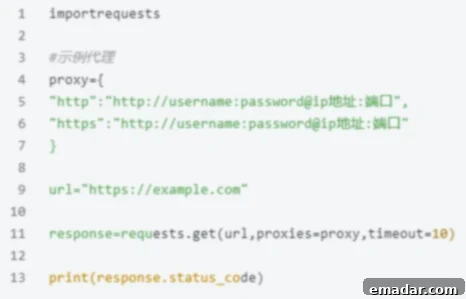
While we won’t embed direct code here, understanding how to implement proxies in your scraping script is crucial. For popular languages like Python, libraries such as `requests` make proxy integration remarkably simple. You typically define a dictionary containing your proxy details – including the protocol (HTTP, HTTPS, SOCKS5), the proxy IP address, port, and often a username and password if it’s an authenticated proxy. This dictionary is then passed as a parameter to your request function.
For example, if you were using a premium proxy account like those provided by IPFLY, the setup is even more streamlined. You would simply replace placeholder values with your specific account credentials (username, password, and port). Premium providers often handle the complexity of IP rotation and management behind the scenes, allowing you to focus on your data extraction logic rather than proxy infrastructure. This simplifies the development process and reduces the chances of misconfiguration, leading to a more robust and efficient scraper from the outset.
Web Scraping Pitfalls: Avoiding Five Common Beginner Mistakes
Embarking on a web scraping journey is exciting, but without proper guidance, beginners often fall into common traps that lead to quick IP bans and project failures. Being aware of these pitfalls and adopting best practices from the start will save you immense frustration and time.
- Scraping Popular Websites Without IP Rotation: This is perhaps the most frequent mistake. Attempting to scrape data from high-traffic, well-protected sites (e.g., major e-commerce platforms, social media giants) using a single, static IP address will result in an immediate IP block, often within minutes or even seconds. Websites monitor consecutive requests from the same IP, triggering their anti-bot defenses.
- Reliance on Free Proxy Services: While tempting due to zero cost, free proxies are notoriously unreliable, incredibly slow, and often compromised. They typically have low anonymity, are frequently blacklisted, and can pose significant security risks, exposing your data to malicious actors. The likelihood of getting blocked is extremely high, and the data quality will be poor.
- Excessively High Request Frequency: Sending requests too quickly or too frequently, without introducing delays between requests, is a surefire way to be flagged as a bot. This behavior can overload a website’s server and is often perceived as an attack, leading to aggressive blocking. Being “polite” by mimicking human-like delays is crucial.
- Neglecting User-Agent Configuration: The User-Agent header in your HTTP request tells the website what kind of client is accessing it (e.g., Chrome on Windows, Safari on iOS). If your scraper sends a generic or missing User-Agent, or one that clearly identifies it as a bot library (e.g., “Python-requests/2.25.1”), it immediately exposes your automated activity.
- Lack of Timeout and Error Handling: Web scraping is inherently prone to network issues, website changes, and unexpected responses. If your script doesn’t implement proper timeouts (to prevent indefinite waiting for a response) and robust error handling (e.g., retries, logging, graceful exits), a single network glitch or a minor website change can cause your entire program to crash, halting your data collection prematurely.
To navigate these challenges successfully and build a resilient web scraper, here are some essential best practices:
- Utilize High-Anonymity Proxy IPs: Invest in reputable, high-quality residential proxies (like those offered by IPFLY) that offer superior anonymity and are harder for websites to detect. These proxies blend in with legitimate user traffic.
- Implement IP Rotation and Retry Mechanisms: Always rotate your IP addresses, either after each request or after a set number of requests. Couple this with a retry mechanism that intelligently re-sends failed requests using a different IP after a short delay, improving your success rate.
- Mimic Realistic Browser Behavior: Beyond just User-Agents, configure other HTTP headers (e.g., `Accept`, `Accept-Language`, `Referer`) to resemble those of a real browser. Consider using browser automation tools like Selenium or Playwright for highly dynamic or JavaScript-heavy sites, as they render pages just like a browser.
- Control Request Concurrency and Frequency: Implement delays (e.g., `time.sleep()` in Python) between requests. Consider using techniques like exponential backoff for retries. Avoid hitting a single website too hard; distribute your requests over time to reduce suspicion.
- Build Robust Error Handling: Implement `try-except` blocks to catch potential errors (e.g., network issues, HTTP errors). Define timeouts for all requests. Log errors comprehensively to debug issues efficiently and ensure your scraper can gracefully recover from unexpected situations.
Conclusion: Mastering Web Scraping Starts with Superior IP Management
For anyone delving into the world of web scraping, whether a curious beginner or an experienced data analyst, the mastery of IP proxy usage is not merely an advanced technique; it is the foundational first step towards building effective, scalable, and reliable data collection systems. It’s the critical enabler that transforms a basic script into a powerful data acquisition tool. Proxies don’t just help you circumvent the frustrating obstacle of “access denied”; they significantly enhance your scraping efficiency, broaden your data collection capabilities, and ensure the high quality and integrity of the data you gather.
Regardless of your specific data collection goals – be it gathering competitive e-commerce intelligence, performing in-depth social media sentiment analysis, meticulously monitoring price fluctuations, or executing precise localized data extraction – remember this pivotal principle:
“The journey of successful data collection begins with stable, secure, and highly anonymous proxy IPs.”
Don’t wait for your web scraping projects to fail, or worse, for your accounts to be permanently banned, before you realize the critical importance of a robust proxy strategy. Take proactive steps now. Experiment with reputable proxy service providers like IPFLY to establish your personalized, high-performance web scraping IP pool. Investing in quality proxies from the outset is an investment in the long-term success and resilience of your data projects.
Key Advantages of IPFLY Proxies:
- Global Reach: Access to a vast network of nodes across 190+ countries, offering a comprehensive selection of static and dynamic residential IPs to meet any geographical targeting requirement.
- Unmatched Purity & Anonymity: IPs are meticulously screened for high purity and offer unparalleled anonymity, making them ideal for long-term account management and maintaining reputation across various cross-border platforms.
- Blazing Fast & Stable Connections: Experience near-instantaneous, sub-second connections that remain consistently stable, minimizing disconnections and maximizing scraping uptime.
- Comprehensive Protocol Support: Full compatibility with HTTP, HTTPS, and SOCKS5 protocols, ensuring flexibility and broad integration capabilities with your existing scraping tools and infrastructure.
- Universal Platform Compatibility: Seamless integration across all major platforms and tools, including popular anti-detect browser frameworks, system-wide proxy settings, and various automation software.
👉 Claim your exclusive offer and get access to premium IPs today!