

Are you under the impression you’re using a “residential IP,” only to find it’s a shared data center IP that’s been rotated tens of thousands of times? Account suspensions, throttling, and anomalous activity detections – all these problems can be traced back to compromised or “impure” IP addresses!
Don’t panic! Today, we’re going to demystify everything you need to know:
- ✅ What exactly is a residential IP?
- ✅ How can you verify if your current IP is truly residential?
- ✅ What does “IP purity” mean, and why is it critical for your account’s longevity and success?
In the competitive digital landscape, the quality of your IP address is often an overlooked, yet paramount, factor determining the success or failure of your online ventures. Whether you’re managing multiple e-commerce stores, running intricate social media campaigns, or executing targeted advertising, a clean and legitimate IP address is your digital passport to uninterrupted operations. Ignoring this crucial aspect can lead to significant financial losses, wasted effort, and irreversible damage to your online presence.
I. Understanding the Fundamentals: What is a Residential IP?
A residential IP, as the name suggests, is an Internet Protocol (IP) address assigned by an Internet Service Provider (ISP) to a genuine home or individual user. Think of the IP address your home Wi-Fi network uses – that’s a prime example of a residential IP. These IPs are tied to physical locations and real-world internet connections, making them appear as legitimate as any everyday user browsing the internet from their home.
The distinction between residential IPs and other types, particularly data center IPs, is crucial. Data center IPs originate from cloud hosting providers and commercial servers. While functional, they are easily identifiable as non-human traffic sources by sophisticated detection systems employed by major websites and platforms. Residential IPs, on the other hand, seamlessly blend in with regular user traffic, significantly reducing the likelihood of detection and scrutiny.
Key Advantages of Using a Residential IP:
- 📌 High Anonymity and Authenticity: Your online activities appear to originate from a real user in a specific geographic location, rather than a commercial server. This grants a higher level of anonymity and trustworthiness in the eyes of online platforms.
- 📌 Reduced Risk of Triggering Security Measures: Platforms are designed to flag suspicious activity originating from data centers, which are often associated with bots, spammers, and malicious actors. Residential IPs inherently bypass many of these initial security checkpoints, leading to higher platform trust and fewer verification requests.
- 📌 Ideal for Various High-Demand Scenarios: They are perfectly suited for tasks requiring genuine user behavior, such as cross-border e-commerce management (multiple accounts), social media marketing and account nurturing, ad verification, market research, web scraping sensitive data, and secure access to geo-restricted content.
Despite these clear benefits, a common pitfall is the misconception that any purchased proxy is a “true” residential IP. Many users inadvertently acquire proxies that are advertised as residential but are, in fact, recycled, shared, or even compromised data center IPs. This leads to the frustrating experience of investing in a proxy service only to face persistent throttling, account suspensions, and outright bans – consequences directly attributable to the deceptive nature of the underlying IP address.
II. Verifying Your IP: Is It Truly Residential?
Don’t just take a seller’s word for it when they claim, “These are residential IPs.” You have the power to verify this yourself! Identifying a genuine residential IP is a critical skill for anyone operating online. There are several reliable methods to ascertain the true nature of your IP address, helping you avoid costly mistakes and protect your online assets.
✅ Method One: Utilizing IP Geolocation and Information Tools
Leading IP lookup tools, such as `ipinfo.io` (widely used in the cross-border community), offer accurate and comprehensive details about any given IP address. Simply input your IP address into the tool, and it will provide a wealth of information including:
- ASN (Autonomous System Number) / ISP Name: This indicates the entity responsible for routing this IP address on the internet. For a residential IP, you should see the name of a legitimate Internet Service Provider, such as Comcast, AT&T, Verizon, Vodafone, BT, Orange, etc.
- IP Type: Many tools will explicitly classify the IP type. Look for classifications like “Residential,” “Broadband,” or “ISP.”
- Hosting Provider Information: This section is crucial. If it displays names like “DigitalOcean,” “AWS (Amazon Web Services),” “Google Cloud Platform,” “Microsoft Azure,” “OVH,” or similar commercial hosting providers, then you are almost certainly using a data center IP, not a genuine residential one. These providers house servers, not individual home users.

Paying close attention to these details can quickly unveil the true nature of your proxy. A reputable residential proxy service will always show an ISP name consistent with real consumer internet providers.
✅ Method Two: Observing IP Usage Patterns – Frequent Rotation or Sharing
The behavior of an IP address can often be a tell-tale sign of its purity and legitimacy. If your proxy service exhibits certain patterns, it’s a strong indicator that you might not be using a high-quality residential IP:
- Multiple Accounts Using the Same IP: If your proxy provider assigns the same IP address to numerous users or if you find yourself unable to manage multiple accounts effectively without conflicts, it’s a shared proxy. While some residential proxies are shared, excessive sharing significantly diminishes their purity and increases detection risk.
- Excessively Frequent IP Changes: While dynamic residential IPs rotate, an unusually rapid or uncontrolled rotation without explicit user command can be a red flag. This might indicate that the provider is struggling to maintain a pool of clean IPs and is constantly shuffling you through a limited, often abused, set.
- Frequent CAPTCHA Verifications, Login Failures, or Abnormal Login Alerts: If you constantly encounter “I’m not a robot” checks, experience unexpected login failures, or receive security alerts about unusual login attempts from platforms like social media sites or e-commerce marketplaces, your IP is almost certainly flagged. These are clear signs that the platform’s security systems have identified your IP as suspicious, leading to increased scrutiny and potential restrictions.
These characteristics are strong indicators that you might be using one of the following:
- ❌ A Highly Shared Proxy: Often oversubscribed, leading to diminished performance and purity.
- ❌ A Polluted or Abused IP Segment: An IP range that has been previously used for spamming, scraping, or other illicit activities, landing it on blacklists.
- ❌ A Non-Residential Proxy Masquerading as Residential: Data center IPs that are deceptively marketed as residential.
Understanding these patterns allows you to proactively identify and switch away from problematic proxies before they inflict significant damage on your online operations.
III. The Undeniable Power of “IP Purity”: Why It Dictates Your Account’s Fate
IP purity can be simply understood as:
Has this IP address been involved in any malicious activities in the past, and does it currently represent a “clean,” trustworthy network identity?
This concept extends beyond mere “residential” status. A residential IP that has been heavily abused by previous users can be just as detrimental as a data center IP. Platforms maintain sophisticated databases of IP reputation, flagging addresses associated with spam, fraud, account creation bots, excessive scraping, or other violations of their terms of service. An “impure” IP carries a digital stain that significantly impacts its trustworthiness.
The Dire Consequences of Using a “Stained IP”:
If your online activities are routed through a compromised or “dirty” IP, you will inevitably encounter severe limitations and outright bans:
- Immediate TikTok Throttling and Zero Views: Logging into TikTok with a flagged IP often results in your videos receiving zero views, regardless of content quality. The platform’s algorithm will silently suppress your reach, rendering your efforts futile.
- Persistent Amazon Account Risk Control and CAPTCHAs: For Amazon sellers, a dirty IP can trigger constant risk assessments, leading to endless CAPTCHA verifications, account freezes, or even permanent suspension, especially when managing multiple storefronts.
- Instant Google Ads Account Rejection: When attempting to set up advertising campaigns on platforms like Google Ads, using an impure IP can lead to immediate account rejection during the review process, before you even spend a single dollar. Google’s strict ad policies often link IP reputation to advertiser trustworthiness.
- Social Media Account Bans (Facebook, Instagram, etc.): Operating multiple social media accounts for marketing or personal use becomes a minefield. Impure IPs are quickly identified as automated or suspicious, leading to rapid shadow-banning or permanent account closure.
- Failed Web Scraping and Data Collection: Websites will quickly block or present distorted data to IPs identified as being part of scraping farms, making vital market research or competitive analysis impossible.
😱 The terrifying reality is that virtually all “invisible throttling” and unexplained account performance issues can often be traced back to a problematic IP address!
Platforms invest heavily in anti-fraud and anti-bot systems to protect their user base, maintain fair competition, and ensure the integrity of their services. They want to distinguish genuine human users from automated scripts, spammers, and malicious entities. An IP with low purity signals that the user might be attempting to circumvent rules, leading to pre-emptive punitive actions. Therefore, understanding and actively managing IP purity is not just a best practice; it is the bedrock of sustainable online operations.
IV. Elevating Your IP Purity: The Path to Unrestricted Online Activity
The most crucial step in achieving and maintaining high IP purity is making an informed decision about your proxy service provider. Resist the temptation of free or exceptionally cheap proxies. These services almost invariably rely on overused, recycled, or outright blacklisted IPs that will do more harm than good to your online ventures.
Investing in a premium, reputable proxy provider is not an expense; it’s an essential investment in the security and longevity of your online business assets. Such providers prioritize IP quality, constantly monitoring and refreshing their pools to ensure optimal performance for their users.
Introducing IPFLY Residential Proxy IPs: Your Solution for Uncompromised IP Purity
IPFLY stands out in the crowded proxy market by employing a robust infrastructure and intelligent systems designed specifically to deliver unparalleled IP purity. Through its self-built server network and advanced big data filtering systems, IPFLY commits to providing:
- Authentic ISP-Allocated Residential IPs: IPFLY sources its proxies directly from legitimate Internet Service Providers, ensuring that each IP address is genuinely assigned to a real home user. This eliminates the risk of using disguised data center IPs that are easily flagged by sophisticated detection systems.
- Pure, Unpolluted IP Segments: Every IP in IPFLY’s vast pool undergoes rigorous screening. The system actively identifies and filters out IP addresses or entire IP ranges that have any history of abuse, spamming, or blacklisting. This guarantees that you are connecting through a “clean slate” IP, free from the digital stains of past misdeeds.
- Non-Shared, Abuse-Free History: IPFLY emphasizes dedicated or minimally shared residential IPs, preventing the performance degradation and detection risks associated with oversubscribed proxies. The focus is on providing IPs with a pristine usage history, ensuring maximum trust with target websites.
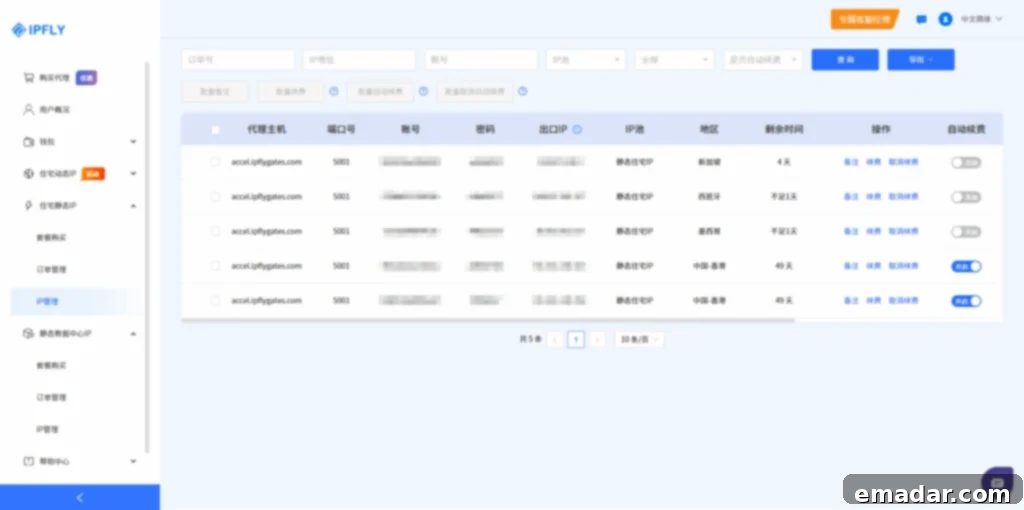
- Advanced Features for Optimal Control: The platform offers comprehensive tools for IP detection, precise geographic targeting and filtering, and seamless multi-country switching. This level of control allows users to tailor their IP usage to specific operational needs, further enhancing anonymity and reducing detection risks.
Diverse Applications Supported by IPFLY’s High-Purity Residential Proxies:
IPFLY’s commitment to IP purity makes its residential proxies indispensable for a wide array of demanding online activities:
- Social Media Account Management: Safely nurture and manage multiple accounts on platforms like TikTok, Xiaohongshu, Facebook, Instagram, and Twitter without triggering security alerts or shadow bans. Mimic natural user behavior for effective marketing and content dissemination.
- Advertising Campaigns: Ensure successful ad launches and accurate campaign monitoring for platforms like Google Ads and Meta Ads. Bypass geo-restrictions for ad verification and competitive intelligence, knowing your IP won’t lead to instant rejection.
- Data Collection and Web Scraping: Execute large-scale data harvesting projects with higher success rates and reduced blockage. Collect vital market research, pricing data, and competitive analysis without compromising your data integrity.
- Cross-Border E-commerce Multi-Store Management: Operate multiple online stores on platforms like Amazon, eBay, or Shopify seamlessly. Prevent account linking and suspensions by maintaining distinct, trusted IP footprints for each store.
- General Secure Browsing: Enhance online privacy, access geo-restricted content, accelerate gaming connections, and securely visit websites without revealing your true location or encountering IP-based blocks.
By leveraging IPFLY’s specialized infrastructure, users gain a critical advantage: the confidence that their online activities are routed through IPs that are trusted by even the most vigilant platforms, paving the way for sustained success and growth.
V. Conclusion: Prioritizing IP Purity for Business Resilience
The true value of an IP address isn’t measured by its cost, but by its “cleanliness” and trustworthiness!
The distinction between a general “residential IP” and a “pure residential IP” is not merely semantic; it is the cornerstone of effective and sustainable online operations. While a residential IP offers inherent advantages over a data center IP, its true efficacy is inextricably linked to its purity – its history and reputation on the internet. A residential IP that has been abused or overused can be just as detrimental, if not more frustrating, than a standard data center proxy.
- Residential IP ≠ Guaranteed Safety: Owning a residential IP is a good start, but it doesn’t automatically guarantee freedom from detection or restrictions if that IP has a poor reputation.
- Pure IP = Your Business Lifeline: An IP with high purity, free from any history of abuse, is the essential foundation for robust online presence, safeguarding your accounts, and ensuring uninterrupted workflow.
For cross-border traders, advertisers, e-commerce entrepreneurs, and anyone engaged in high-stakes online activities, we strongly recommend the following proactive measures:
- Vigilantly Check Your Current IP Type: Regularly use reliable IP lookup tools to verify if your IP is truly residential and not a disguised data center IP.
- Confirm Genuine Residential Status: Look beyond the label; ensure your IP is allocated by a real ISP and is not part of a compromised or over-shared pool.
- Consistently Monitor IP Purity: Make IP reputation a regular part of your operational checks. Protecting your account assets from unexpected bans and throttles is a continuous effort.
By understanding and prioritizing IP purity, you equip your business with a resilient defense against the ever-evolving detection systems of major online platforms, ensuring your continued success in the digital realm.
Why IPFLY’s Solution Stands Out?
IPFLY empowers users to efficiently configure and manage high-quality proxy IPs through several distinct technological advantages:
- 1. Proprietary Server Network: IPFLY’s self-built and managed server infrastructure spans major global cities. This proprietary control allows for rigorous quality assurance, ensuring consistently high IP purity and effectively bypassing common “blacklist” issues that plague many other proxy services.
- 2. Dynamic IP Allocation Mechanism: The system intelligently rotates IP addresses, mitigating the risks associated with prolonged use of a single IP. This dynamic approach ensures that your online activities appear diverse and organic, further reducing detection footprints.
- 3. Multi-Layered IP Filtering: Employing advanced big data algorithms, IPFLY meticulously filters out low-quality or compromised IP addresses before they ever reach a user. This stringent screening process guarantees a high success rate for proxy connections, offering unparalleled reliability and performance.
👉 Claim your offer and get access to premium quality IPs today!