
IPv4 vs. IPv6: Understanding the Internet’s Dual Foundation and the Role of Proxies
In the vast, interconnected world of the internet, every single device requires a unique identifier to communicate effectively – an IP address. These digital addresses are the fundamental building blocks that allow data to find its way across the globe, ensuring websites load, emails are sent, and applications function seamlessly. For decades, the internet has primarily relied on IPv4, the original standard. However, with the explosive growth of connected devices, from smartphones and smart home gadgets to industrial IoT sensors, the limitations of IPv4’s address space became increasingly apparent, paving the way for the development and gradual adoption of its successor, IPv6.
This comprehensive guide will delve into the critical distinctions between IPv4 and IPv6, exploring why these differences profoundly impact network architecture, performance, and security. Furthermore, we’ll examine how essential tools like proxies serve as vital intermediaries, bridging the gap between these two protocols and ensuring smooth, secure, and adaptable connectivity in a constantly evolving digital landscape.
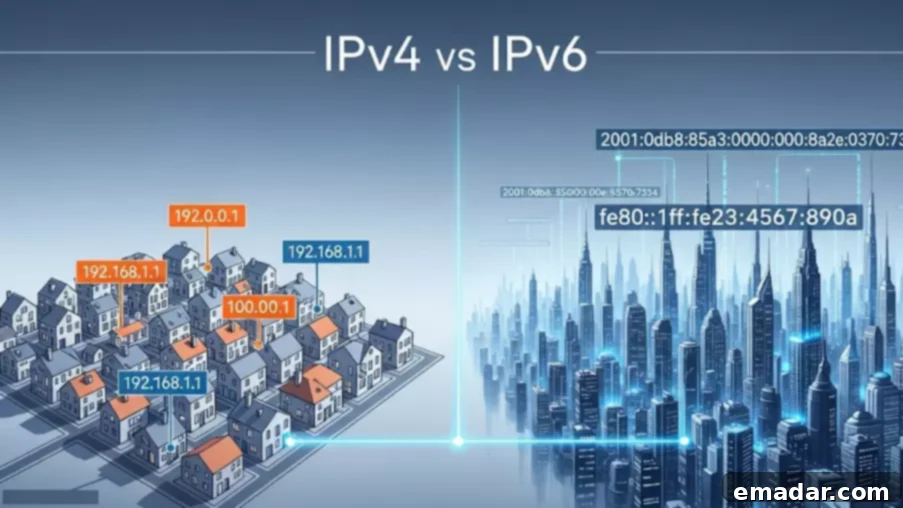
What Exactly Is the Internet Protocol (IP)?
At its core, the Internet Protocol (IP) is a foundational set of rules governing how data is sent across the internet and other computer networks. Think of it as the mailing system for the digital world. When you send an email, stream a video, or browse a website, the data is broken down into small packets. IP is responsible for addressing these packets, ensuring they are routed correctly from their origin to their intended destination. Each device connected to a network, whether it’s your laptop, a server, or a smart device, is assigned a unique IP address. This address acts as its postal code, allowing other devices and servers to locate and exchange information with it. Understanding this crucial element is not just for network engineers; it’s fundamental for anyone looking to optimize and secure their online operations, a principle that leading proxy providers like IPFLY actively advocate.
IPv4: The Internet’s Enduring Foundation
Introduced in **1983**, IPv4 (Internet Protocol version 4) has been the workhorse of the internet for over four decades. It utilizes a 32-bit address space, which translates to a theoretical maximum of approximately 4.3 billion unique IP addresses. While this number seemed immense at the time of its inception, the exponential growth of the internet and the proliferation of connected devices quickly led to concerns about address exhaustion. Many of these addresses were also reserved for specific purposes, such as private networks (e.g., 192.168.x.x, 10.x.x.x) and multicast groups, further limiting the publicly available pool.
IPv4 addresses are typically written in an easy-to-read dot-decimal notation, such as 192.168.1.100 or 203.0.113.45. To mitigate the rapid depletion of addresses, a crucial technology known as Network Address Translation (NAT) became widely adopted. NAT allows multiple devices on a private network to share a single public IPv4 address, effectively extending the lifespan of the protocol. While NAT has been instrumental in keeping the internet functioning, it also introduces complexities, such as breaking true end-to-end connectivity and making certain peer-to-peer applications more challenging to configure.
IPv6: The Future-Proof Solution to Address Scarcity
Developed in response to the looming IPv4 address exhaustion, IPv6 (Internet Protocol version 6) represents a significant leap forward in network addressing and capabilities. It employs a massive 128-bit address format, providing an unimaginably vast number of unique IP addresses – roughly 340 undecillion (that’s 3.4 x 1038!). To put this into perspective, there are enough IPv6 addresses to assign a unique IP to every grain of sand on Earth, and then some, for every person on Earth.
IPv6 addresses are expressed using eight groups of four hexadecimal digits, separated by colons, for example: 2001:0db8:85a3:0000:0000:8a2e:0370:7334. To improve readability and simplify writing these lengthy addresses, IPv6 incorporates shorthand rules to compress sequences of zeros. For instance, 2001:0db8:85a3::8a2e:0370:7334 is a valid compressed form. Beyond its immense address space, IPv6 introduces several key enhancements that significantly improve network efficiency, security, and functionality:
- Elimination of NAT: With a virtually infinite supply of addresses, IPv6 renders NAT unnecessary. This enables true end-to-end connectivity, simplifying network configurations and improving the functionality of many internet applications and services. Every device can have its own globally unique public IP address.
- Built-in IPSec Support: Security is paramount, and IPv6 was designed with integrated support for IP Security (IPSec) from the ground up. IPSec provides robust authentication and encryption capabilities at the network layer, offering enhanced data integrity, confidentiality, and origin authentication for all network traffic. While optional in IPv4, it’s a fundamental part of IPv6’s design philosophy.
- Streamlined Header Design and Efficient Routing: IPv6 features a simpler and more efficient header format compared to IPv4. This streamlined design allows routers to process packets more quickly, reducing latency and improving overall network performance. It also offers improved support for multicast addressing, enabling efficient delivery of data to multiple destinations simultaneously, rather than relying on broadcast messages that consume more network resources.
- Simplified Network Autoconfiguration (SLAAC): IPv6 simplifies network management through Stateless Address Autoconfiguration (SLAAC). Devices can automatically configure their own IPv6 addresses without the need for a DHCP server, making network setup and deployment more straightforward and resilient. This reduces administrative overhead and enhances network flexibility.
IPv4 vs. IPv6: A Side-by-Side Technical Comparison
Understanding the core differences between these two protocols is crucial for network architects, developers, and businesses alike. Here’s a detailed comparison highlighting their key characteristics and implications:
| Feature | IPv4 | IPv6 |
| Address Length | 32-bit (approx. 4.3 billion unique addresses) | 128-bit (approx. 3.4 x 1038 unique addresses) |
| Notation | Decimal, dot-separated (e.g., 192.168.1.1) |
Hexadecimal, colon-separated (e.g., 2001:0db8::1) |
| NAT Required? | Commonly used for address conservation | Not needed, enables true end-to-end connectivity |
| Security (IPSec) | Optional add-on, not natively integrated | Built-in and integral to the protocol’s design |
| Multicast Support | Optional, often uses broadcast for group communication | Built-in, efficient delivery to multiple endpoints; no broadcast |
| Header Efficiency | Larger, more complex header, potentially slower processing | Simplified and fixed-size header for faster routing decisions |
| Checksum in Header | Present, processed at each router hop | Removed, checksum handled by upper layers (TCP/UDP) for efficiency |
| Address Configuration | Mainly DHCP (Dynamic Host Configuration Protocol) | SLAAC (Stateless Address Autoconfiguration) and DHCPv6 |
| Fragmentation | Performed by routers during transit | Handled only by the sending host for improved efficiency |
These distinctions highlight not just differences in address size, but fundamental shifts in how networks operate, offering significant improvements in scalability, security, and overall performance with IPv6.
Why IPv6 Adoption Has Been a Gradual Process
Despite the clear advantages of IPv6, particularly its vast address space and improved features, its global adoption has been slower than initially anticipated. Several factors contribute to this protracted transition, creating a complex, hybrid internet environment:
- Legacy System Compatibility: A significant portion of the internet’s infrastructure, including older routers, switches, servers, operating systems, and applications, was built primarily for IPv4. Upgrading or replacing these systems to be fully IPv6-compatible can be a monumental task, requiring extensive testing and potential downtime.
- Financial Investment: The transition to IPv6 often necessitates substantial financial investment. This includes purchasing new hardware, updating software licenses, and training IT personnel to manage and troubleshoot IPv6 networks. For many organizations, especially smaller ones, these costs can be prohibitive.
- Transition Complexity: The internet cannot simply switch off IPv4. Instead, a long period of coexistence is required, known as a “dual-stack” environment, where networks run both IPv4 and IPv6 simultaneously. Managing such an environment, along with implementing tunneling and translation mechanisms (like NAT64/DNS64) to allow communication between IPv4-only and IPv6-only segments, adds significant operational complexity.
- Perceived Lack of Urgency: For many businesses and individual users, the immediate impact of IPv4 address exhaustion has been masked by the widespread use of NAT. As long as their current setup works, the incentive to invest in a costly and complex IPv6 migration might not feel urgent enough.
Consequently, the internet today operates in a fascinating hybrid state, where both IPv4 and IPv6 traffic coexist, often traversing different paths or requiring translation at various points.
Where Proxies Become Indispensable in the IPv4/IPv6 Landscape
In this dual-protocol world, one area where the IPv4 vs. IPv6 dynamic becomes particularly relevant and critical is within proxy networks. Proxies, acting as powerful intermediaries between a user’s device and the broader internet, play a crucial role in navigating the complexities of this transition. They are essential tools for enhancing privacy, security, bypassing geo-restrictions, facilitating web scraping, and supporting various business operations by masking or changing a user’s original IP address.
Here’s how the type of IP protocol directly influences proxy services and their utility:
- IPv4 Proxies: The Current Mainstay
IPv4 proxies remain incredibly popular and widely used, primarily because the vast majority of websites, online services, and applications still predominantly support IPv4. They are essential for accessing legacy systems and ensuring compatibility with the broader internet. However, due to the inherent scarcity of IPv4 addresses, these proxies are often more expensive, reflecting the high demand and limited supply. Businesses requiring access to specific geographical locations or high-trust IPs frequently rely on IPv4 proxies for tasks like price monitoring, ad verification, and localized content testing.
- IPv6 Proxies: The Cost-Effective Future
IPv6 proxies leverage the virtually unlimited pool of IPv6 addresses, making them significantly more affordable in many cases. This abundance reduces the likelihood of IP bans and blacklisting when performing large-scale operations like web scraping or data collection. They offer a future-proof solution for accessing sites that have fully adopted IPv6. However, their utility is currently limited by the fact that not all websites and platforms have complete IPv6 support. While their adoption is growing, businesses must verify target site compatibility before relying solely on IPv6 proxies.
- Dual-Stack Proxy Solutions: The Bridge to Universal Connectivity
Recognizing the hybrid nature of the internet, many forward-thinking businesses and individuals increasingly depend on proxy providers that offer dual-stack solutions. These services can handle both IPv4 and IPv6 traffic seamlessly, intelligently routing requests through the appropriate protocol. This versatility ensures maximum compatibility across all platforms, allowing users to access both older IPv4-only sites and newer IPv6-enabled services without needing to switch providers or manage complex configurations. Dual-stack proxies are critical for maintaining continuous operations and achieving broad internet coverage.
How Businesses Leverage IPv4 and IPv6 Proxies for Strategic Advantage
The choice between IPv4 and IPv6 proxies, or a combination thereof, depends heavily on a business’s specific objectives and the nature of their online activities. Different industries find unique value in each protocol type:
- E-commerce & Market Research: Businesses involved in competitive analysis, price monitoring, or inventory tracking often prioritize IPv4 proxies. This is because most major e-commerce platforms and online retailers still operate primarily on IPv4 infrastructure, making IPv4 proxies indispensable for reliable and consistent data collection. They ensure access to localized pricing and product information without detection.
- SEO & Digital Marketing: For large-scale SEO tasks such as rank tracking, keyword research, competitor analysis, and link building, IPv6 proxies can be incredibly beneficial. Their vast address pools allow marketers to rotate through a huge number of unique IPs, significantly reducing the risk of IP bans when performing intensive scraping operations. This enables comprehensive data gathering crucial for optimizing online visibility.
- Streaming, Social Media & Content Delivery: Global content access, managing multiple social media accounts, or ensuring consistent user experience across different regions often requires providers that can seamlessly support both IPv4 and IPv6. Dual-stack residential proxies are particularly valuable here, providing legitimate-looking IPs that can bypass geo-restrictions and maintain account integrity, regardless of the target platform’s IP protocol.
- Cybersecurity & Brand Protection: Companies use proxies for threat intelligence gathering, monitoring for fraudulent activities, and protecting their brand reputation. Depending on the target source, they might need a mix of IPv4 and IPv6 proxies to ensure full coverage across various threat landscapes and dark web forums.
- Ad Verification: To ensure advertising campaigns are displayed correctly and legitimately, ad verification services need proxies to simulate user traffic from different locations and device types. Both IPv4 and IPv6 proxies are used to test ad placements on a wide range of websites and apps, confirming visibility and preventing ad fraud.
IPFLY’s Strategic Approach to IPv4 and IPv6 Proxy Solutions
At IPFLY, we recognize the critical importance of providing robust support for both IPv4 and IPv6 protocols across our diverse range of proxy services. Our commitment is to empower businesses with the flexibility and reliability needed to navigate the internet’s complex dual-protocol environment. Whether you require residential proxies, ISP proxies, or datacenter proxies, our infrastructure is meticulously designed for seamless compatibility with both IPv4 and IPv6, enabling truly global and adaptable operations.
- With our extensive network of IPv4 proxies, clients gain reliable access to the vast majority of legacy systems and websites that continue to rely on older infrastructure. This ensures uninterrupted data collection, competitive analysis, and access to location-specific content without compatibility issues.
- Simultaneously, our rapidly expanding pool of IPv6 proxies provides access to an almost limitless supply of addresses. This dramatically reduces the risk of IP bans and captchas, significantly increasing efficiency for tasks like large-scale web scraping, data automation, and bot management. Clients can leverage the cost-effectiveness and scalability that IPv6 addresses offer for future-oriented projects.
This unwavering dedication to dual compatibility ensures that companies partnering with IPFLY can adapt smoothly and confidently, regardless of how quickly IPv6 adoption accelerates worldwide. We provide the essential bridge, allowing businesses to operate without compromise in today’s hybrid internet.
The Unavoidable Future of IPv4 and IPv6 Coexistence
Looking ahead, the trajectory is clear: IPv6 adoption will continue its steady expansion as more devices come online and new internet-based services emerge that benefit from its advanced capabilities and abundant address space. The growing demand for unique identifiers for IoT devices, smart cities, and enhanced mobile connectivity makes the transition to IPv6 not just desirable, but inevitable. However, it’s equally important to understand that IPv4 will not simply vanish overnight. The sheer scale of its existing infrastructure and the embedded reliance of countless systems mean that we are entering a long period of coexistence, perhaps for decades, where both protocols will operate side-by-side.
For businesses, this prolonged transition phase carries a vital implication: future-proofing operations hinges on choosing tools, services, and infrastructure that inherently support both protocols. Investing in solutions that can intelligently manage and route traffic across IPv4 and IPv6 environments will ensure continuity, prevent compatibility roadblocks, and position your organization for sustained growth in the evolving digital landscape. This strategic foresight is crucial for maintaining competitive advantage and adaptability.
Conclusion: Embracing a Dual-Protocol Internet with Smart Proxy Solutions

The debate between IPv4 and IPv6 is not about one protocol completely supplanting the other in the immediate future; rather, it’s about understanding their distinct roles and how they collaboratively shape the modern internet. While IPv4 maintains its dominant presence today due to its historical entrenchment, IPv6 undeniably represents the future of internet connectivity, offering unparalleled scalability, enhanced security, and improved efficiency. For businesses operating in this dynamic digital world, particularly those leveraging the power of proxies, the key takeaway is clear: ensuring access to robust dual-stack solutions that seamlessly support both protocols is not merely an advantage—it’s a necessity.
By comprehending these fundamental differences and strategically deploying versatile proxy networks, organizations can confidently navigate the complexities of a hybrid internet, stay ahead of emerging trends, and secure their operations in a rapidly evolving digital ecosystem. Partner with providers like IPFLY to gain the flexibility and performance needed to thrive in this dual-protocol era.
Stay informed about the latest proxy trends and industry insights. Join IPFLY’s Telegram channel and never miss important updates again.