
In the vast and rapidly evolving landscape of global digital operations, whether it’s cross-border e-commerce, social media management, or large-scale data collection, an IP address transcends its basic function as merely an “internet pass.” It has fundamentally transformed into a critical asset—a robust shield safeguarding account security and a powerful engine driving business efficiency. Navigating the complexities of the online world, especially when operating across different geographical boundaries, demands a sophisticated approach to IP management.
You’ve likely encountered the terms “Static Residential IP” and “Dynamic Residential IP” in your exploration of reliable proxy solutions. These two distinct types of residential proxies are frequently discussed, yet their fundamental differences, optimal use cases, and ultimately, which one is best suited for your specific international business needs, often remain unclear. Making an informed choice is paramount to avoiding pitfalls, ensuring seamless operations, and achieving your strategic objectives.
This comprehensive guide aims to demystify these concepts, providing you with a clear understanding of static and dynamic residential IPs. By the end of this article, you will be equipped to confidently select the right IP solution, optimize your online strategies, and secure your digital presence in the global marketplace. We’ll explore their unique characteristics, delve into their ideal applications, and offer actionable insights to help you make the best decision for your cross-border ventures, ensuring you invest wisely and avoid common operational setbacks.

What is a Static Residential IP?
A Static Residential IP is a type of proxy IP address that originates from a real Internet Service Provider (ISP) broadband user network, meaning it is directly assigned by an ISP to a household. The defining characteristic of a static residential IP is its stability: the IP address remains constant and does not change over extended periods, often for months or even years. This permanence makes it highly trusted by online platforms, as it mimics the behavior of a genuine, long-term home internet connection. Unlike data center IPs which are easily detectable and often flagged, static residential IPs are virtually indistinguishable from regular home internet users, offering unparalleled anonymity and reliability for specific tasks.
For instance, services like IPFLY provide static residential IPs that are dedicated and non-rotating. This means you gain exclusive access to a specific IP address that acts as your stable online identity, making it ideal for operations that require consistent geographical presence and high levels of trust. These IPs are sourced ethically, ensuring compliance and performance, and are designed to offer a premium, stable connection for demanding online activities. They are perfect for establishing a persistent digital footprint that platforms will recognize and trust over time, reducing the risk of security challenges.
Key Characteristics of Static Residential IPs:
- Origin from Residential Broadband: These IPs are assigned by legitimate ISPs such as AT&T, Verizon, Comcast, British Telecom, NTT, or Telekom, directly to residential users. This makes them inherently trusted by websites and online services, as they appear to be authentic, individual home connections.
- Fixed and Unchanging IP: Once assigned, the IP address remains constant for the duration of its use. This “sticky” nature is crucial for maintaining a consistent online identity, which is paramount for sensitive activities that require an established and unshifting digital presence.
- Exceptional Stability and Reliability: The dedicated nature of static IPs ensures a stable and uninterrupted connection, minimizing the risk of disconnections or IP flagging. This reliability is critical for continuous operations where even minor interruptions can have significant consequences.
- Ideal for Long-Term Account Binding: Their permanence makes them perfect for activities that require a consistent digital footprint, such as managing long-standing accounts or platforms with strict geo-location requirements. They solidify your virtual location, making you appear as a consistent user.
- Ensures Environment Consistency: For platforms that monitor user behavior and IP changes closely, a static IP maintains a consistent ‘digital environment,’ significantly reducing the likelihood of security alerts or account suspensions. This predictability is a key factor in avoiding automated detection systems.
Typical Applications for Static Residential IPs:
Static residential IPs are the preferred choice for scenarios where continuity, trust, and a stable digital presence are paramount. Their ability to mimic genuine user behavior without frequent IP changes is invaluable for sensitive operations that prioritize security and consistency.
- Cross-border E-commerce Store Management: For sellers operating on platforms like Amazon, eBay, Shopify, or Etsy, using a static residential IP for each store is critical. It allows you to bind a specific IP to a particular store account, ensuring a consistent geographical identity that prevents account flagging, suspension, or restrictions based on unusual IP changes. This is vital for managing product listings, processing orders, and handling customer service across different regions, ensuring a stable seller profile.
- Long-Term Social Media Account Nurturing (e.g., TikTok, Instagram, Facebook): Building a strong presence on social media requires consistent activity from a stable location. Static IPs are perfect for “warming up” and maintaining primary accounts for influencers, brands, or marketing agencies. They provide the necessary stability to nurture an account over months, preventing security checks that often occur with frequently changing IPs, which can lead to shadowbanning or account locks.
- Facebook Business Manager (BM) and Ad Account Management: Advertising platforms, especially Facebook Ads and Google Ads, have stringent policies regarding account security. Managing multiple ad accounts or Facebook Business Managers from different static residential IPs ensures that each account appears to be operated from a consistent, legitimate location. This significantly reduces the risk of ad account bans, payment issues, or compliance flags, protecting your advertising spend and campaign integrity.
- Platform Registration and Payment Verification: Many online services, financial institutions, and specific digital platforms have strict “geo-fencing” or regional access policies. When registering new accounts, verifying payments, or accessing geo-restricted content that demands a consistent location, a static residential IP provides the necessary stability and trustworthiness to complete these actions successfully, minimizing fraud detection triggers and ensuring uninterrupted service access.
- Exclusive Access to Geo-Restricted Content: For businesses or individuals needing uninterrupted access to region-locked streaming services, local news portals, or specific online databases from a particular country, a static residential IP ensures persistent access without the constant need for re-verification that dynamic IPs might trigger. This is crucial for market research, content consumption, or local business intelligence.
What is a Dynamic Residential IP?
A Dynamic Residential IP, also known as a Rotating Residential IP, operates from real residential networks but with a fundamental difference: its IP address changes frequently. These IPs are typically sourced from a vast pool of real user devices (often through Peer-to-Peer or P2P networks with user consent) and are designed to rotate automatically. This rotation can occur at various intervals – sometimes every few minutes, with every new request, or after a specific period defined by the user. The primary advantage of dynamic residential IPs lies in their sheer volume and the ability to continuously acquire fresh, untracked IP addresses, making them incredibly versatile for tasks requiring high anonymity and scalability.
Unlike static IPs, where you maintain a single consistent identity, dynamic IPs allow you to “blend in” with a multitude of different users from various locations across the globe. This constant change makes it extremely difficult for websites to track your activity or block your access, as each request often comes from a different IP address, appearing as if numerous individual users are accessing the site. This characteristic is invaluable for operations that require frequent, high-volume interactions without leaving a traceable digital footprint.
Key Characteristics of Dynamic Residential IPs:
- Sourced from Real User Devices (P2P/Rotating Residential Networks): These IPs are part of a network of actual residential devices, ensuring they appear as genuine users to target websites. This allows for unparalleled bypass capabilities compared to other proxy types, as they mimic organic traffic behavior.
- High-Frequency Automatic Switching: The IP address automatically rotates, either on a timed interval (e.g., every 5 minutes) or with every new HTTP request, providing a fresh identity for each interaction. This rapid cycling is key to avoiding detection and maintaining anonymity during intensive online tasks.
- Massive Global IP Pool Coverage: Providers like IPFLY offer access to millions of dynamic residential IPs spanning numerous countries and cities worldwide. This vast pool enables highly granular geo-targeting and makes IP bans virtually irrelevant, as you can always access a new, clean IP.
- Optimized for One-Time or High-Concurrency Scenarios: Their rotating nature makes them ideal for tasks that involve a large number of requests over a short period or require frequent changes in IP identity to avoid detection. They are built for scale and efficiency in demanding environments.
- Superior Anonymity and Stealth: The constant rotation makes it incredibly difficult for websites to identify or track your cumulative activities, offering a high degree of anonymity and reducing the chances of IP blocking. This enhances data integrity and operational secrecy.
Typical Applications for Dynamic Residential IPs:
Dynamic residential IPs excel in scenarios where anonymity, broad geographical reach, and the ability to handle a high volume of requests without detection are critical. They are the backbone of many data-intensive and automated online operations, offering flexibility and resilience against sophisticated anti-bot systems.
- Large-Scale Data Collection and Web Scraping: For businesses needing to extract vast amounts of data from websites—such as e-commerce product listings, competitive pricing, real estate data, financial market trends, or public sentiment—dynamic residential IPs are indispensable. They allow users to bypass anti-bot measures, CAPTCHAs, and IP bans by rotating through a massive pool of clean IPs, ensuring successful and uninterrupted data acquisition at scale.
- SEO Monitoring and Competitor Analysis: Marketers and SEO specialists use dynamic IPs to check search engine rankings from various geographical locations, monitor competitor strategies, analyze localized advertising campaigns, and perform comprehensive keyword research. By rotating IPs, they can simulate searches from different countries or cities, gaining accurate, unbiased local search results and insights into market trends without triggering detection systems.
- Ad Verification and Brand Protection: Advertisers and agencies utilize dynamic residential IPs to verify ad placements, detect ad fraud, ensure brand safety, and check geo-targeting compliance. By viewing ads from multiple locations, they can confirm that campaigns are running as intended, appearing on appropriate websites, and reaching the correct audiences, while also monitoring for malicious ad injection or brand impersonation.
- Short-Term Bulk Account Registration and Testing: When the goal is to register a large number of accounts on a platform (e.g., for testing purposes, creating burner accounts, or initial seeding for marketing campaigns) or to perform automated tests across various web applications, dynamic IPs provide the necessary volume of unique IP addresses. This allows for rapid creation without flagging security systems that detect multiple registrations from a single IP.
- Market Research and Price Intelligence: Businesses need to gather real-time pricing information from different regions and online retailers to stay competitive. Dynamic IPs facilitate this by allowing automated tools to access localized pricing data, ensuring businesses can optimize their own pricing strategies and react quickly to market changes in a global landscape.
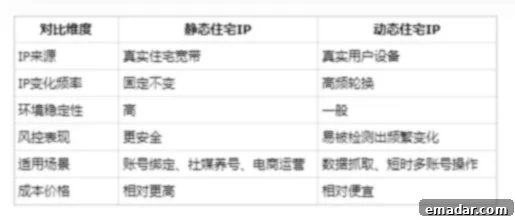
Static vs. Dynamic Residential IP: A Comprehensive Comparison
Choosing between static and dynamic residential IPs largely depends on your specific operational requirements and the nature of your online activities. While both offer the high trust factor of originating from residential networks, their core functionalities and optimal use cases diverge significantly. Understanding these differences is crucial for deploying an effective and secure proxy strategy that aligns perfectly with your business objectives.
Here’s a detailed breakdown comparing the two types of residential proxies, highlighting their distinct characteristics and ideal applications:
IP Persistence and Identity:
- Static Residential IP: Offers a fixed, unchanging IP address. This means your online presence from a specific location remains consistent over time, mimicking a permanent home internet connection. It’s like having a permanent digital address that platforms learn to trust.
- Dynamic Residential IP: Provides constantly rotating IP addresses. Your online identity changes frequently, often with every request or at set intervals. This offers a chameleon-like presence, allowing you to blend in with a multitude of different users, making it challenging for websites to track continuous activity.
Trust and Detection Risk:
- Static Residential IP: Highly trusted due to its ISP-assigned nature and consistent behavior, mimicking a long-term home user. The risk of detection for stable, legitimate activities is very low. However, if used for abusive, high-volume, or repetitive tasks from a single IP, it can eventually be flagged. Its value lies in establishing a stable, trustworthy identity.
- Dynamic Residential IP: Also highly trusted because IPs originate from real residential users. The rotating nature significantly reduces the risk of detection or blocking, as no single IP performs too many requests. This strategy is ideal for bypassing advanced anti-bot systems that monitor IP activity patterns and rate limits, as it disperses your requests across numerous identities.
Best Use Cases:
- Static Residential IP: Optimal for long-term account management, maintaining consistent online identities, geo-restricted access requiring stability (e.g., banking, exclusive content), secure payments, and operations where an unchanging digital footprint is paramount for trust and security.
- Dynamic Residential IP: Best suited for large-scale data collection, web scraping, SEO monitoring, ad verification, bulk account registration, and any task requiring high anonymity and the ability to distribute requests across many unique IPs to avoid detection and achieve scale.
Scalability and Volume:
- Static Residential IP: Scalability is achieved by acquiring more dedicated IPs. While effective for managing a distinct number of profiles or locations, it’s typically used for a limited number of high-value accounts or specific geo-locations where permanence is key.
- Dynamic Residential IP: Offers unparalleled scalability due to access to a massive pool of millions of IPs. This makes it ideal for high-concurrency tasks, distributing traffic, and overcoming rate limits across vast datasets or platforms without needing to manage individual dedicated IPs.
Cost Structure:
- Static Residential IP: Often priced per IP address, per month, reflecting the dedicated nature and premium stability of the resource. Costs can accumulate with a large number of dedicated IPs, making it a budget consideration for extensive, diverse stable presences.
- Dynamic Residential IP: Typically priced based on bandwidth usage or port count, reflecting the dynamic nature and access to a large, rotating pool. Can be more cost-effective for high-volume, short-duration tasks where the primary need is for a large number of changing IPs.
Geo-Targeting Capabilities:
- Static Residential IP: Provides precise and consistent geo-targeting for a specific city or region, maintaining that location for the IP’s lifespan. This is ideal when you need to appear from one exact location continuously.
- Dynamic Residential IP: Offers flexible and broad geo-targeting, allowing users to select IPs from numerous countries, states, or cities and rotate through them as needed for diverse geographical data collection or market analysis. This allows for extensive global coverage and granular localized testing.
How to Choose: Aligning IP Type with Your Business Scenarios
The decision between a static and a dynamic residential IP should never be arbitrary. It must be a strategic choice, meticulously aligned with your specific business goals, operational requirements, and the nature of the platforms you interact with. Understanding the nuances of each IP type and how they map to different use cases is the key to maximizing your efficiency, ensuring security, and achieving your objectives without unnecessary friction or bans. Here’s a breakdown by common business scenarios to help guide your selection:
If You Are a Cross-Border E-commerce Seller:
- Managing multiple storefronts on platforms like Amazon, Shopee, TikTok Shop, or eBay.
- Requiring long-term account binding, secure payment processing, and stable advertising account management.
👉 Your optimal choice is Static Residential IPs. For e-commerce, consistency is king. Each seller account, especially those tied to specific payment methods, banking details, or geographical regions, needs a dedicated and stable digital identity. A static IP ensures that your platform (e.g., Amazon Seller Central) always perceives you as logging in from the same, trusted location. This significantly reduces the risk of account suspensions, geo-restrictions on product listings, or issues with payment gateways that scrutinize IP changes. Imagine trying to manage an Amazon US store and an Amazon Germany store; using separate static IPs for each ensures their respective regional legitimacy and consistent operational environment, effectively protecting your valuable seller accounts from security flags and algorithmic scrutiny.
If You Are Engaged in Social Media Lead Generation or Matrix Marketing:
- Conducting bulk operations on multiple TikTok, Facebook, or Instagram sub-accounts.
- Performing daily high-frequency registration, login, or engagement activities.
👉 A blended strategy often yields the best results: utilize Static IPs for your main, high-value accounts and Dynamic Residential IPs for your sub-accounts or lead generation activities. For core brand profiles, influential accounts, or primary business pages that require a consistent presence and long-term nurturing, a static residential IP provides the necessary stability and trust. This prevents frequent security checks and maintains account health. Conversely, when you need to run large-scale engagement campaigns, manage numerous smaller accounts for lead generation, perform mass liking/commenting, or conduct rapid, temporary registrations, dynamic residential IPs are ideal. Their rotating nature allows you to perform these high-volume tasks without individual IPs getting flagged, effectively distributing your activity across a vast pool of unique identities, making it challenging for platforms to detect automated behavior.
If You Are a Technical Professional or Data Operations Specialist:
- Scraping vast amounts of data, such as e-commerce product information, Google search results, or App store rankings.
- Batch verifying ad landing pages or conducting competitor price intelligence.
👉 IPFLY’s Dynamic Residential IPs are the superior choice. For data-intensive operations, the primary challenges are avoiding IP bans, bypassing sophisticated anti-bot mechanisms, and efficiently collecting information from numerous sources globally. Dynamic residential IPs, with their massive global IP pool and high-frequency rotation capabilities, are perfectly engineered for these tasks. They allow you to perform high-concurrency data requests, making it appear as though countless different users are accessing the target websites. This significantly increases your success rate for web scraping, competitive analysis, SEO monitoring, and ad verification, ensuring you can gather the required data at scale without encountering debilitating IP blocks or rate limits. The ability to geo-target specific regions with rotating IPs also provides crucial accuracy for localized data collection.
Making the right IP choice is a foundational step towards secure, efficient, and scalable online operations. By carefully evaluating your needs against the unique strengths of static and dynamic residential IPs, you can empower your business to thrive in the complex global digital environment. Choosing the wrong type can lead to unnecessary costs, account suspensions, or inefficient data collection, underscoring the importance of this strategic decision. Invest in the right proxy solution to safeguard your digital assets and accelerate your global ventures.
Register now to instantly set up your highly trusted global online environment and supercharge your international business operations!