
In the dynamic worlds of cross-border e-commerce and social media marketing, the term “Native IP” frequently surfaces. While many recognize it as a premium, more expensive option, the underlying reasons for its superiority, its technical advantages, and its critical importance often remain unclear. This comprehensive guide aims to demystify Native IPs, delving into their fundamental technology, their tangible benefits in real-world applications, and crucial advice on selecting a reliable service provider to steer clear of deceptive “repackaged IPs.”
I. Deconstructing Native IP Technology: Why It Mirrors a Real User’s Online Identity
At its core, a Native IP (Native IP) refers to an internet protocol address that has been consistently and exclusively allocated to either a residential home user or an enterprise user since its initial assignment. Crucially, it has never been utilized for any proxy or relay networks. These IPs, acquired directly from an ISP (Internet Service Provider), possess a complete historical record of usage patterns and long-term operational consistency. This includes typical user behaviors such as sustained logins from a specific geographical region, regular visits to particular websites, and consistent email reception – all indicative of genuine human interaction.
To truly appreciate the value of Native IPs, it’s essential to understand how they differ from other prevalent IP types:
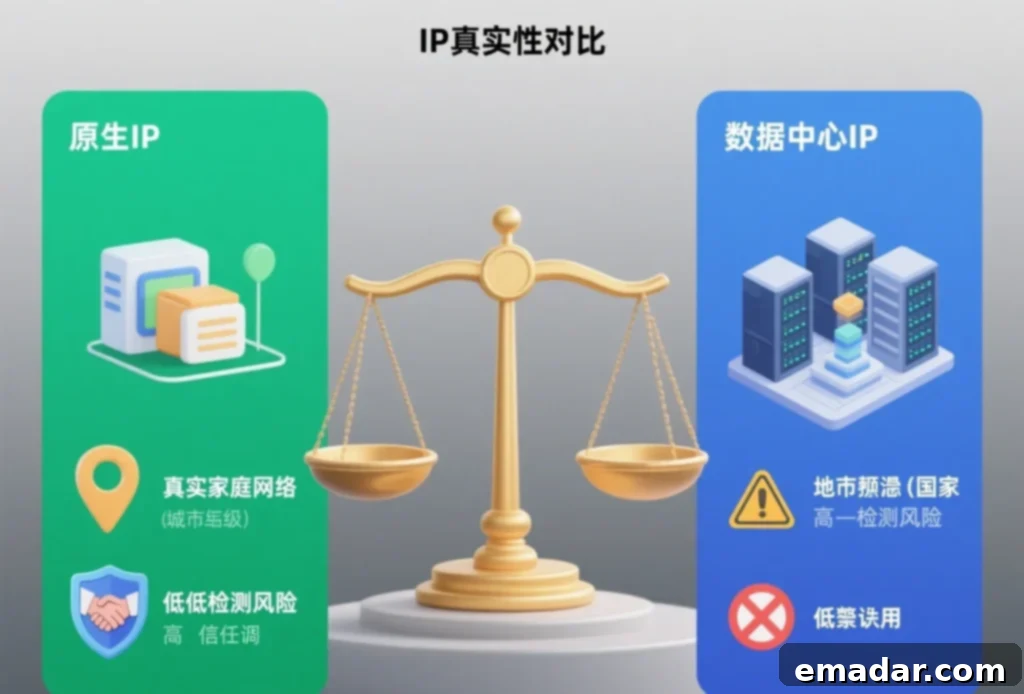
- Datacenter IPs originate from large-scale server farms and Internet Data Centers (IDCs). These IPs are often registered in bulk, possess virtually no usage history, and are frequently associated with automated, machine-driven behavior. Platforms can easily detect and flag them due to their characteristic IP ranges and lack of typical user patterns. Consequently, they are often the first to be subjected to stringent security checks, CAPTCHAs, or outright blocking.
- Residential IPs, while indeed originating from actual home broadband users, often come with significant caveats. Many are acquired through P2P (peer-to-peer) shared networks, which means their availability and stability can be highly inconsistent. They might be temporarily assigned, shared among multiple users, or frequently change, leading to a fragmented and unreliable usage history. While they offer a degree of authenticity beyond datacenter IPs, their inherent instability and potential for shared, questionable histories can still trigger platform flags.
- Native IPs stand apart as the pinnacle of authenticity. They are a powerful combination of “local user behavior” and a “long-term, trustworthy usage trajectory.” This makes them indistinguishable from a genuine internet user’s network characteristics, offering unparalleled credibility. They provide the most robust foundation for activities that demand high levels of trust and low detection risk, as they perfectly mimic the digital footprint of an ordinary internet subscriber.
In essence, a Native IP allows your online presence to be virtually indistinguishable from that of a real, local internet user, providing an authentic digital disguise.
II. IP Type Comparison: Structure, Origin, and Risk Profile at a Glance
Understanding the distinctions between various IP types is crucial for making informed decisions, especially for critical online operations. This table provides a clear comparison, highlighting the unique attributes, potential risks, and optimal applications for each IP category.
| IP Type | Source (IPFLY) | Detectability | Risk Level | Ideal Scenarios |
| Native IP | Original allocation from ISP, no relaying | Extremely low (hardest to detect as proxy) | Lowest | Account registration/verification, social media management, secure payments, high-value operations |
| Residential IP | P2P shared network, residential attributes but not fixed | Medium (may be flagged over time) | Medium | Data scraping, low-frequency operations, general browsing |
| Datacenter IP | Bulk-generated from server farms | Extremely high (easily identified) | High | High-concurrency web scraping, development/testing, tasks with minimal risk sensitivity |
To expand on this comparison, Native IPs are sourced directly from telecommunication companies, ensuring they have an authentic association with a real subscriber. This direct allocation means they avoid the pitfalls of shared network histories and are consistently stable, allowing them to accumulate a clean, credible usage record over time. Their low detectability stems from the fact that they don’t exhibit any of the common indicators of proxy use, such making them ideal for high-stakes activities where trust and stealth are paramount.
Residential IPs, while offering a geographic advantage over datacenter IPs, often suffer from the instability of their P2P origins. The dynamic nature of these IPs means that their history can be volatile, potentially carrying the digital “baggage” of previous users. This makes them moderately detectable and introduces a medium level of risk, suitable for less sensitive tasks where occasional flagging is tolerable but not ideal for long-term account integrity. While some providers offer ‘static’ residential IPs, these are often still sourced via complex sharing mechanisms, distinguishing them from truly ‘native’ allocations.
Datacenter IPs, due to their clear association with cloud providers and commercial servers, are the easiest to detect. They lack the nuanced behavioral patterns of human users and are frequently used for bot activity, making them a prime target for anti-fraud systems. Their high risk level makes them unsuitable for almost any activity requiring a human-like digital footprint, limiting their utility to bulk, low-value tasks where detection is expected and manageable.
III. Common Misconception: Native IP ≠ Immune to Bans
A prevalent misunderstanding is that deploying a Native IP grants automatic immunity from account suspension or flagging. This is a significant cognitive pitfall. While Native IPs dramatically reduce the “initial risk” of your operations being suspected as machine-driven or illicit, they are not a silver bullet against all platform scrutiny. Platforms today employ sophisticated, AI-driven risk control systems that analyze a multitude of behavioral signals beyond just the IP address. If your activities trigger these advanced detection mechanisms, even the most pristine Native IP cannot guarantee complete protection.
Consider the following scenarios, where even a Native IP would struggle to maintain an authentic facade:
- Frequent, Repetitive Actions Across Multiple Accounts: If you are managing dozens or hundreds of social media accounts performing identical tasks (e.g., liking, commenting, posting the same content) at an unnatural pace, regardless of IP type, this pattern will be flagged as bot-like behavior.
- Rapid Environmental Changes: Abruptly switching between different devices, operating systems, browser fingerprints, languages, or geographical locations within a short timeframe for the same account is a major red flag. Platforms track consistency in your digital environment to build a user profile.
- Use of Unauthorized Scripts or Aggressive Data Scraping: Employing automated scripts for illegal data collection, brute-force attacks, or actions that violate platform terms of service will inevitably lead to detection and bans. The IP merely provides the connection; the *behavior* dictates the outcome.
Platform security systems are designed to identify suspicious patterns, not just IP addresses. They analyze factors like user agent strings, browser history, cookie consistency, mouse movements, typing speed, and even the natural pauses between actions. A Native IP provides a clean ‘origin’ for your digital identity, but if the subsequent ‘journey’ exhibits non-human characteristics, it will still trigger alerts. Therefore, while Native IPs are a foundational element of any robust anti-detection strategy, they must be complemented by consistent, human-like behavior and careful account management.
Native IP offers a fundamental layer of identity camouflage, ensuring you appear “more human from the source,” but it does not grant a “waiver for policy violations.” It’s a critical component of a comprehensive anti-detection strategy, not a standalone solution for circumventing rules.
IV. Essential Applications of Native IP: Critical Business Scenarios
In certain online business operations, the use of Native IPs transitions from a mere advantage to an absolute necessity. These are scenarios where platforms impose stringent trust requirements and where the authenticity of your IP address directly impacts the success and longevity of your endeavors.
1. Cross-border Account Registration & Profile Verification
Platforms like TikTok, Facebook, Instagram, Shopify, Amazon, and PayPal are hyper-vigilant about the origin and reputation of IPs used for account creation and login. If an IP is identified as being from a data center, a known proxy network, or exhibiting suspicious characteristics, it can immediately trigger a range of security measures: demanding SMS verification codes, initiating multi-factor authentication, triggering automated fraud alerts, or outright account suspension. Native IPs are the optimal solution for establishing a high “initial trust score.” They signal to these platforms that the account is being accessed from a genuine residential location, significantly reducing the likelihood of immediate scrutiny and allowing for smoother onboarding and long-term account health. For example, trying to register a PayPal account from a location that doesn’t match the registered address and an IP identified as a data center will almost certainly lead to instant closure, whereas a Native IP from the correct region vastly increases success rates.
2. Large-scale Social Media Marketing Matrix Management
For businesses managing a substantial portfolio of social media accounts—be it dozens or hundreds—on platforms such as Facebook, Twitter, Reddit, or LinkedIn, IP management is paramount. If even a few of your accounts share a questionable IP, or if an IP has a history of being associated with spam or policy violations, the entire batch of accounts can be “marked” or linked, leading to a cascading effect of suspensions. Native IPs enable you to isolate the “risk path” for each account. By assigning a dedicated, unique Native IP to each social media profile or a small group of profiles, you create independent digital identities, preventing cross-contamination of risk. This strategy is vital for maintaining the health and longevity of your social media assets, allowing for effective, large-scale engagement without triggering mass platform crackdowns.
3. Overseas Payments and Financial Service Access
Any activity involving financial transactions, such as binding credit cards, registering e-wallets (e.g., Stripe, TransferWise), verifying email addresses for financial services, or accessing online banking in a foreign country, falls under intense fraud scrutiny. Financial institutions and payment gateways employ sophisticated anti-fraud algorithms that deeply analyze IP reputation, geographical location, and consistency with other user data. An IP mismatch or an IP flagged as non-residential can instantly halt transactions, freeze funds, or lead to account closure. Native IPs are indispensable here, helping to construct an identity profile that simulates a “normal user accessing local internet services.” This provides the critical authenticity needed to navigate the highly sensitive and risk-averse environments of global financial systems, ensuring smooth and secure transactions for international business operations.
V. How to Verify a Provider Offers Genuine Native IPs
The market is increasingly flooded with services claiming to provide “Native IPs,” when in reality, they are merely repackaging residential or even datacenter IPs under a more appealing label. For the average user, distinguishing genuine Native IPs from these imitations can be challenging. To protect your investment and ensure you’re getting what you pay for, consider these critical dimensions for verification:
- Source Chain Transparency: Demand clear evidence that the IPs originate directly from an ISP’s real residential or enterprise user base, without passing through P2P shared networks. Ask how they acquire their IPs. Genuine Native IPs are typically provisioned directly from telecommunication companies, ensuring a clean and direct link. If a provider is vague about their sourcing or hints at P2P aggregation, proceed with caution. The stability and integrity of P2P networks can be highly questionable, often leading to shared histories and unpredictable performance.
- IP Stability & Historical Behavior: True Native IPs should exhibit long-term consistency. This means they remain assigned to the same geographical location and typically have a clean, verifiable history of legitimate online activity. Inquire about the average uptime and how long their IPs have been in service. A provider should be able to attest to the lack of prior malicious activity associated with their IPs. Stable IPs that possess original geographical usage patterns are far less likely to be flagged by sophisticated anti-fraud systems.
- Account Ban Rate Verification & Case Studies: A reliable indicator of genuine Native IPs is their performance in real-world scenarios. Ask providers for testimonials or case studies from large clients, particularly concerning reduced verification triggers or lower ban rates on high-security platforms. While no IP guarantees 100% immunity, a significantly lower incidence of flags compared to other IP types is a strong testament to their authenticity. A reputable provider should be confident in demonstrating their product’s efficacy through client success stories or offering a trial period for you to test their claims.
- Supply Mechanism & Allocation Control: Determine if the provider possesses its own dedicated IP resource pool or if they are simply reselling IPs from third parties. Providers with proprietary IP infrastructure and direct partnerships with ISPs are better positioned to offer genuine Native IPs. Furthermore, inquire about their ability to provide granular allocation options, such as specific regions, cities, or even particular ISPs. This level of control is indicative of a robust and legitimate Native IP service, ensuring that you can precisely match your IP to your target audience for maximum authenticity.
On this crucial front, platforms like IPFLY distinguish themselves by possessing self-built IP resource pools and implementing multi-layered screening mechanisms. They are capable of delivering stable and exceptionally reliable Native IP resources. Their IPs are sourced directly from genuine home and enterprise networks, meticulously avoiding the intermediaries and potential pitfalls of P2P relay paths. This direct, unadulterated origin makes IPFLY’s Native IPs particularly well-suited for long-term business deployments on platforms with stringent risk control systems, offering an unmatched level of trust and operational security.
Conclusion: Native IP – The Cross-border Entrepreneur’s Invisible Asset
While often overshadowed by more visible assets like servers, accounts, or automation scripts, Native IP is a fundamental, yet often unseen, infrastructure that critically determines the longevity and success of your online operations. Its ability to mimic a genuine user’s digital footprint makes it an invaluable layer of protection against platform scrutiny and fraud detection systems. The capacity to recognize, acquire, and strategically deploy Native IPs can profoundly impact your success in the competitive arenas of cross-border e-commerce, social media marketing, and online business.
Native IP is not just an address; it’s a digital identity. It’s the invisible shield that protects your hard-earned accounts and allows your business to scale authentically. In a world where digital trust is increasingly scarce, investing in genuine Native IPs is investing in the long-term viability and credibility of your ventures. It minimizes the risk of costly account suspensions, ensures smooth access to critical platforms, and enables you to focus on growth rather than constant troubleshooting.
IPFLY stands as a dedicated professional proxy service provider focused on the cross-border industry, offering comprehensive solutions tailored to your needs:
- ✔ Global coverage extending across 190+ countries and regions, ensuring you can target any market effectively.
- ✔ Supports a diverse range of proxy types: static/dynamic residential proxies, premium Native IPs, and robust datacenter proxies, providing flexibility for all operational requirements.
- ✔ Delivers exclusive, pristine IPs, guaranteeing that each account operates with its own clean, dedicated IP, free from shared histories.
- ✔ Ensures zero-log policy and high anonymity, safeguarding your privacy and maintaining an undetectable online presence. Seamlessly integrates with leading fingerprint browsers for enhanced anti-detection capabilities.
- ✔ Offers full API integration support, enabling effortless batch configuration and streamlined management for large-scale operations.
Leverage the power of authentic digital identities. Secure your online presence and unlock unparalleled opportunities in the global marketplace.
👉 Claim your special offer and acquire premium IPs today!