
In the expansive and increasingly complex digital landscape of 2025, businesses face unprecedented challenges in maintaining security, ensuring operational efficiency, and conducting critical online activities such as data collection and market research. While traditional proxy solutions like static and rotating residential proxies are widely known, a more sophisticated and robust tool has emerged as indispensable for enterprises and developers: reverse rotating proxies. These specialized solutions represent a significant leap forward in proxy technology, meticulously engineered to offer unparalleled reliability, flexibility, and scalability for demanding corporate environments.
At their core, reverse rotating proxies ingeniously merge the well-established reverse proxy architecture with dynamic, constantly refreshed rotating IP pools. This powerful combination allows organizations to effectively conceal their vital backend infrastructure, shielding it from direct exposure and potential threats, while simultaneously distributing outgoing requests across a vast array of dynamically changing IP addresses. This dual functionality is pivotal, empowering companies to strike a delicate balance between robust security, blistering speed, and absolute anonymity, all while skillfully circumventing common digital obstacles like IP blocks, rate limits, and sophisticated bot detection systems.
This comprehensive guide will thoroughly demystify reverse rotating proxies. We will delve into their intricate operational mechanisms, uncover their multifaceted benefits for modern businesses, explore their most impactful real-world applications across various industries, and provide a practical, step-by-step framework for their effective setup and optimization in the current digital era. Understanding and deploying this technology can be a game-changer for any enterprise looking to fortify its online presence and expand its digital capabilities.
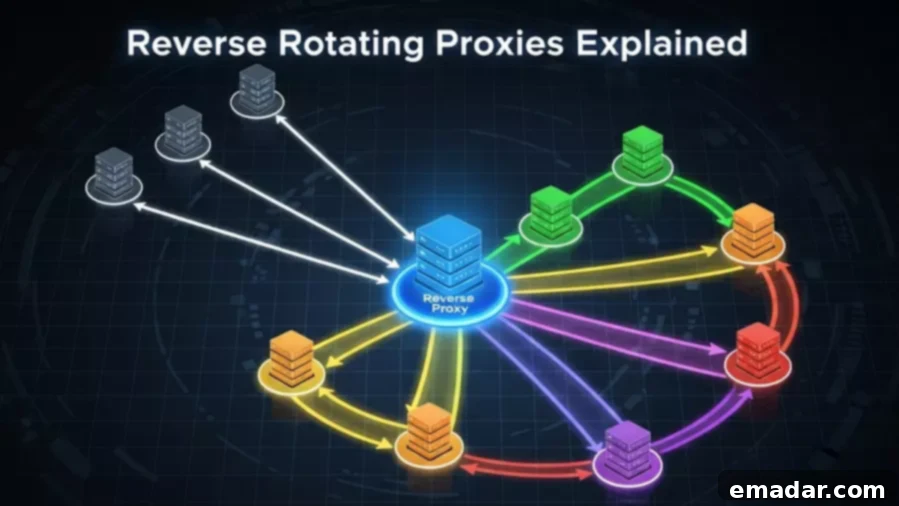
How Reverse Rotating Proxies Function: A Detailed Overview
To truly grasp the sophisticated nature of reverse rotating proxies, it’s essential to first understand the foundational concept of a reverse proxy. Unlike a forward proxy, which operates on the client side to obscure user activity, a reverse proxy acts as an intermediary server positioned strategically in front of one or more origin servers. When a user or client sends a request, it first hits the reverse proxy, which then intelligently routes that request internally to the appropriate backend server. This architecture fundamentally isolates the origin servers from direct public access, adding a crucial layer of security and control.
The innovation that transforms a standard reverse proxy into a “reverse rotating” proxy is the integration of a dynamic rotating mechanism. This advanced feature ensures that each subsequent request processed by the reverse proxy can be dispatched through a distinct IP address, drawn from an extensive and diverse pool of available IPs. This meticulous process delivers several critical advantages:
- Diversified Request Origin: Each outgoing request appears to originate from a different geographical location or network, making it incredibly difficult for target websites to identify and block the source. This is crucial for tasks requiring high volumes of requests, such as web scraping or ad verification.
- Enhanced Backend Protection: The origin servers remain completely insulated from direct exposure to the internet. This protective shield significantly reduces the attack surface, making it exponentially harder for malicious actors to launch direct attacks like DDoS, SQL injections, or other server-specific vulnerabilities.
- Optimized Load Distribution: Beyond simply rotating IPs, the reverse proxy can intelligently balance the incoming load across multiple backend servers. This prevents any single server from becoming a bottleneck, ensuring consistent performance and high availability, even during peak traffic periods.
In essence, reverse rotating proxies operate as both a vigilant gatekeeper, safeguarding critical infrastructure, and a sophisticated disguise artist, cloaking the identity of the organization’s online operations. They are the frontline defense and the anonymity engine for businesses engaged in large-scale and sensitive online activities.
Core Advantages of Implementing Reverse Rotating Proxies
The strategic deployment of reverse rotating proxies yields a multitude of benefits, making them an invaluable asset for any enterprise navigating the complexities of the digital world.
- Unparalleled Infrastructure Security
- Profound Anonymity and Data Privacy
- Superior Load Balancing Capabilities
- Significantly Higher Success Rates in Web Operations
- Streamlined Centralized Management
- Enhanced Geographical Targeting and Testing
One of the paramount reasons businesses integrate reverse rotating proxies is for superior infrastructure protection. By design, all incoming requests are first filtered through the reverse proxy, never directly reaching your origin servers. This fundamental separation means that even if a malicious actor attempts to probe your network, they will only encounter the proxy layer. Combined with the dynamic IP rotation, this architecture forms a formidable security barrier, drastically mitigating risks from various threats including Distributed Denial of Service (DDDoS) attacks, brute-force attempts, and IP-based blocking. The constant change of IPs makes persistent tracking and targeting of your infrastructure nearly impossible, providing a robust defense against sophisticated cyber threats.
For organizations involved in highly sensitive operations such as extensive data collection, rigorous ad verification, or in-depth market research, maintaining absolute anonymity and privacy is not just a preference but a critical necessity. Reverse rotating proxies excel in this domain. The continuous cycling of IP addresses ensures that your digital footprint is fragmented and untraceable, effectively preventing long-term tracking and profiling by target websites. Furthermore, the inherent reverse proxy structure guarantees that the actual IP addresses of your backend servers and internal systems are never disclosed, upholding the highest standards of operational secrecy and safeguarding proprietary information. This also aids in compliance with stringent data privacy regulations like GDPR and CCPA.
Beyond security and anonymity, reverse rotating proxies are exceptionally effective at enhancing system performance through intelligent load balancing. They are engineered to efficiently distribute incoming requests across not only multiple outgoing IP addresses but also multiple backend servers. This strategic distribution prevents any single server from becoming overwhelmed during traffic surges or under sustained high load, thereby eliminating potential bottlenecks and ensuring consistent, high-speed access to your services. This capability is vital for organizations that experience unpredictable traffic spikes or need to manage thousands of concurrent connections without compromising service quality.
Whether your business is involved in meticulously scraping vast e-commerce sites for competitive pricing, diligently checking SEO rankings across different search engines, or proactively monitoring competitor advertisements, the omnipresent threat of IP bans is a constant challenge. However, with the sophisticated mechanism of rotating IP pools, each subsequent request made through the reverse proxy appears to originate from a fresh, unique IP address. This dynamic change dramatically reduces the likelihood of detection and subsequent blocking, leading to a substantially higher success rate in data acquisition and other automated web tasks compared to relying on static or fewer rotating proxies.
Managing a complex web infrastructure with numerous endpoints and varying proxy configurations can be a monumental task, often leading to errors and inefficiencies. Reverse rotating proxies offer a powerful solution by providing a centralized management interface. This single control point allows administrators to effortlessly configure and oversee all aspects of IP rotation, request filtering, and routing rules. This consolidated approach not only saves valuable time and resources but also significantly reduces the potential for human error in complex and dynamic operational workflows, leading to more stable and predictable outcomes.
For businesses with a global presence, understanding user experience and market dynamics across different regions is paramount. Reverse rotating proxies enable precise geographical targeting, allowing organizations to simulate user behavior or test content delivery from specific locations around the world. By routing traffic through IP pools localized to particular countries or cities, companies can accurately gauge local content performance, verify geo-targeted ad campaigns, and conduct market research with genuine regional insights, all while maintaining their backend’s anonymity and security. This capability is invaluable for A/B testing localized content, verifying regional ad placements, and ensuring a consistent user experience globally.
Practical Applications: Real-World Use Cases of Reverse Rotating Proxies
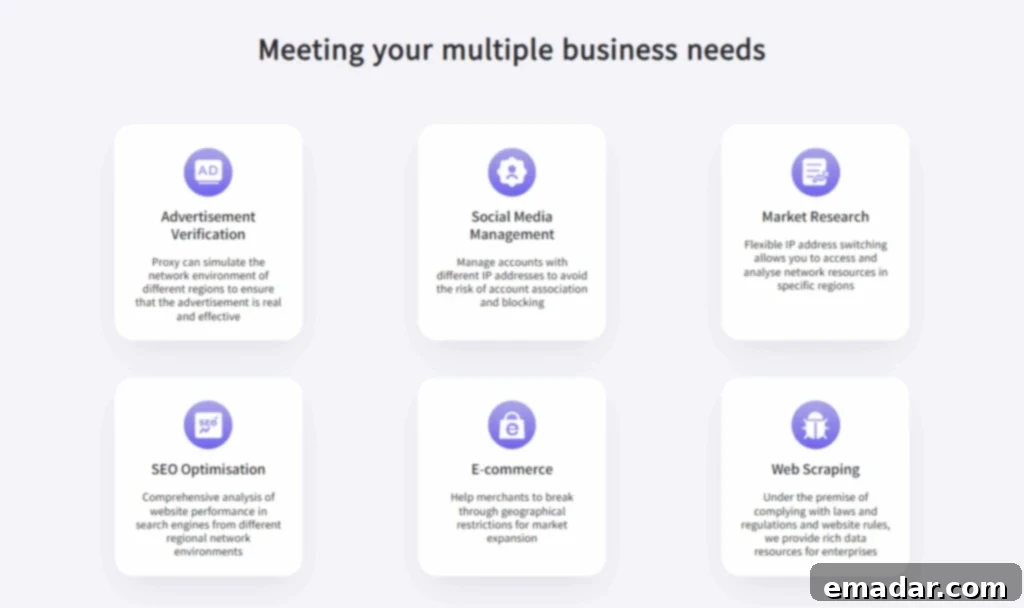
High-Volume Web Scraping and Data Collection
Companies that rely heavily on large-scale web scraping—such as those aggregating pricing data from competitors, monitoring product availability across e-commerce platforms, or collecting vast amounts of public sentiment data—find reverse rotating proxies indispensable. These proxies effortlessly bypass sophisticated anti-bot detection systems, CAPTCHAs, and rate limits that would otherwise halt data collection. Simultaneously, they protect the underlying scraping infrastructure from being identified and banned, ensuring continuous, uninterrupted data flow for critical business intelligence.
Precise Ad Verification and Brand Safety
In the highly competitive and often fraudulent digital advertising ecosystem, advertisers utilize reverse rotating proxies to meticulously verify that their ads are appearing correctly, in the intended geographical regions, and on appropriate websites. The constant rotation of IPs ensures that verification requests appear organic and legitimate, preventing ad fraud detection systems from flagging them. This ensures accurate campaign performance monitoring, detects malicious ad placements (ad injection), and safeguards brand reputation by ensuring ads are not displayed alongside inappropriate content.
Global Content Delivery and User Experience Testing
Enterprises that deliver digital content globally, or those with geo-specific applications, frequently need to test accessibility and performance from various geolocations. Reverse rotating proxies are ideal for this. They facilitate serving traffic through diverse global IP pools, enabling accurate testing of localized content, A/B testing different regional layouts, and ensuring consistent user experiences worldwide. Critically, this is achieved while keeping the actual origin servers completely shielded from direct public internet access, enhancing security and maintaining operational integrity.
Advanced Cybersecurity and Proactive Fraud Prevention
In the realm of cybersecurity, fraud detection systems often leverage diversified IP monitoring to identify suspicious activities. Businesses can strategically deploy reverse rotating proxies to simulate external threats, track malicious activities, and monitor for security vulnerabilities from numerous external vantage points. This allows for proactive threat intelligence gathering and the identification of potential attack vectors, all without compromising or exposing their internal security infrastructure or corporate IP addresses. It’s a crucial tool for ethical hacking and vulnerability assessments.
Efficient Social Media Management and Automation
For marketing agencies and brands managing a multitude of social media accounts across popular platforms like Instagram, TikTok, X (formerly Twitter), or Facebook, automation is key. However, these platforms have stringent anti-spam and anti-bot policies that can lead to account suspensions. Routing requests through reverse rotating proxies with diverse IP addresses makes automated social media tasks appear more organic. This prevents account locks and shadow-banning, enabling smoother, more effective social media marketing campaigns and competitive analysis without detection.
Comprehensive Market Research and Competitive Intelligence
Gaining an edge in today’s market often means staying ahead of competitors. Reverse rotating proxies are instrumental for conducting thorough market research and competitive intelligence. Businesses can discreetly gather insights on competitor pricing strategies, product launches, customer reviews, and market trends. By anonymizing their requests and appearing as diverse users from different locations, companies can collect critical data without revealing their identity, ensuring unbiased information and preventing competitors from detecting their research activities.
Implementing Reverse Rotating Proxies: A Practical Setup Guide
Deploying reverse rotating proxies requires a strategic approach to maximize their benefits and ensure seamless integration with existing operations.
Step 1: Selecting the Optimal Provider
The foundation of a successful reverse rotating proxy setup lies in choosing the right service provider. It’s important to note that not all proxy services offer the specialized capabilities of reverse rotating setups. Leading providers, such as IPFLY, offer access to extensive global IP networks, often exceeding 90 million IPs worldwide. When selecting, consider the following:
- IP Pool Size and Diversity: A larger pool reduces the chance of encountering previously flagged IPs. Look for a mix of residential (real user IPs), ISP (static residential IPs), and datacenter IPs, each suitable for different use cases.
- Geographical Coverage: Ensure the provider offers IPs in the regions relevant to your operations for accurate geo-targeting and data collection.
- Customizable Rotation Rules: The ability to define how often IPs rotate (time, request, or custom logic) is crucial for adaptability.
- Backend Shielding Capabilities: Verify that the provider’s architecture inherently offers robust protection for your origin servers.
- Uptime and Reliability: A reliable proxy network is paramount for continuous operations.
- Pricing Model: Understand if pricing is based on bandwidth, number of ports, or requests to align with your budget and usage patterns.
- Customer Support: Responsive and knowledgeable support is essential for complex proxy deployments.
Step 2: Configuring Dynamic Rotation Rules
Once a provider is chosen, the next critical step is to configure the rotation logic that dictates how IP addresses change. Advanced providers offer granular control over these rules:
- Time-Based Intervals: IPs can be rotated automatically after a specific duration, for example, every 10 seconds, 30 seconds, or 1 minute. This ensures a consistent refresh rate.
- Request-Based Triggers: IPs can be changed after a predetermined number of requests have been sent through the current IP (e.g., rotate after every 5th request). This is ideal for tasks where immediate IP change is less critical.
- Custom Logic and Event-Based Triggers: For highly specialized tasks, rotation can be triggered based on specific events, such as a website returning a particular HTTP response code (e.g., 403 Forbidden or 429 Too Many Requests), or through API calls. This offers the highest level of flexibility and responsiveness to anti-bot measures.
Step 3: Deploying the Reverse Proxy Layer
This stage involves setting up the actual reverse proxy infrastructure that acts as the initial gateway for all incoming requests. All user or bot traffic will first pass through this layer. The reverse proxy then intelligently processes these requests and assigns an appropriate, rotating IP before forwarding them to your backend servers. Businesses can integrate additional features at this layer:
- Load Balancers: To distribute traffic efficiently across multiple backend servers.
- Caching Mechanisms: To store frequently accessed data closer to the user, reducing server load and improving response times.
- SSL/TLS Termination: To offload encryption/decryption tasks from your backend servers, enhancing security and performance.
Technologies commonly used for this layer include Nginx, HAProxy, or cloud-native load balancing services offered by major cloud providers.
Step 4: Continuous Monitoring and Optimization
Deployment is not the final step; continuous monitoring is crucial for long-term performance and success. Businesses should leverage analytics and monitoring tools to track key metrics:
- Success Rates: Monitor the percentage of requests that successfully complete without being blocked or encountering errors.
- Latency: Track the response times to identify any performance bottlenecks introduced by the proxy layer.
- Blocked Requests: Analyze patterns of blocked requests to understand anti-bot measures and adjust proxy strategies accordingly.
- IP Pool Health: Monitor the quality and reputation of the IP addresses being used.
Based on these insights, adjustments to rotation frequency, IP types, and specific proxy configurations can be made to ensure optimal performance and achieve the highest possible success rates.
Challenges and Important Considerations
While reverse rotating proxies offer significant advantages, it’s also important to be aware of potential challenges and considerations during their implementation and ongoing management.
Potential Latency Issues
Routing requests through multiple layers, including a reverse proxy and then a rotating IP network, inherently adds extra network hops. This can, in some scenarios, introduce a slight delay or increased latency compared to direct connections. To mitigate this, it is crucial to choose high-speed proxy providers with robust infrastructure and strategically located servers that are geographically close to your target websites or users. Optimized network routing and efficient server architectures play a key role in minimizing latency.
Cost Implications of Large IP Pools
Maintaining access to vast, diverse, and high-quality rotating IP pools, especially those with millions of residential or ISP IPs across global locations, can be a significant investment. This cost can escalate, particularly for businesses operating at a global scale or requiring extremely high volumes of requests. It’s important to conduct a thorough cost-benefit analysis, exploring different pricing models (e.g., bandwidth-based, port-based, or request-based) and optimizing usage to ensure efficient expenditure without compromising performance.
Complexity of Configuration and Management
Reverse rotating proxies are considerably more complex to configure and manage than simpler forward or static proxies. Their multi-layered architecture, dynamic IP rotation logic, and integration points require a higher level of technical expertise. Businesses may need dedicated IT personnel with networking and proxy management skills, or they might opt for fully managed proxy services from a reputable provider. Misconfiguration can lead to operational inefficiencies, security vulnerabilities, or even service disruptions.
Ensuring IP Quality and Reputation
Not all IP addresses within a large pool are created equal. Some IPs might have a poor reputation due to past misuse, leading to immediate blocking or CAPTCHAs. Ensuring the quality and cleanliness of the IP pool is a continuous challenge. Providers must actively manage and filter their IPs to remove compromised or flagged addresses. Businesses should look for providers that offer advanced filtering systems and boast high success rates, indicating effective IP reputation management.
Why Leading Enterprises Choose IPFLY for Reverse Rotating Proxies

At IPFLY, we have witnessed firsthand how leading enterprises across a diverse array of industries are increasingly adopting reverse rotating proxies as a cornerstone of their digital strategy. They are drawn to these solutions for their unparalleled scalability, inherent flexibility, and the robust operational advantages they provide. With an extensive infrastructure boasting comprehensive coverage in over 190+ countries worldwide, IPFLY ensures that our clients benefit from:
- Expansive IP Network: Access to a colossal network of over 90 million+ high-quality IPs, encompassing residential, ISP, and datacenter proxy types. This massive and diverse pool guarantees an IP for every need, minimizing detection and maximizing success rates across any target.
- Fortified Backend Shielding: Our core architecture incorporates robust reverse proxy capabilities, delivering impregnable security for your critical backend servers and infrastructure. This protection ensures your origin servers remain anonymous and secure from direct external threats.
- Advanced Customizable Rotation Logic: IPFLY provides highly customizable rotation rules, allowing enterprises to fine-tune proxy behavior to perfectly match the demands of their most complex and sensitive workflows. Whether it’s time-based, request-based, or event-driven rotation, our system offers the flexibility required for precision operations.
- High Performance and Reliability: Leveraging self-built servers and an intelligently managed network, IPFLY delivers consistently high performance and unwavering reliability, ensuring that your operations proceed smoothly and efficiently.
- Intelligent Filtering Systems: Our sophisticated filtering mechanisms continuously monitor and cleanse the IP pool, ensuring that only high-quality, unflagged IPs are routed to your requests, thus maintaining exceptional success rates.
This comprehensive suite of features positions IPFLY as a trusted and indispensable partner for companies engaged in mission-critical digital activities such as large-scale web scraping, precise ad verification, intricate social media management, and proactive cybersecurity monitoring. By choosing IPFLY, clients gain not only access to a superior proxy network but also a strategic advantage in maintaining high success rates with minimal operational risk and maximum efficiency.
Conclusion: The Imperative for Reverse Rotating Proxies in 2025 and Beyond
Far from being a mere niche tool, reverse rotating proxies have firmly established themselves as a foundational, business-grade solution for enterprises navigating the challenges of modern digital operations. They are the quintessential answer for organizations grappling with the critical demands of security, scalability, data collection, and anonymity at a global scale. These advanced proxy solutions brilliantly synthesize the inherent anonymity and resilience of rotating proxies with the robust protection and architectural advantages of reverse proxy structures, rendering them perfectly suited for the dynamic and often adversarial digital landscape of today and tomorrow.
In an era where digital footprints are constantly scrutinized, and online operations face perpetual threats from sophisticated bot networks, IP bans, and targeted attacks, the ability to operate with both discretion and unwavering efficiency is paramount. By judiciously selecting a high-quality provider, meticulously configuring dynamic rotation rules, and continuously optimizing performance, companies can unlock the full spectrum of benefits offered by reverse rotating proxies. This strategic adoption will not only fortify their digital infrastructure but also empower them to execute ambitious data-driven strategies with unprecedented success, truly thriving in 2025 and all the years that follow.
Stay connected with IPFLY’s team and community on Telegram for the latest updates and insights.