
Understanding the Essence and Core Value of Residential Proxy IPs
In today’s interconnected digital landscape, the ability to operate online with authenticity and anonymity is paramount for businesses. Residential Proxy IPs are at the forefront of this need, representing real IP addresses generated through genuine home network devices. These proxies meticulously simulate the browsing behavior of an ordinary internet user, offering a stark contrast to their datacenter counterparts. This inherent authenticity bestows upon them three fundamental advantages that are crucial for modern business operations:
Unmatched Credibility
Residential proxies are directly assigned by local Internet Service Providers (ISPs), meaning they are perceived by target websites as genuine user access points. This high level of authenticity significantly reduces the likelihood of detection, blocking, or flagging by sophisticated anti-bot systems. Unlike datacenter IPs, which are often grouped and easily identified as non-human traffic, residential IPs seamlessly blend in with regular internet users, making them invaluable for tasks requiring a high degree of trust.
Dynamic Anonymity and Seamless Disguise
A key feature of advanced residential proxy networks is their support for on-demand IP address rotation. This dynamic capability allows users to instantly switch between different IPs, effectively circumventing stringent anti-scraping mechanisms, geographical restrictions, and IP bans. Whether you need to make frequent requests from various locations or maintain a fresh online identity for each interaction, dynamic residential IPs provide the flexibility required to stay undetected and access desired content without interruption. This continuous disguise is essential for large-scale operations.
Versatile Business Adaptability
Modern businesses demand flexibility, and residential proxies deliver with both static and dynamic modes to cater to diverse operational requirements. Static residential IPs offer long-term identity stability, making them ideal for managing persistent online accounts, such as social media profiles or e-commerce seller accounts, where consistent IP addresses are preferred to avoid suspicion. Conversely, dynamic residential IPs enable high-frequency anonymous access, perfect for tasks like web scraping, market research, or ad verification, where rapidly changing IP addresses are crucial for bypassing detection and collecting vast amounts of data efficiently.

Six Essential Selection Criteria for Enterprise-Grade Residential Proxy IPs
Choosing the right residential proxy provider is a critical decision that can significantly impact a business’s online operations and overall success. With a multitude of options available, enterprises must diligently evaluate providers based on several key dimensions to ensure they invest in a high-quality, reliable, and compliant solution. Here are six crucial standards to consider:
① Resource Authenticity and Sourcing
The foundation of a reliable residential proxy network lies in the authenticity of its IP resources. It is paramount to ensure that the provider directly sources IPs from ISPs, rather than relying on resold or questionable third-party sources. Directly acquired IPs guarantee higher legitimacy and reduce the risk of being flagged or blacklisted. For instance, reputable providers like IPFLY often build their entire server infrastructure in-house, ensuring direct control and authenticity over their vast IP pool, offering peace of mind to their clients.
② Level of Anonymity and Stealth
A truly effective residential proxy should offer a complete anonymity layer, ensuring that no identifying information about the original client device leaks to the target website. This includes meticulously reconstructing all request header information to mimic a local device’s characteristics. Advanced solutions, such as those offered by IPFLY, support full-protocol anonymous access, meaning every aspect of the connection is carefully managed to prevent any trace of proxy usage, making it virtually impossible for target sites to distinguish between a proxy and a genuine user.
③ Dynamic IP Update and Alert Mechanisms
For dynamic residential proxies, the frequency of IP pool refreshes and the efficiency of the invalidation alert system are vital. A rapidly refreshing pool ensures a continuous supply of clean, unused IPs, while an effective alert system quickly removes any compromised or non-functional IPs. Providers like IPFLY boast millisecond-level response times for IP switching, ensuring that businesses can maintain high operational efficiency without being hindered by stale or detected IPs. This constant refreshment is crucial for tasks requiring high volumes of unique access.
④ Compliance and Security Assurances
Data privacy and legal compliance are non-negotiable in the current regulatory environment. A top-tier residential proxy provider must guarantee that all IP usage records are thoroughly isolated, preventing any potential links back to individual users or activities. IPFLY, for example, offers dedicated, private resource pools for its clients, ensuring that their IP usage remains completely confidential and separate from other users. This commitment to data isolation is essential for businesses operating under strict data protection regulations such as GDPR or CCPA.
⑤ Robust Technical Support and Stability
The technical underpinning of a proxy service directly impacts its performance and reliability. Businesses need assurances of connection stability and a high success rate for their requests. Look for providers that offer robust technical support and a strong Service Level Agreement (SLA), such as IPFLY’s guarantee of 99.9% uptime. This level of technical support and infrastructure ensures that operations run smoothly, minimizing downtime and maximizing productivity, particularly for mission-critical tasks.
⑥ Advanced Anti-Detection Capabilities
The digital arms race between anti-bot systems and proxy providers is continuous. Therefore, the speed at which a provider updates its anti-detection algorithms is paramount. Leading providers employ sophisticated techniques to counter evolving detection methods. IPFLY, for instance, utilizes dynamic disguise fingerprinting technology, which constantly adapts to simulate unique device characteristics, making it significantly harder for target websites to identify and block automated traffic. This proactive approach ensures long-term operational effectiveness against increasingly complex security measures.
Five Transformative Application Scenarios for Businesses
Residential proxy IPs are not just technical tools; they are strategic assets that can profoundly reshape and enhance various business operations. Their ability to simulate genuine user behavior from diverse geographical locations unlocks new possibilities for market analysis, digital marketing, and secure online interactions. Here are five practical scenarios where residential proxies can provide a significant competitive edge:
Scenario One: Building an Intelligent Marketing Matrix
For businesses seeking to establish a robust and effective global marketing presence, residential proxies are indispensable. By leveraging static residential IPs, companies can create and manage multi-regional account systems across various platforms like TikTok, Google, and Facebook. These stable IPs ensure that accounts appear legitimate and rooted in specific geographic locations. Dynamic IPs can then be deployed for A/B testing ad effectiveness, allowing for precise ad targeting and optimization based on regional performance. A prominent cross-border e-commerce client, after integrating IPFLY’s solutions, reported an impressive 83% reduction in ad rejection rates, demonstrating the profound impact on marketing campaign success and reach.
Scenario Two: Establishing a Comprehensive Data Harvesting Network
Gaining a competitive advantage often relies on timely and accurate market intelligence. Dynamic residential proxies empower businesses to overcome geographical restrictions and IP blocking, enabling comprehensive data harvesting from competitor websites and market platforms. IPFLY clients have successfully deployed these proxies to achieve stable collection rates exceeding 200 requests per second on major e-commerce platforms like Amazon and Shopify, all while maintaining a remarkably low blocking rate of less than 0.2%. This capability ensures that businesses can acquire crucial pricing data, product trends, and consumer insights without interruption, fueling informed strategic decisions.
Scenario Three: Globalized Account Operations and Management
For businesses managing a multitude of online accounts, particularly in social media or e-commerce, maintaining stability and avoiding bans is a constant challenge. Utilizing static residential IPs allows for the creation of stable social media account matrices, ensuring consistent access and interaction from specific, trusted locations. In a notable instance, IPFLY provided UK residential IPs that enabled an MCN (Multi-Channel Network) agency to operate its TikTok accounts for over 17 months with zero bans, highlighting the critical role of dedicated, clean residential IPs in fostering long-term account health and operational continuity across global platforms.
Scenario Four: Compliant Access for Financial Services
In the highly regulated financial sector, access to precise, real-time market data from specific geographical regions is crucial. Residential IPs facilitate compliant access to financial markets, allowing quantitative trading firms and analysts to gather essential information without triggering security alerts. A quantitative institution, for example, utilized IPFLY’s static US residential IPs to achieve millisecond synchronization with Nasdaq market data. This high-speed, geo-specific access ensures that financial professionals have the most current and accurate data for algorithmic trading, risk assessment, and market analysis, adhering strictly to compliance standards.
Scenario Five: Secure Testing and Sandbox Environments
Developers and QA teams often require environments that accurately mimic real-world user traffic from diverse locations for testing purposes. Dynamic residential IPs provide the perfect solution for creating secure testing sandbox environments. They allow developers to simulate global user access paths, conducting stress tests, performance evaluations, and penetration tests under realistic conditions. IPFLY’s infrastructure, for instance, supports initiating over 3000 simultaneous, independent IP requests, enabling thorough load testing and ensuring that applications can handle high traffic volumes and diverse geographical user bases effectively before deployment.
A Comprehensive Procurement Guide for Residential Proxy IPs
Selecting the ideal residential proxy solution involves more than just looking at the price tag; it requires a deep dive into the provider’s capabilities and features. To ensure your investment yields maximum return and delivers on its promises, consider the following critical aspects that define a superior residential proxy service:
Resource Scale: A robust residential proxy network is characterized by its sheer volume of available IPs. Look for providers boasting massive dynamic IP pools, ideally in the tens of millions, complemented by millions of static residential IPs. This extensive inventory, often representing the largest legitimate residential networks on the market, ensures unparalleled diversity and reduces the chances of IP exhaustion or detection, providing a reliable foundation for any large-scale operation.
Intelligent Routing: Precision in IP targeting is paramount for many business tasks. An advanced proxy service should offer intelligent routing based on Location-Based Services (LBS), enabling accurate IP positioning with an error margin of less than 1 kilometer. This granular geographical control is essential for highly localized tasks such as geo-targeted ad verification, local SEO monitoring, and accessing region-specific content, ensuring that your requests always originate from the intended location.
Security Architecture: Data security and privacy are non-negotiable. A top-tier residential proxy solution must incorporate a military-grade security architecture, including robust encryption protocols like TLS 1.3 and advanced traffic obfuscation techniques. Furthermore, compliance certifications such as SOC2 demonstrate a provider’s commitment to stringent security controls and data protection, offering businesses peace of mind that their operations are safeguarded against potential threats and regulatory scrutiny.
Cost Control: Efficient resource utilization directly translates to cost savings. Dynamic IPs offered on a usage-based billing model, rather than fixed subscriptions, can lead to significant cost reductions, often saving businesses up to 67% compared to traditional pricing structures. This flexible approach ensures that you only pay for the bandwidth and IPs you actually consume, optimizing your operational budget and making large-scale tasks more economically viable.
Response Speed: For time-sensitive operations, latency is a critical factor. A high-performance residential proxy network should boast API access latency of less than 35ms, ensuring near real-time data retrieval and interaction. Coupled with the ability to support tens of millions of concurrent requests, such speed and capacity are crucial for applications requiring rapid data processing, high-frequency trading, and massive-scale web scraping, providing an immediate competitive advantage.
The Three Key Evolutionary Directions of Residential Proxy IPs
The residential proxy landscape is continuously evolving, driven by technological advancements, increasing demand for privacy, and the growing complexity of anti-bot systems. Staying ahead means understanding these future trends that are shaping the next generation of proxy solutions. Here are three significant evolutionary directions:
① Privacy Compliance-Driven Technological Iteration
With the global proliferation of data protection regulations like GDPR and CCPA, the focus of residential proxy technology is shifting from simple IP replacement to comprehensive, full-chain privacy protection. This involves more than just hiding an IP; it’s about creating a truly anonymous digital footprint. For example, leading providers like IPFLY are developing sophisticated device fingerprint dynamic simulation systems. These systems can simultaneously alter over 20 parameters, including browser Canvas fingerprints and WebRTC addresses, ensuring that each request possesses a completely unique “digital identity.” This advanced level of anonymization meets the stringent compliance requirements of even financial-grade operations, making it harder for advanced detection systems to link activities back to a single source.
② AI-Powered Intelligent Scheduling Networks
Artificial intelligence is set to revolutionize proxy management. A 2024 industry report indicates that 67% of top-tier enterprises are beginning to adopt AI-powered dynamic routing algorithms. AI-driven neural network models can analyze target website anti-scraping rules in real-time—such as Cloudflare fingerprint detection—and automatically pair the optimal IP type for each request. For instance, when encountering Amazon’s bot verification challenges, such a system might prioritize deploying clean static IPs that have had no access records within the past six months, thereby reducing blockage rates by as much as 91%. This intelligent, adaptive scheduling ensures maximum success rates and efficiency, especially against sophisticated detection systems.
③ Fusion of Edge Computing and Distributed Nodes
The explosion of 5G and IoT devices is creating new and diverse sources for residential IPs. This trend is leading to the integration of edge computing with distributed proxy nodes, forming decentralized networks. IPFLY, for example, is already collaborating with European telecom operators on home gateway sharing initiatives. This involves utilizing the idle bandwidth of authorized smart routers in users’ homes to construct a decentralized proxy network. Real-world tests on an e-commerce platform in the Netherlands showed that using these innovative IPs resulted in access speeds three times faster than traditional proxy solutions, demonstrating the potential for enhanced performance, lower latency, and a broader geographical spread for proxy networks.
Practical Residential Proxy IP Solutions: Real-World Case Studies
To truly understand the power and versatility of residential proxies, it’s insightful to examine real-world applications where they have provided tangible business benefits. These case studies illustrate how strategic deployment of residential IPs can overcome significant operational hurdles and unlock new opportunities.
Case Study 1: TikTok Live Stream Cold Start Traffic Boost
**Problem:** New TikTok accounts often trigger risk control limitations within the first 5 minutes of going live, severely restricting their initial organic reach and audience engagement. This “cold start” phenomenon is a major barrier for new content creators and marketers.
**Solution:**
- **Geo-Locking with Static IPs:** The client used IPFLY’s UK static residential IPs to bind their streaming device, fixing the perceived geographical location of the live broadcast. This created a consistent, trusted identity for the account.
- **IP Reputation Vetting:** Before streaming, the historical 30-day activity of the chosen IP was queried via an IP reputation API, with a requirement for over 95% activity to ensure a ‘warm’ and legitimate IP.
- **Simulated Human Behavior:** For 72 hours prior to going live, the accounts mimicked genuine user behavior: logging in 3 times daily and browsing similar live streams for 30 minutes each session to build credibility.
**Effect:** Following these steps, 10 test accounts saw their organic traffic recommendations on TikTok dramatically increase from 12% to 67%, significantly boosting their initial reach and engagement without immediate throttling.
Case Study 2: Cross-border Payment Rate Data Scraping
**Problem:** PayPal’s merchant interface imposes a strict limit of 50 queries per day from a single IP address, making large-scale, real-time collection of cross-border payment rate data impossible for market analysis.
**Solution:**
- **Dynamic IP Rotation:** A dynamic residential proxy rotation pool from IPFLY was deployed, configured to rotate the IP address for every single request.
- **Asynchronous Scraping Framework:** A Python asynchronous framework combined with Playwright was utilized to achieve a high request rate of 5 requests per second efficiently. While the original content might imply a code snippet, this refers to the *methodology* and tools used for implementation, not a block of executable code itself.
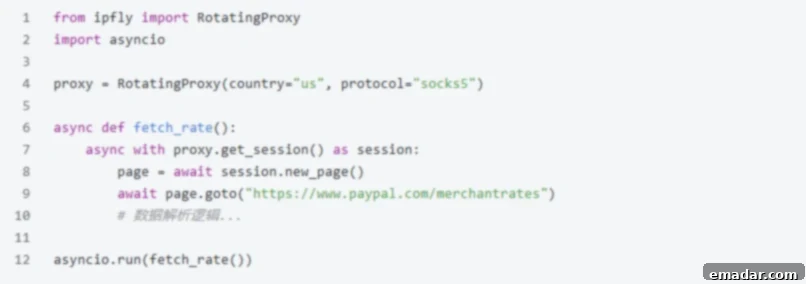
- **Traffic Timing Obfuscation:** To further evade detection, random request intervals (between 0.1s and 2.5s) were introduced to mimic human browsing patterns.
**Effect:** These combined strategies increased the average daily data collection from 1,200 entries to an astounding 54,000 entries, with a 0% IP ban rate, showcasing the power of dynamic residential proxies for high-volume data acquisition.
Advanced Optimization Handbook for Residential Proxy IPs
Mastering residential proxies extends beyond basic usage; it involves implementing sophisticated strategies to maximize performance, bypass advanced anti-bot measures, and optimize cost efficiency. This advanced handbook outlines key techniques for deep tuning your residential proxy operations.
Ultimate Anti-Scraping Strategy
To effectively counter sophisticated anti-scraping mechanisms, a multi-faceted approach is required. Implement an HTTP header dynamic generator that automatically crafts and combines parameters such as `Accept-Language` and `X-Forwarded-For` for each request. Critically, these headers must perfectly match the geographical region of the assigned IP to maintain authenticity. Furthermore, integrate an intelligent error handling system: upon encountering a 403 Forbidden error, the system should automatically switch to another IP within the same Autonomous System Number (ASN), leveraging tools like IPFLY’s ASN filtering API. This ensures that even if one IP is flagged, another from the same legitimate network is immediately available, maintaining seamless operation and minimizing downtime.
Large-Scale Concurrency Performance Optimization
Achieving high performance in large-scale concurrent operations with residential proxies requires meticulous optimization. Start by pre-loading connection pools, establishing hundreds or even thousands of long-lived connections in advance. Utilize keep-alive interfaces, such as those provided by IPFLY, to maintain these connections and minimize the overhead of handshake processes for each new request. Additionally, implement geographically-based sharding for processing requests. This involves distributing tasks across different proxy servers based on their proximity to the target regions, significantly reducing latency and improving overall efficiency. By maintaining active connections and optimizing routing, businesses can handle millions of concurrent requests with unparalleled speed and reliability.

Cost Control and Resource Allocation
Effective management of proxy resources is crucial for optimizing costs without compromising performance. Implement a traffic prediction algorithm, training an LSTM (Long Short-Term Memory) model using historical data to forecast future IP usage. This allows for dynamic procurement of IP solutions, purchasing resources only when truly needed. Furthermore, adopt a strategy of sensitive operation isolation. For high-risk tasks, such as account registration, allocate higher-reputation IPs (e.g., those costing $0.12/IP) that offer greater trust and success rates. For routine data querying, utilize standard IPs (e.g., $0.03/IP). This tiered approach ensures that critical operations are safeguarded with premium resources while everyday tasks are managed cost-effectively, providing a balanced and efficient resource allocation strategy.
IPFLY Global Residential Proxy Solutions
Unlock the full potential of your online operations with IPFLY’s comprehensive residential proxy solutions. Experience unparalleled flexibility with dynamic IP rotation, maintain consistent online identities with long-lasting static proxies, and ensure peak performance with efficient, secure data proxies. IPFLY offers a massive pool of over 90 million real residential IPs, delivering the scale and authenticity your business demands. Take advantage of limited-time special offers and benefit from dedicated 24/7 technical support, ensuring your operations are always smooth and secure. Don’t let digital barriers hinder your growth.
Visit IPFLY now and empower every network request with a true, local identity.