
In our increasingly interconnected yet geographically segmented digital world, encountering geo-restrictions is an unavoidable reality for individuals and businesses alike. Whether you’re trying to access region-exclusive streaming content, conduct vital cross-border market research, or manage international business operations, geo-blocking presents a significant hurdle. This is where Node Unblockers emerge as a powerful, indispensable solution. By simulating network nodes in target regions, these services allow users to seamlessly bypass IP blocks, access restricted resources, and maintain a global digital presence. This comprehensive guide will delve into the core principles, diverse use cases, and essential considerations for choosing premium Node Unblocker solutions, empowering you to select the ideal node services and effortlessly overcome geographical barriers in the digital realm.

Understanding Node Unblockers: Core Principles and Advanced Features
At its heart, a Node Unblocker is a sophisticated proxy network designed to grant users unrestricted access to geo-blocked content. It operates by routing your internet traffic through intermediary servers, or “nodes,” located in various geographical regions worldwide. This mechanism effectively masks your real IP address, making it appear as though your connection originates from the node’s location, thus bypassing any regional restrictions.
How Node Unblockers Work: The Underlying Mechanism
The operational framework of a Node Unblocker relies on a simple yet highly effective principle:
The Role of a Node
A node is essentially a proxy server strategically positioned around the globe. When you initiate a request to access a website or online service, instead of connecting directly, your request is first sent to a chosen node server. This server then forwards your request to the target website, effectively acting as an intermediary. Critically, it replaces your actual IP address with its own, ensuring your identity and location remain concealed from the destination server.
The “Unblocking” Process
The “unblocker” aspect comes into play when you specifically connect to a node situated in a region where the content you wish to access is available. For example, if you aim to watch content exclusive to Netflix US, you would connect through a node located in the United States. The target Netflix server would then “see” the US node’s IP address, recognize it as a local connection, and grant access, completely bypassing any geo-detection measures. The core principle can be visualized as: User → Node Server → Target Website. This clever redirection replaces your real IP with a node IP, making geo-detection irrelevant.
Key Functional Advantages of Modern Node Unblockers
Beyond simply changing your IP, advanced Node Unblockers offer a suite of features designed for optimal performance, security, and versatility:
Extensive Global Node Coverage
A leading advantage is the unparalleled global reach. Premium Node Unblocker services boast vast networks, often supporting nodes in over 190 countries and regions. For instance, a provider like IPFLY offers access to over 90 million global nodes. This extensive coverage ensures that users can pinpoint exact regional access, whether it’s for a specific city’s local news, a country’s streaming library, or niche market data. This precision is vital for targeted data collection, market analysis, and localized content access, ensuring that no digital content remains out of reach due to geographical boundaries.
Dynamic IP Rotation Capabilities
To combat increasingly sophisticated anti-bot and geo-detection systems, modern Node Unblockers offer dynamic IP rotation. This crucial feature automatically switches your node’s IP address either per request, after a set number of requests, or on a predefined schedule (e.g., changing a Japanese node IP every 10 minutes). Dynamic rotation is invaluable for high-frequency tasks such as web scraping, price monitoring, or managing multiple accounts, as it makes it significantly harder for target websites to detect and block your activity by associating multiple requests with a single IP address. This helps maintain anonymity and ensures uninterrupted access, preventing temporary or permanent bans.
Broad Protocol Compatibility
Versatility is key for diverse digital needs. Efficient Node Unblockers support a range of network protocols, including HTTP, HTTPS, and Socks5. HTTP/HTTPS proxies are standard for web browsing and most web-based applications, offering excellent compatibility. Socks5 proxies, on the other hand, provide a more robust and secure connection, capable of handling all types of network traffic, making them ideal for browsers, advanced web crawlers, gaming, and complex enterprise systems requiring a deeper level of network integration. This ensures that users can integrate node services seamlessly into various applications and workflows.
Core Use Cases for Node Unblockers: Breaking Digital Barriers
Node Unblockers are not just for casual browsing; they are powerful tools for a wide array of personal and professional applications, enabling access and operations across borders.
Streaming and Entertainment Unblocking
Scenario: Many popular streaming platforms, such as Netflix, HBO Max, Disney+, and even live-streaming sites like Twitch, offer vastly different content libraries or restrict access entirely based on geographical location. Users often wish to watch Netflix US exclusives, access HBO Max content available only in Europe, or view region-locked Twitch streams that are unavailable in their current location.
Solution: For stable, long-term access to geo-restricted streaming content, static residential nodes are the optimal choice. A static residential node provides a consistent IP address (e.g., a New York, US IP address) that is associated with a real internet service provider (ISP) in the target region. This consistency is crucial because streaming services often flag accounts that frequently change IP addresses, which can lead to login issues or even account suspension. Using a static residential node ensures a stable, “local” identity, mimicking a genuine user in the desired region and allowing for uninterrupted viewing without triggering security alerts.
Cross-Border E-Commerce and Market Research
Scenario: Businesses and researchers require real-time, accurate data from various markets to stay competitive. This includes monitoring product prices on Amazon US, scraping sales data from Shopee in Southeast Asia, or managing multi-region social media accounts, such as analyzing trends on TikTok Japan. Accessing this data directly can be challenging due to geo-restrictions and sophisticated anti-scraping measures employed by these platforms.
Solution: Dynamic residential nodes with rotation capabilities are indispensable for these high-frequency, data-intensive tasks. By automatically switching node IPs per request or on a rapid schedule (e.g., changing Southeast Asia IPs every few seconds or requests), dynamic residential proxies significantly reduce the likelihood of detection and blocking. This rotation mimics diverse user activity from many different IP addresses, allowing for efficient data scraping, comprehensive price comparison, and robust market analysis without being flagged as bot activity. This ensures businesses can gather vital competitive intelligence and manage their international digital footprint effectively.
Enterprise-Level Cross-Border Operations
Scenario: Multinational corporations often face the challenge of providing secure, low-latency access to internal systems for employees located in different countries. For example, employees abroad might need to access headquarters’ internal systems that are IP-authenticated to specific regions. Similarly, financial institutions require real-time retrieval of overseas market data for critical decision-making, where speed and reliability are paramount.
Solution: Dedicated datacenter nodes are specifically engineered to meet the demanding requirements of enterprise-level operations. These nodes offer superior speed, lower latency, and higher concurrency compared to residential options. Utilizing dedicated datacenter nodes (e.g., high-speed European nodes for access to European servers) ensures that employees can access critical internal systems swiftly and securely, meeting region-specific IP authentication requirements. For financial services, the low latency is crucial for real-time data feeds, enabling rapid data retrieval and analysis that directly impacts market strategies and financial transactions. Their robust infrastructure also supports large-scale batch operations and high traffic volumes.
How to Choose an Efficient Node Unblocker: Key Selection Criteria
Selecting the right Node Unblocker is critical for achieving your desired outcomes. It requires careful consideration of several factors, including node quality, geographic reach, and provider reliability.
Node Quality Is Critical: Residential vs. Datacenter Nodes
The type of node you choose significantly impacts your success rate, anonymity, and cost. Understanding the distinctions between residential and datacenter nodes is fundamental.
| Metric | Residential Nodes (Recommended for most) | Datacenter Nodes |
| Anonymity | Highly anonymous. IPs are assigned by real ISPs, making them appear as genuine users. Extremely difficult for target sites to detect as a proxy. | Lower anonymity. IPs originate from data centers, which are often blacklisted or easily flagged as “datacenter IP” by sophisticated anti-bot systems. |
| Stability | Generally high stability, often with 99.9%+ uptime, ideal for long-term tasks requiring consistent connections without interruption. | Good for short-term, high-speed access. Stability can be high, but detection risk limits their utility for persistent connections. |
| Detection Risk | Very low. Mimics real user behavior, rarely triggers anti-bot systems or CAPTCHAs. | Higher. Frequently detected by advanced geo-blocking and anti-bot systems, leading to CAPTCHAs, blocks, or flagged activity. |
| Speed | Moderate to high. Performance can vary based on the original user’s internet speed, but premium providers optimize for speed. | Very high. Directly connected to high-speed internet infrastructure, offering superior raw speed and low latency. |
| Cost | Moderate to higher (e.g., $19.99/month for IPFLY basic plan). Reflects the higher quality and authenticity. | Lower cost. More affordable due to their easier detectability and less organic nature. |
| Best For | Streaming, social media management, e-commerce, market research, account creation, anything requiring genuine user behavior. | High-volume data transfer, automated testing, accessing less protected sites, bulk operations where detection risk is low. |
Recommendation: For the vast majority of tasks involving sensitive websites, high-value data, or content with strict geo-restrictions, prioritize a hybrid solution where residential nodes serve as the mainstay. Datacenter nodes can be used for less sensitive, high-speed tasks where IP detection is not a major concern. Leading providers like IPFLY offer the flexibility to custom-combine node types, allowing you to tailor your proxy strategy to specific project needs and optimize both performance and cost.
Geographic Coverage and Node Density
It’s not enough for a provider to simply claim “global coverage.” You need to ensure they have sufficient nodes, and critically, a high density of nodes, in your specific target regions. For instance, if your focus is on Middle Eastern markets, you’ll need reliable and numerous nodes in countries like the UAE and Saudi Arabia. Inadequate node density in a critical region can lead to frequent connection failures, slower response times, and an inability to access the desired content consistently. A robust network ensures a higher success rate for connections and faster access to localized data, which is essential for precise geo-targeting and avoiding interruptions.
Technical Support and Compliance
The quality of a Node Unblocker service extends beyond just its technical infrastructure to the support and ethical standards of the provider.
24/7 Support
Technical issues, such as node failures or connectivity problems, can arise at any time. Reliable 24/7 customer support is invaluable for quick troubleshooting and node replacement. Providers like IPFLY, which offer real-time node monitoring and auto-switching capabilities, further enhance reliability by proactively addressing issues before they impact your operations. Access to knowledgeable support can save significant time and prevent costly disruptions to your projects.
Privacy Compliance
Data privacy is paramount in today’s digital landscape. Always choose providers with transparent “no logging” policies, meaning they do not store records of your online activity. Furthermore, ensure the provider complies with international data protection regulations such as GDPR (General Data Protection Regulation) and CCPA (California Consumer Privacy Act). Compliance indicates a commitment to user privacy and data security. IPFLY, for example, prides itself on being internationally certified for data security, offering peace of mind that your activities are private and your data is protected.
IPFLY Node Unblocker Solutions: A Full-Scenario Node Network
As a global leader in node services, IPFLY offers a meticulously designed suite of three core node types, providing comprehensive Unblocker solutions tailored for every conceivable scenario, from individual streaming to complex enterprise-level data operations.
Static Residential Nodes: Stability First for Persistent Identities
Advantages: IPFLY’s static residential nodes provide real, ISP-assigned IP addresses that remain fixed to a specific region (e.g., London, UK). This stability is crucial for establishing and maintaining a long-term, consistent digital identity online. These nodes support all major protocols (HTTP/HTTPS/Socks5), allowing for versatile integration with both manual browser setups and advanced enterprise API systems. Their authenticity makes them virtually undetectable by geo-blocking systems.
Use Cases: These nodes are perfect for demanding tasks that require a persistent and trustworthy online presence. This includes long-term cross-border e-commerce store operations, where maintaining a consistent IP for a seller account (e.g., registering and managing UK Amazon accounts) is vital to avoid suspicion. They are also ideal for social media account matrix management, such as daily maintenance and engagement for a network of Facebook US accounts, ensuring stable access and preventing account flags.
Dynamic Residential Nodes: Essential for High-Frequency, Anti-Detection Tasks
Advantages: IPFLY boasts an immense network of over 90 million global dynamic residential IPs, offering unparalleled flexibility. Users can precisely filter these IPs by country, city, and even ISP (e.g., selecting only Vancouver, Canada nodes). The key benefit is millisecond-level response times coupled with automatic IP rotation. This intelligent rotation mechanism (e.g., switching nodes every 50 requests) is specifically designed to circumvent advanced anti-crawl and anti-bot detection systems, making it highly effective for large-scale, automated tasks.
Use Cases: Dynamic residential nodes are indispensable for data scraping operations, such as collecting extensive job data from Indeed US across various cities, or conducting comprehensive SEO keyword rank monitoring across multiple regions to accurately gauge search engine results. Their ability to rapidly rotate IPs minimizes the risk of being blocked, ensuring continuous data flow for competitive intelligence and market analysis.
Dedicated Datacenter Nodes: Unrivaled High-Speed Priority
Advantages: IPFLY’s dedicated datacenter nodes are engineered for sheer speed and low latency, offering exclusive high-speed connections with an average latency of less than 80ms (e.g., Frankfurt, Germany nodes for European servers). This makes them perfect for speed-sensitive applications that demand instant responses, such as real-time 4K streaming on Netflix without buffering. Furthermore, these nodes provide unlimited bandwidth, significantly boosting enterprise-level batch operations and large data transfers by over 30%, making high concurrency a non-issue.
Use Cases: These nodes excel in scenarios where raw speed and throughput are paramount. This includes automated testing, such as performing multi-region APP compatibility testing to ensure flawless user experience across different geographical locations. They are also highly effective for streaming content unblocking, providing the necessary bandwidth and low latency for fast-loading, buffer-free 4K video playback, making them ideal for high-definition entertainment access.
Node Unblocker Setup Guide: Using IPFLY as an Example
Getting started with a Node Unblocker, particularly with a user-friendly service like IPFLY, is a straightforward process. Follow these steps to begin bypassing geo-restrictions:
Step 1: Registration and Plan Selection
Begin by visiting the official IPFLY website at https://www.ipfly.net. The first step is to register for an account. Once registered, carefully review the available node plans and select one that aligns with your specific needs. For instance, if you require proxies for Asian markets, you might choose the “Dynamic Residential Nodes – Asia Plan.” IPFLY offers a valuable incentive for new users: 10 free nodes for testing. It’s highly recommended to utilize these free nodes to thoroughly test connection success rates in your target regions, ideally testing at least 3 or more nodes to gauge reliability and speed.
Step 2: Node Configuration Methods
After selecting your plan and receiving your node credentials (IP address, port, username, password), you’ll need to configure your device or application to use the proxy.
Manual Browser Setup (Chrome Example)
One of the most common ways to use a Node Unblocker is through your web browser. For Google Chrome:
- Open Chrome and navigate to “Settings.”
- Scroll down and click on “Advanced” to reveal more options.
- Under the “System” section, click “Open proxy settings.” This will typically open your operating system’s network proxy settings.
- In the proxy settings window, look for a section related to “Manual proxy configuration.”
- Enter the IPFLY node IP address and the corresponding port number. You will also need to specify the protocol (e.g., Socks5 or HTTP/HTTPS) provided by IPFLY.
- Save your changes. You may be prompted for a username and password upon your first access through the proxy.
While manual configuration is effective, for advanced users or those managing multiple proxies, consider using browser extensions like “Proxy SwitchyOmega” or system-wide proxy managers for easier switching and management.
Step 3: Node Effect Verification
Once your node is configured, it’s crucial to verify that it’s working correctly and that your IP address has indeed changed to the desired location.
- Confirm IP Location: Open your browser and visit a reliable IP checker website, such as WhatIsMyIP.com or IPinfo.io. Verify that the displayed IP address and its associated geographical location match your chosen target region. If it still shows your real IP or an incorrect location, double-check your configuration settings.
- Test Download Speed: For performance-sensitive tasks like streaming or large data transfers, testing the connection speed is important. Use a tool like SpeedTest.net to measure the download and upload speeds through your proxy. As a general guideline, residential nodes should ideally provide speeds greater than 10Mbps for a smooth experience, while dedicated datacenter nodes, due to their optimized infrastructure, should aim for speeds exceeding 50Mbps, especially for 4K streaming or high-volume enterprise tasks.
Node Unblocker Pitfalls to Avoid: Best Practices for Success
While Node Unblockers are powerful tools, their effective use requires awareness of common pitfalls and adherence to best practices to ensure continuous, undetected access.
Preventing “Node Abuse” Blocks
Aggressive or unmanaged proxy usage can quickly lead to detection and blocking by target websites. To avoid this, it’s essential to mimic human behavior:
- Limit Request Frequency: Do not bombard a single node with an excessive number of requests. Keep your request frequency below a reasonable threshold (e.g., less than 100 requests per minute) to avoid triggering rate-limiting mechanisms.
- Add Random Delays: Integrate random delays (e.g., 5-10 seconds between requests) into your automated scripts. This makes your activity appear less machine-like and more natural, significantly reducing the likelihood of detection.
- Rotate User Agents: Websites often scrutinize user-agent strings. Rotate different legitimate user-agent strings (e.g., different browsers, operating systems) to further diversify your requests.
- Manage Cookies and Headers: Ensure your requests include realistic HTTP headers and manage cookies appropriately to maintain session consistency, just like a real browser would.
By implementing these strategies, you can minimize the risk of your nodes being identified and blocked, ensuring the longevity and effectiveness of your unblocking efforts.
Differentiating Between “Node Unblocker” and “VPN”
While both Node Unblockers (proxies) and VPNs (Virtual Private Networks) help mask your IP address, they serve distinct purposes and operate differently:
- Node Unblockers (Proxies): These focus on IP-level regional simulation. They operate at the application layer (e.g., for a specific browser, software, or API request). This provides granular control, allowing you to route specific traffic through a proxy while keeping other local services (like your banking app) on your regular internet connection. This precision is invaluable for tasks requiring a specific geo-location without affecting your entire network environment.
- VPNs: A VPN creates an encrypted tunnel for your *entire device’s* network traffic. It changes your IP address at the system level, meaning all your online activities (web browsing, apps, background services) will appear to originate from the VPN server’s location. While excellent for general privacy and security, this broad approach can sometimes interfere with local services that rely on your genuine location (e.g., geo-detection by your local bank app or ride-sharing services), potentially causing issues or triggering security alerts.
Choosing between a Node Unblocker and a VPN depends on your specific needs: for targeted geo-unblocking and data collection, a Node Unblocker offers more flexibility and control. For overall privacy and security across all applications, a VPN is typically preferred.
Choosing “Pay-as-You-Go” Billing for Efficiency
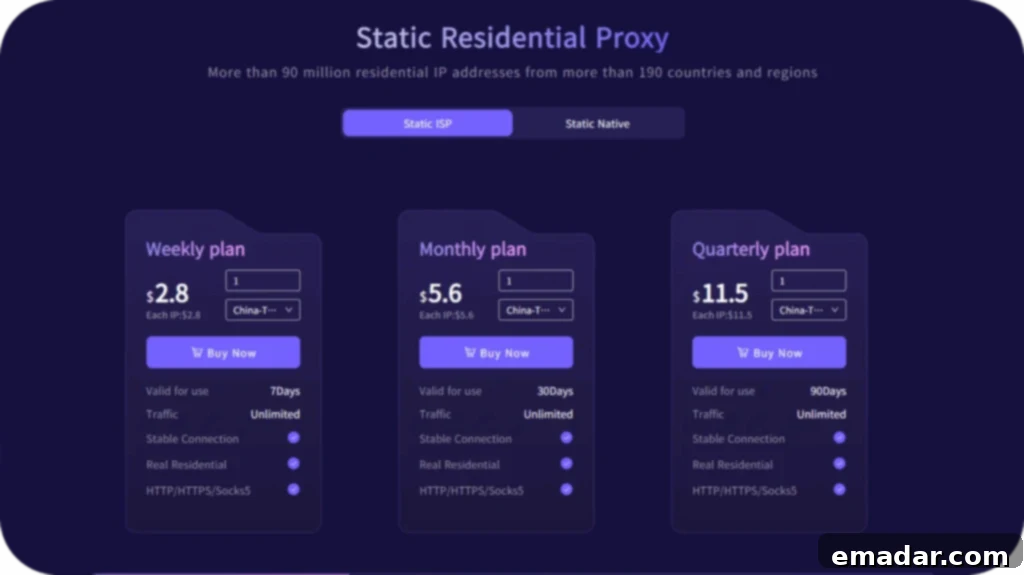
When selecting a Node Unblocker service, consider the billing model carefully. Many providers offer fixed-bandwidth plans, which can lead to unnecessary waste if your usage fluctuates or is low-frequency. Instead, opt for “pay-as-you-go” or flexible bandwidth plans, where you only pay for the data you consume. For users with low-frequency or intermittent needs, plans like IPFLY’s basic plan, which might offer 10GB/month for an affordable price like $19.99, provide excellent cost-efficiency without committing to large, unused data allowances. This flexible model ensures you get the most value for your investment, adapting to your actual usage patterns rather than being locked into rigid contracts.
Efficient Geo-Unblocking Starts with Premium Nodes
In a world increasingly segmented by digital borders, Node Unblockers stand as indispensable tools for both individuals and enterprises seeking unrestricted access to global online content and markets. Their effectiveness, however, is not uniform; it fundamentally relies on the quality, geographic coverage, and responsive support of the chosen node provider. A robust Node Unblocker empowers you to overcome geo-restrictions for everything from seamless streaming and critical market research to secure, high-performance enterprise operations.
Among the myriad options, IPFLY distinguishes itself as a premier provider, offering a massive pool of pure, high-quality nodes, flexible plans tailored to diverse needs, and enterprise-grade stability. Its comprehensive suite of static residential, dynamic residential, and dedicated datacenter nodes ensures that whether you prioritize stability, anonymity, or raw speed, there’s an IPFLY solution perfectly suited to your requirements. By integrating IPFLY’s advanced proxy services, users can confidently navigate the complexities of geo-blocking, maintain optimal online performance, and secure their digital presence across international boundaries.
To further enhance your online performance, security, and ability to bypass any geo-restrictions, we invite you to visit the IPFLY official website. Discover more about their innovative solutions and experience the superior quality of their premium proxy services firsthand.