
Every time we open a web browser, send an email, or stream a video, a complex and intricate set of rules works tirelessly behind the scenes, powering the entire digital world. At the very heart of these rules sits the ‘commander-in-chief’ of internet communication: the Internet Protocol (IP).
You’ve likely encountered terms like “IP address” and “TCP/IP,” but what do they truly signify? What critical role does the IP protocol play in our online lives, and how does it relate to its ubiquitous partner, the Transmission Control Protocol (TCP)? This article aims to demystify these fundamental concepts, providing a clear understanding of the internet’s core mechanisms and their profound implications for professionals navigating the digital landscape.
What Exactly is a “Protocol”?
Before diving deep into the Internet Protocol, it’s essential to grasp the concept of a “protocol” in a broader sense. Imagine two diplomats from different nations meeting for crucial negotiations. For their discussion to be fruitful, they must first agree on a common language, adhere to specific diplomatic courtesies, and standardize the format for exchanging documents. This pre-established set of agreed-upon rules is, in essence, a diplomatic protocol.
In the digital realm, the principle is precisely the same. A network protocol is a defined set of rules and standards that computers and other network devices adhere to for seamless and efficient communication. Without these protocols, the internet would descend into chaos, with devices unable to understand each other, much like people speaking different languages without a common translator. Protocols ensure order, predictability, and interoperability across the vast global network, making modern digital interactions possible.
The Internet Protocol (IP): The Digital Postman
Among the countless network protocols, the Internet Protocol (IP) stands out as one of the most fundamental and indispensable. Its primary mission, though seemingly straightforward, is monumentally critical: to move data packets from a source device to a destination device across the vast, interconnected network of the internet. Think of IP as the reliable, albeit sometimes imperfect, digital postman of the internet.
To accomplish this colossal task, the IP protocol primarily relies on two core mechanisms:
1. The IP Address: Your Digital Home Address
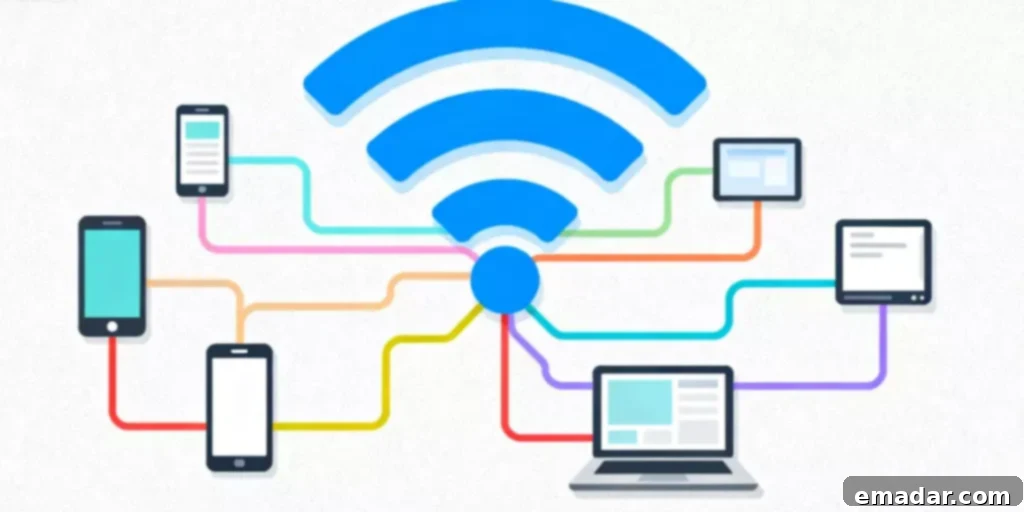
The IP protocol dictates that every single device connected to the internet must possess a unique identifier—an IP address. This address is akin to a physical street address for your home or office (e.g., 192.168.1.1 or 2001:0db8:85a3:0000:0000:8a2e:0370:7334 for IPv6). This unique address ensures that data fragments, which we call “data packets,” know precisely where they are destined to go, allowing them to traverse the intricate network infrastructure and arrive at the correct recipient.
2. IP Data Packets: The Standardized Envelopes
When you need to send a lengthy document via postal mail, you might break it down into several smaller, standard-sized envelopes. The IP protocol operates on a similar principle. It segments larger blocks of data into manageable, standardized units known as “data packets” or “IP packets.” This segmentation allows data to be efficiently transmitted across various network links, each with potentially different maximum transmission unit (MTU) sizes.
Each IP data packet is meticulously structured and typically comprises two main components:
- Packet Header: This is analogous to the information written on a physical envelope. It contains crucial metadata for routing, including the source IP address (the sender’s address), the destination IP address (the recipient’s address), the protocol type of the encapsulated data (e.g., TCP, UDP), the packet length, and other control information like the Time-to-Live (TTL) field, which prevents packets from endlessly circulating the network.
- Data (Payload): This is the actual content being transmitted, akin to the letter inside the envelope. It carries the segment of information that originated from the application layer.
The IP protocol, acting like our diligent postman, focuses solely on reading the destination address on the packet header and making its best effort to deliver it. However, this “best effort” approach highlights a fundamental characteristic—and limitation—of IP: it is a “connectionless” and “unreliable” protocol. This means:
- No Guarantee of Delivery: IP does not confirm if a packet successfully reached its destination. Packets can be lost due to network congestion, hardware failures, or routing issues.
- No Guarantee of Order: Packets belonging to the same data stream might take different routes and arrive out of sequence at the destination.
- No Guarantee of Integrity: IP does not natively check if the packet was corrupted during transit.
- No Flow Control: IP doesn’t regulate the rate at which data is sent to prevent overwhelming the receiver or the network.
Despite these apparent “flaws,” IP’s simplicity and stateless nature are precisely what make it incredibly efficient and scalable for routing billions of packets across a global network. Its unreliability at a basic level paved the way for more sophisticated protocols to build upon its foundation.
TCP: Building Reliability on an Unreliable Foundation
Given that the IP protocol is inherently “unreliable,” how is it that our internet communication remains so stable and dependable? The answer lies in IP’s indispensable partner: the Transmission Control Protocol (TCP). Together, TCP and IP form the backbone of the internet, known as the TCP/IP protocol suite.
If IP is the fundamental postal system responsible for addressing and dispatching letters, then TCP is the advanced “insured and tracked express delivery service with a signature confirmation”. TCP operates on top of IP, adding layers of sophisticated mechanisms to transform IP’s best-effort delivery into a highly reliable, ordered, and error-checked data stream.
Here’s how TCP meticulously compensates for IP’s shortcomings:
- Three-Way Handshake: Establishing a Connection: Before any data transmission begins, TCP initiates a “three-way handshake.” This is like a phone call where both parties confirm readiness: the sender sends a “SYN” (synchronize) request, the receiver responds with a “SYN-ACK” (synchronize-acknowledge), and the sender finalizes with an “ACK” (acknowledge). This process establishes a reliable, full-duplex connection, ensuring both ends are prepared for data exchange.
- Data Sequencing and Reassembly: Ensuring Order: TCP assigns a unique sequence number to every data packet (or segment, as they are called in TCP). Even if these segments take different paths and arrive out of order, the receiving TCP layer uses these sequence numbers to correctly reassemble them into the original, complete message. This prevents data from being scrambled or misinterpreted.
- Acknowledgement (ACKs) and Retransmission: Guaranteeing Delivery: For every segment successfully received, the recipient sends an “ACK” (acknowledgment) back to the sender. If the sender does not receive an acknowledgment within a specified timeout period, it assumes the segment was lost or corrupted and automatically retransmits it. This robust mechanism ensures that all data eventually reaches its destination.
- Flow Control and Congestion Control: Managing Traffic: TCP also implements sophisticated algorithms for flow control (to prevent a fast sender from overwhelming a slow receiver) and congestion control (to reduce transmission rates when network congestion is detected). These features maintain network stability and optimize performance.
The symbiotic relationship between TCP and IP, forming the core TCP/IP protocol suite, is what underpins nearly all modern internet applications we use daily, including web browsing (HTTP), file transfers (FTP), email (SMTP/IMAP/POP3), and streaming services. This powerful combination delivers the stability, reliability, and efficiency we expect from our digital interactions.
IP Protocol: An Essential Course for Digital Professionals
While the TCP/IP protocols diligently operate in the background for the average user, requiring no direct intervention, a profound understanding of the IP protocol’s mechanics—especially the significance of the IP address as a core identity marker—is absolutely crucial for professionals in fields such as cross-border e-commerce, social media marketing, data analysis, and online reputation management. For these roles, understanding IP is a cornerstone for business security and operational integrity.
Modern digital platforms (e.g., Amazon, TikTok, Facebook, Google) employ advanced risk control systems that heavily rely on IP addresses to verify user authenticity, detect fraudulent activities, and identify associated accounts. An IP address serves as a primary digital fingerprint, silently informing platforms about the user’s location, network type, and connection history.
- IP Association Risks: Operating multiple business accounts or social media profiles from a single IP address significantly increases the risk of platform detection. If these accounts are linked by their shared IP, a violation or ban on one account can trigger a cascading effect, leading to the suspension or termination of all associated accounts. This “IP ban” can be catastrophic for businesses relying on multiple digital identities.
- Geographical Restrictions and Geo-targeting: Many platforms, services, and content offerings are geographically restricted or optimized based on a user’s IP address. An IP address that doesn’t align with the target market can prevent access to critical backend functionalities, localized market data, specific advertising campaigns, or even regional content. This limitation hampers market research, competitive analysis, and effective localized marketing strategies.
- Compliance and Security: IP addresses are also vital for maintaining compliance with regional data regulations and enhancing cybersecurity. Ensuring your operations originate from IPs in compliant regions can prevent legal issues, while consistent IP usage can bolster security protocols.
This is precisely where specialized proxy IP services, such as IPFLY, become invaluable. For professionals who manage intricate digital operations involving multiple online identities, IPFLY provides a robust, secure, and reliable solution. Their offerings, particularly high-purity, independent static residential and ISP proxies, are indispensable tools for maintaining operational integrity and mitigating risks.
By configuring each business account with a dedicated IPFLY proxy IP, operators can achieve unparalleled control and security:
- Achieve Complete IP Isolation: Each account gains a unique, distinct network identity, making it appear as an independent, legitimate user to platforms. This fundamental separation effectively eliminates IP association risks, safeguarding individual accounts from cross-contamination and collective penalties.
- Simulate Authentic Local Environments: By selecting IP addresses that match their target markets, businesses can operate as if they are physically present in those regions. This not only significantly boosts the trust score of their accounts but also enables precise testing and optimization of localized marketing campaigns, content delivery, and pricing strategies, leading to higher engagement and conversion rates.
IPFLY stands as a dedicated and professional proxy service provider for the cross-border industry, distinguished by its commitment to quality and comprehensive support:
- ✔ Extensive global coverage across 190+ countries, offering unparalleled reach.
- ✔ Diverse IP options including static/dynamic residential proxies, native IPs, and robust data center proxies.
- ✔ Provision of exclusive, pure IPs ensuring dedicated usage and enhanced trust.
- ✔ A strict no-logs policy and high anonymity features, compatible with fingerprint browsers for maximum security.
- ✔ Seamless API integration, simplifying bulk IP configuration and management for large-scale operations.
Leveraging IPFLY’s advanced proxy solutions empowers digital professionals to navigate the complexities of online platforms with confidence, ensuring secure, compliant, and highly effective global operations.
👉 Claim your special offer and access premium IPs today!