
In today’s fiercely competitive digital landscape, access to accurate, timely, and comprehensive data is not merely an advantage—it’s a fundamental necessity for businesses, marketers, and data analysts alike. Especially for dynamic e-commerce operations and critical market research endeavors, the challenge of gathering valuable information from websites across the globe can be formidable. Obstacles such as stringent geo-restrictions, sophisticated anti-bot countermeasures, and regional content variations frequently impede data collection efforts. This is where the innovative power of residential proxies becomes indispensable. By providing authentic IP addresses that mimic genuine users, residential proxies effectively bypass these barriers, enabling businesses to collect vast amounts of data efficiently, securely, and without interruption.
This comprehensive guide delves deeply into the transformative role of residential proxies, meticulously exploring their advanced applications in both large-scale web scraping and the fast-paced world of e-commerce. We will highlight their unparalleled benefits, illustrate practical implementation workflows, and examine diverse, real-world applications that empower businesses to gain a significant competitive edge.
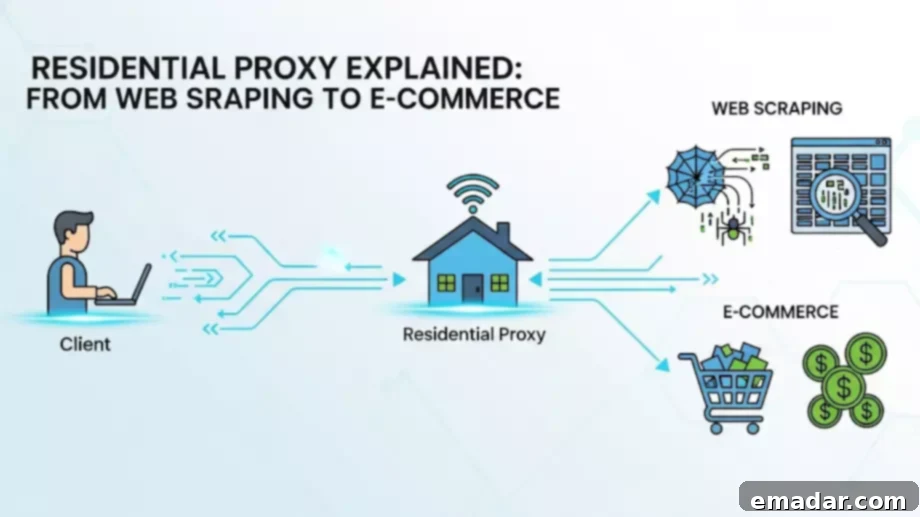
Understanding the Foundation: What Are Residential Proxies?
A residential proxy stands distinct in the world of internet anonymity and data access. Fundamentally, it is an IP address legitimately assigned by an Internet Service Provider (ISP) to a real, physical household. This crucial distinction sets them apart from other proxy types, particularly data center proxies. Data center IPs originate from commercial servers and are often flagged by sophisticated website detection systems as non-human or suspicious, leading to blocks and CAPTCHAs. Residential proxies, conversely, are perceived by target websites as authentic, organic traffic from genuine users accessing the internet from their homes. This inherent legitimacy is the cornerstone of their effectiveness in data collection.
The operational models of residential proxies can be broadly categorized into two primary types, each serving specific strategic objectives:
- Static Residential Proxies: These proxies maintain the same IP address for extended periods, sometimes indefinitely. They are ideally suited for tasks that require long-term consistency and a stable identity. Examples include managing multiple social media accounts, maintaining persistent sessions for specific web applications, or ensuring consistent scraping from a single geographic location over time without IP changes. Their stability minimizes interruptions and simplifies management for ongoing, identity-sensitive operations.
- Rotating Residential Proxies: These dynamic proxies automatically change the IP address assigned to a user, either with every request, after a set time interval, or upon encountering a block. This constant rotation makes them exceptionally powerful for high-volume data collection tasks where avoiding detection is paramount. By distributing requests across a vast pool of diverse IPs, rotating proxies effectively circumvent rate limits, IP bans, and other anti-bot mechanisms, enabling uninterrupted and large-scale data extraction.
The unparalleled authenticity and inherent flexibility of residential proxies make them the superior choice for any application demanding reliability, scalability, and anonymity, particularly in the demanding fields of web scraping and e-commerce intelligence. They provide a vital bridge between the need for extensive data and the ever-increasing sophistication of website protection.
How Residential Proxies Revolutionize Web Scraping
Web scraping is the automated process of extracting structured data from websites, transforming unstructured web content into valuable information. This process is critical for businesses seeking actionable insights into competitive intelligence, comprehensive market trends, or informed operational decisions. However, scraping large datasets from the internet is fraught with challenges, as websites employ various techniques to prevent automated access. Residential proxies are not just a tool but an essential catalyst for successful and scalable scraping operations, ensuring data collection without facing blocks or restrictions.
Key Benefits of Incorporating Residential Proxies in Web Scraping
The integration of residential proxies into a web scraping architecture yields several profound advantages:
- Unmatched Block and CAPTCHA Avoidance: Websites are designed to detect and block suspicious, repetitive requests originating from a single IP address, often presenting CAPTCHAs as a deterrent. Residential IPs, by appearing as requests from normal, distinct users, significantly reduce the risk of being flagged, challenged, or permanently blocked. This ensures a higher success rate and smoother scraping operations, even when conducting repeated, high-frequency requests.
- Precise Geo-Specific Data Collection: A significant challenge in global data collection is content localization. Many websites display different prices, product availability, promotions, or even entire content structures based on the visitor’s geographic location. Residential proxies enable scrapers to route requests through IP addresses located in specific countries, cities, or even regions. This capability allows for simultaneous scraping from multiple regions, providing truly accurate, localized, and global data, which is critical for international market analysis.
- Seamless High-Volume Operations: For projects requiring the collection of vast quantities of data, high-volume operations are essential. Rotating residential proxies are designed precisely for this purpose. By automatically cycling through a massive pool of diverse IP addresses, they enable thousands, or even millions, of concurrent requests without any single IP exceeding rate limits or triggering anti-bot defenses. This drastically accelerates data collection timelines, making large-scale projects feasible and efficient.
- Enhanced Data Accuracy and Reliability: When scraping efforts are hindered by blocks or incomplete data, the resulting analytics can be skewed and unreliable. By mimicking real user traffic with authentic IPs, residential proxies ensure that data collection is complete, reliable, and unbiased. This leads to higher quality datasets, which in turn support more precise analysis and more confident decision-making.
Example Use Case: Consider an ambitious e-commerce analytics team tasked with monitoring competitor pricing strategies across a dozen international markets. Without residential proxies, this would require complex setups, constant IP changes, and frequent blocks. With a robust residential proxy network, scraping scripts can be deployed simultaneously from different regions worldwide. These scripts collect real-time data on pricing, inventory levels, promotional offers, and product descriptions specific to each locale. This granular, real-time intelligence empowers businesses to dynamically adjust their own pricing strategies, optimize stock levels, and launch targeted promotions with unprecedented agility, staying ahead of market shifts.
Residential Proxies: A Cornerstone of E-Commerce Success
The modern e-commerce landscape is a data-driven ecosystem. Businesses in this sector depend heavily on accurate, up-to-the-minute data to inform their pricing, inventory management, marketing campaigns, and overall strategic planning. Residential proxies are invaluable assets in this environment, providing reliable and uninterrupted access to critical web data, ensuring that e-commerce operations remain agile and competitive.
Key E-Commerce Applications Enhanced by Residential Proxies
The practical applications of residential proxies in e-commerce are extensive and diverse:
- Dynamic Price Monitoring and Optimization: In a highly competitive market, pricing can be the ultimate differentiator. Businesses use residential proxies to meticulously track competitor prices across various product categories and geographical regions. This allows for dynamic adjustments to their own pricing strategies, ensuring they remain competitive or can identify opportunities for premium pricing. Simultaneous, location-based requests facilitated by residential IPs provide comprehensive market insights that are impossible to achieve otherwise.
- Strategic Inventory Tracking: Understanding competitor inventory levels is crucial for supply chain planning, identifying market demand gaps, and preventing stockouts. By frequently monitoring which products are in stock (or out of stock) on competitor websites, businesses can plan their promotions more effectively, forecast demand more accurately, and maintain optimal inventory levels. Residential proxies prevent blocks during these frequent requests, ensuring the reliability and consistency of this vital data.
- In-Depth Market Research and Trend Analysis: Residential proxies empower e-commerce businesses to collect rich data on product reviews, customer ratings, and user feedback from various platforms and regions. This data is invaluable for identifying emerging product trends, understanding customer sentiment towards existing products, and gathering insights that drive informed product development and marketing decisions. They help uncover regional preferences and untapped market opportunities.
- Robust Ad Verification and Campaign Integrity: For global advertising campaigns, it’s essential to verify that ads are being displayed correctly, in the intended regions, and on appropriate platforms. Residential proxies allow businesses to simulate user access from different countries, enabling them to verify campaign performance, monitor brand safety, and ensure ad compliance without exposing the company’s original IP. This ensures advertising budgets are spent effectively and campaigns maintain their integrity.
- Agile Dynamic Campaign Adjustments: Beyond mere verification, residential proxies enable businesses to make real-time, data-driven adjustments to their promotions, product visibility, and pricing based on newly collected market data. This agility allows marketers to respond instantly to competitor moves, capitalize on emerging trends, and optimize campaign performance for maximum engagement and sales conversion.
Example Scenario: Imagine a rapidly expanding fashion retailer preparing to launch a new global product line. To ensure success, the marketing team needs to monitor fashion trends, influencer promotions, and competitor pricing across major markets like New York, Paris, London, and Tokyo. Leveraging a network of residential proxies, the team can collect real-time insights from e-commerce sites, fashion blogs, and social media platforms in each of these cities. This critical intelligence allows them to adjust their launch campaigns, tailor product offerings to regional tastes, and optimize their digital marketing strategies on the fly, maximizing engagement and driving higher sales across all target markets.
Practical Web Scraping Workflows with Residential Proxies
To fully harness the power of residential proxies in web scraping, a thoughtful approach and adherence to best practices are essential. Effective deployment ensures both efficiency and resilience against website defenses.
- Strategically Rotate IPs for High-Volume Scraping: For any large-scale data extraction project, relying on a single IP is a recipe for immediate blocking. Utilizing rotating residential proxies is crucial, as it ensures that requests are constantly spread across a vast pool of distinct IP addresses. This distribution significantly reduces the likelihood of detection by anti-bot systems and allows for sustained, high-volume data collection without interruption.
- Implement Parallel Requests for Enhanced Efficiency: Time is often of the essence in data acquisition. Sending multiple requests simultaneously, or in parallel, can dramatically speed up the data collection process. When combined with a robust residential proxy network, parallel processing becomes incredibly powerful, enabling businesses to gather significantly more data in a fraction of the time compared to sequential processing.
- Rigorously Monitor Success Rates and Performance: Effective scraping isn’t just about sending requests; it’s about ensuring those requests are successful. Continuously tracking metrics such as proxy response times, the number of blocked requests, and overall success rates is vital. This monitoring allows for immediate identification of underperforming proxies or problematic target sites, enabling prompt adjustments to scraping workflows to ensure they remain effective and uninterrupted.
- Seamlessly Leverage Automation Tools and Frameworks: To manage the complexity and scale of large-scale scraping operations, integrating residential proxies with specialized automation platforms or custom scripting frameworks (like Scrapy, Beautiful Soup, or Puppeteer) is highly recommended. These tools streamline the process, allowing for efficient proxy rotation, request management, error handling, and data parsing, leading to seamless and scalable data collection.
Addressing the Challenges in Web Scraping and E-Commerce Monitoring
While residential proxies offer robust solutions, web scraping and e-commerce monitoring are not without their inherent challenges. Understanding these obstacles and how residential proxies mitigate them is key to successful operations.
- Overcoming IP Blocks and Rate Limits: Websites frequently implement sophisticated systems to detect and block IP addresses that exhibit suspicious behavior, such as sending an unusually high volume of requests from a single source. This often leads to IP blocks or temporary rate limits. Residential proxies, especially rotating ones, are specifically designed to counter this by distributing requests across thousands of unique IP addresses, making each request appear distinct and organic, thereby significantly reducing the risk of detection and blocks.
- Efficient Load Distribution for Massive Requests: Handling thousands or even millions of concurrent requests, particularly in global scraping operations, presents a significant architectural challenge in terms of load distribution. Without proper management, this can lead to slow response times or overwhelming the target site. High-quality residential proxy providers offer intelligent proxy management systems that automatically distribute the load across their vast IP pools, optimizing performance and ensuring smooth, efficient data flow.
- Ensuring Unblemished Data Accuracy: Failed requests, partial data collection, or encountering CAPTCHAs can severely skew analytics and lead to unreliable insights. Residential proxies enhance data accuracy by maintaining stable, authentic connections, minimizing errors and ensuring that the scraped data is complete and reflective of what a real user would see. This leads to higher quality datasets for analysis.
- Navigating Compliance and Ethical Considerations: Businesses engaging in web scraping must operate within legal and ethical boundaries, respecting website policies (like robots.txt), intellectual property rights, and stringent privacy regulations (such as GDPR and CCPA). Residential proxies facilitate safe and compliant data collection by allowing businesses to operate anonymously without exposing their own primary IP addresses, thus reducing legal exposure while adhering to ethical scraping practices.
How IPFLY Powers Superior Web Scraping and E-Commerce Intelligence
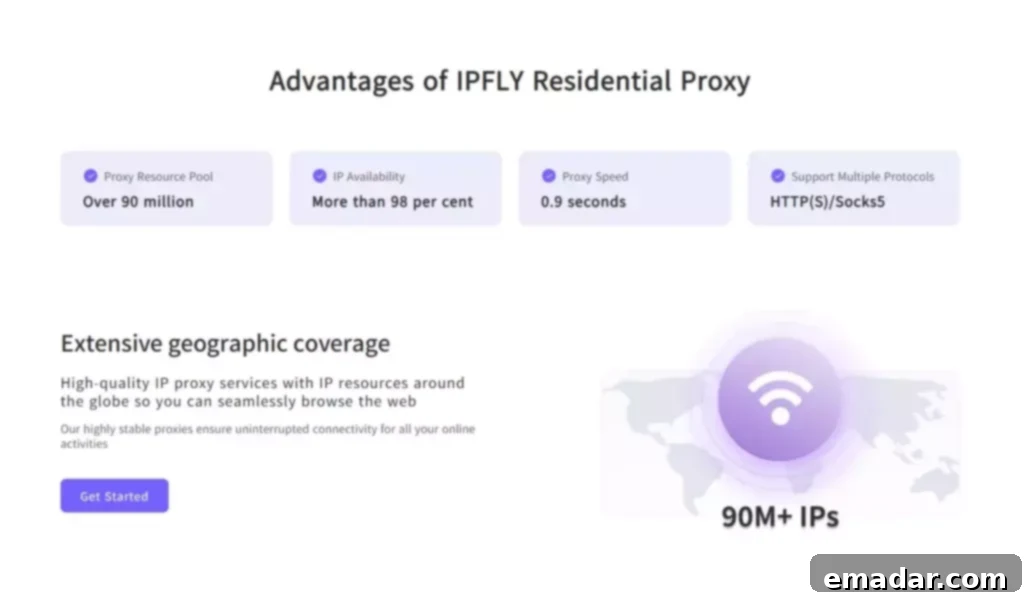
IPFLY stands as a premier provider of professional residential proxy solutions, meticulously engineered to meet the rigorous demands of data-intensive tasks in both web scraping and e-commerce intelligence. Our infrastructure is built for reliability, scale, and performance, empowering businesses to unlock unparalleled access to global web data.
- Extensive Global IP Pool: IPFLY boasts an expansive network of over 90 million legitimate residential IP addresses, strategically distributed across more than 190 countries worldwide. This vast pool ensures unparalleled geographic coverage and diversity, enabling users to collect hyper-localized data from virtually any corner of the globe.
- Flexible Static and Rotating Options: Recognizing diverse business needs, IPFLY offers both static (sticky) and rotating residential proxy options. Whether your task requires a consistent IP for long-term account management and stable sessions or dynamic IP rotation for high-volume, block-resistant scraping, IPFLY provides the flexibility to choose the ideal solution for your specific operational requirements.
- Consistently High Success Rates: The core of IPFLY’s offering is its commitment to maximizing data collection efficiency. Our advanced proxy management system and clean IP pool minimize the risk of blocks and CAPTCHAs, translating into consistently high success rates for your scraping tasks and ensuring uninterrupted data flow.
- Scalable Infrastructure for Demanding Operations: IPFLY’s robust, cloud-native infrastructure is specifically designed to support thousands of concurrent requests without compromising speed or reliability. This scalability is crucial for businesses undertaking global market research, real-time price monitoring, or large-scale data extraction projects that demand high throughput.
- Secure and Anonymous Connections: Security and privacy are paramount. IPFLY ensures safe, encrypted, and anonymous access to target websites. This protects your original IP address, safeguards your data collection activities, and maintains the integrity of your e-commerce and analytics tasks, allowing you to operate with confidence.
By leveraging IPFLY’s superior residential proxies in conjunction with optimized scraping workflows, businesses can monitor competitor activities with granular detail, track inventory fluctuations in real-time, verify global ad campaigns effectively, and gather highly actionable insights that drive strategic decision-making and foster sustainable growth.
Advanced Best Practices for Maximizing Residential Proxy Performance
To truly optimize your data collection efforts and ensure long-term success, it’s crucial to implement advanced best practices when working with residential proxies:
- Employ Rotating IPs for All Large-Scale and Sensitive Scraping: While static IPs have their place, for any large-scale data extraction or sensitive tasks where detection is a high risk (e.g., frequent requests to the same domain), dynamic IP rotation is indispensable. This strategy not only prevents immediate detection but also significantly improves overall success rates by cycling through fresh, uncompromised IP addresses.
- Master Parallel Processing for Unparalleled Speed: Beyond simply sending multiple requests, master the art of parallel processing by optimizing the number of concurrent connections based on your system resources and the target website’s tolerance. Intelligent parallelization dramatically reduces the time required for data acquisition, making large projects feasible within tight deadlines.
- Continuously Monitor Proxy Performance and Health: Implement robust monitoring systems to track key metrics such as proxy response times, the percentage of successful requests, and any error codes encountered. This proactive approach allows you to identify and address underperforming proxies, adjust request strategies, or even swap out entire proxy pools to maintain peak efficiency.
- Choose Trusted Providers with a Proven Track Record: The quality of your residential proxies directly impacts the success of your operations. Always select providers known for their reliability, extensive IP networks, strong customer support, transparent pricing, and commitment to compliance. IPFLY, for instance, meets these professional standards, ensuring high uptime and clean IP pools for demanding workflows.
- Strategically Plan and Pace Requests to Mimic Human Behavior: While proxies provide anonymity, overly aggressive or repetitive request patterns can still trigger advanced anti-bot measures. Implement strategic delays between requests, vary your user-agent strings, and simulate mouse movements or scrolling where necessary. This careful pacing mimics genuine human browsing behavior, further reducing the chances of detection and ensuring long-term scraping viability.
Conclusion: The Indispensable Role of Residential Proxies in the Digital Economy

In the contemporary digital economy, where data reigns supreme, residential proxies have unequivocally emerged as an indispensable tool for businesses that rely heavily on sophisticated web scraping and dynamic e-commerce operations. They deliver a unique combination of authenticity, unparalleled scalability, and unwavering reliability, empowering companies to transcend digital barriers. This enables them to collect critical data, meticulously monitor competitors, and strategically optimize their business models with unmatched effectiveness and precision.
By integrating IPFLY residential proxies into their operational workflows, organizations gain access to a world-class, secure, and globally distributed network. This robust infrastructure is purpose-built to support the most demanding tasks, including large-scale data scraping, granular pricing intelligence, comprehensive market analysis, and meticulous campaign verification. With IPFLY’s cutting-edge solutions, businesses are equipped to make faster, more confident, and profoundly data-driven decisions, ensuring they not only stay competitive but actively lead in the ever-evolving global marketplace.
👉 Join the IPFLY Telegram community today to stay abreast of the latest advancements in residential proxy solutions, cutting-edge web scraping strategies, and actionable e-commerce insights. Connect with experts and peers to elevate your data intelligence game.