

Understanding Proxy Servers: Your Digital Middleman
Imagine you want to send a letter but prefer not to reveal your actual address to the recipient. Instead, you enlist a trusted intermediary to dispatch the letter on your behalf and even collect any replies. This intermediary acts as a buffer, ensuring your privacy while facilitating communication. In the vast landscape of the internet, a proxy server functions in much the same way. It acts as a gateway, standing between your device and the target website or online service. When you send a request to a website, it first goes to the proxy server, which then forwards the request using its own IP address. The website responds to the proxy, which then delivers the content back to you. This seamless process effectively hides your true IP address, allowing you to bypass geographical restrictions, enhance your online privacy, and even bolster your digital security.
The applications of proxy servers are remarkably diverse and crucial in today’s interconnected world. They are not merely tools for anonymity but serve multiple strategic purposes. From individual users seeking greater online freedom to large corporations conducting market research, proxies offer a versatile solution. They enable users to navigate the internet with enhanced control over their digital footprint, opening up a world of possibilities that might otherwise be blocked or restricted. Whether your goal is to access region-locked content, secure your browsing habits, or manage large-scale data operations, understanding and utilizing proxy servers can significantly elevate your online capabilities and overall experience. Delving into the specific types of proxies further reveals their unique strengths and optimal use cases for various digital endeavors.
- Enhanced Anonymity: By masking your real IP address, proxy servers ensure your online activities remain private, protecting your identity and personal data from being tracked by websites or third parties.
- Bypassing Restrictions: Gain access to content or services that are geo-blocked or restricted by network policies, effectively unlocking a global internet experience regardless of your physical location.
- Load Balancing & IP Rotation: Essential for tasks like web scraping, proxies can rotate through numerous IP addresses, preventing a single IP from being flagged or banned by target websites, ensuring continuous and efficient data collection.
- Increased Security & Filtering: Proxies can act as a protective barrier, reducing your direct exposure to potential online threats, filtering out malicious content, and adding an extra layer of defense against cyber-attacks.
HTTP Proxy: Your Gateway for Web Browsing
Understanding How HTTP Proxies Work
An HTTP proxy server is specifically engineered to handle web traffic, operating primarily with the HTTP (Hypertext Transfer Protocol) and HTTPS (Hypertext Transfer Protocol Secure) protocols. HTTP is the foundational protocol for data communication on the World Wide Web, dictating how browsers and servers interact. HTTPS, on the other hand, is its more secure counterpart, incorporating SSL/TLS (Secure Sockets Layer/Transport Layer Security) encryption to protect data integrity and confidentiality during transmission. This makes HTTP proxies ideal for a wide range of web-centric activities, from casual browsing to sophisticated data retrieval, providing a tailored solution for interacting with web content.
When you configure your browser or application to use an HTTP proxy for accessing a website, a distinct communication flow is initiated. This process ensures that your requests are routed through the proxy before reaching their final destination and that responses are filtered back to you. The sequence of operations unfolds as follows, illustrating the proxy’s integral role:
- Your web browser or designated client application sends its request, specifying the URL of the target website, directly to the HTTP proxy server rather than the destination server.
- Upon receiving this request, the HTTP proxy server meticulously parses it, examining key components such as the HTTP headers, requested URL, and other metadata. After this analysis, the proxy then forwards the modified or original request to the intended target website.
- Once the target website processes the request, it transmits its response (e.g., the webpage content) back to the proxy server. The proxy then receives this content and relays it to your browser, completing the communication cycle.
For standard HTTP traffic, the proxy server possesses the unique capability to inspect the specific content of your requests and the server’s responses. This includes visibility into URLs, HTTP headers, and even the unencrypted payload. This insight allows HTTP proxies to perform advanced functions like caching frequently accessed web content, which significantly reduces bandwidth usage and speeds up subsequent page loads. Furthermore, this visibility enables robust content filtering, where the proxy can block unwanted elements such as intrusive advertisements, pop-ups, or potentially malicious scripts, thereby enhancing both user experience and security.
Conversely, when handling HTTPS traffic, an HTTP proxy employs a different mechanism to maintain security. It utilizes the CONNECT method to establish a secure, end-to-end encrypted tunnel directly between your browser and the target server. In this scenario, the proxy server acts purely as a relay point for the encrypted data stream. It facilitates the connection but cannot decrypt or inspect the actual content passing through the tunnel. The proxy only sees the metadata, such as the target host and port number, while the sensitive data itself remains fully encrypted and protected from interception or modification by the proxy, ensuring secure communication for sensitive transactions like online banking or e-commerce.
Advantages and Disadvantages of HTTP Proxies
Advantages:
- Effective Caching Capabilities: HTTP proxies can store copies of frequently accessed web pages and resources. This drastically reduces load times for repeat visits, conserves bandwidth, and enhances overall browsing speed, offering a smoother user experience.
- Advanced Content Filtering: Due to their ability to inspect HTTP traffic, these proxies can be configured to block specific content. This includes advertisements, pop-ups, malicious websites, or inappropriate content, making them valuable for corporate environments, schools, or parental controls.
- Ease of Use and Broad Compatibility: HTTP proxies are relatively straightforward to set up, especially for web browsing. Most web browsers and many applications offer native support for HTTP proxy configuration, making them accessible to a wide user base without extensive technical knowledge.
Disadvantages:
- Protocol Limitations: HTTP proxies are primarily designed for TCP-based protocols like HTTP and HTTPS. They are incapable of handling UDP (User Datagram Protocol) traffic, which limits their utility for applications that rely on UDP, such as online gaming, streaming, or VoIP services.
- Limited Application Scope: While excellent for web browsing and related tasks, their functionality is largely confined to HTTP/HTTPS protocols. This means they are generally ineffective for non-web-based protocols like FTP (File Transfer Protocol) for file transfers, SMTP (Simple Mail Transfer Protocol) for email, or custom application protocols.
Key Application Scenarios for HTTP Proxies
HTTP proxies are exceptionally well-suited for a variety of tasks that primarily involve web-based interactions, offering both efficiency and control:
- Anonymous Browsing and Geo-Unblocking: Perfect for users who wish to mask their IP address, protecting their privacy and digital footprint. They are also invaluable for accessing websites or streaming services that are geo-restricted, making content available regardless of the user’s physical location.
- Web Scraping and Data Collection: Essential tools for businesses and researchers needing to collect large amounts of publicly available data from websites. For instance, cross-border e-commerce businesses can leverage HTTP proxies to simulate local IP addresses in various target markets (e.g., the United States or Europe). This allows them to effectively crawl competitor websites, gather vital pricing information, product details, and market trends without being detected or blocked as automated bots.
- Content Filtering and Access Control: Corporations, educational institutions, and public Wi-Fi providers frequently deploy HTTP proxies to manage and restrict internet access. They can block specific categories of websites, filter out adult content, prevent access to social media during work hours, or block known malicious domains, thereby enhancing productivity and network security.
Consider, for example, a market analyst working for an e-commerce company, tasked with researching competitor pricing strategies in the American market. By utilizing an HTTP proxy service, such as those provided by IPFLY, this analyst can effortlessly simulate an IP address originating from the United States. This enables seamless access to US-based e-commerce platforms and retail sites, allowing for accurate data collection without triggering any bot detection mechanisms or being served localized content irrelevant to the target market analysis. This precise control over virtual location ensures data integrity and operational efficiency for critical business intelligence tasks.

Socks5 Proxy: The Versatile All-Rounder
How Socks5 Proxies Operate
The Socks5 proxy stands out as a highly versatile and generalized proxy protocol, operating at the session layer (Layer 5) of the OSI (Open Systems Interconnection) model, which places it between the transport layer and the presentation layer. Unlike HTTP proxies that scrutinize and interpret application-layer data, Socks5 operates with a fundamental indifference to the content of the data packets it handles. Its primary function is simply to relay data packets between the client and the target server, acting as a low-level intermediary without delving into the specifics of the application protocol being used. This makes Socks5 significantly more flexible and capable of handling a broader spectrum of network traffic types.
A key distinguishing feature of Socks5 proxies is their robust support for both TCP (Transmission Control Protocol) and UDP (User Datagram Protocol) protocols. This dual capability is what truly makes Socks5 an “all-around player” in the proxy world. TCP is connection-oriented, ensuring reliable data delivery, and is used for web browsing, email, and file transfers. UDP, on the other hand, is connectionless and prioritizes speed over guaranteed delivery, making it ideal for real-time applications like online gaming, live video streaming, and voice-over-IP (VoIP). The ability of Socks5 to handle both ensures that it can facilitate almost any type of network communication, spanning from conventional web browsing and large file transfers to interactive online gaming sessions and critical video conferences. The default port for Socks5 connections is typically 1080.
The operational workflow of a Socks5 proxy is designed for efficiency and broad compatibility:
- The client application initiates a connection with the Socks5 proxy server. During this initial handshake, they negotiate the Socks protocol version to be used (Socks5, in this case) and, if required, perform authentication to verify the client’s identity and access permissions.
- Following successful negotiation, the client sends a request to the proxy that includes the intended target’s address (which can be either a domain name or an IP address) and the specific port number for the desired service.
- The Socks5 proxy server then establishes a connection to the specified target server. Once this connection is active, the proxy proceeds to transparently relay all subsequent data packets between the client and the target server. Because Socks5 does not inspect or modify the application-layer data, this relay process is highly efficient and minimally invasive.
Since Socks5 proxies do not parse or interpret application-layer data, such as HTTP headers, they generally offer faster processing speeds and introduce less overhead compared to application-layer proxies like HTTP proxies. This “dumb pipe” approach minimizes latency and maximizes throughput. Furthermore, Socks5 supports various authentication mechanisms, including username/password authentication. This allows for granular control over who can utilize the proxy service, enhancing security and manageability, making it a preferred choice for scenarios requiring both flexibility and controlled access.
Advantages and Disadvantages of Socks5 Proxies
Advantages:
- Universal Protocol Support: The most significant advantage is its ability to support both TCP and UDP protocols. This makes Socks5 incredibly versatile, suitable for virtually any internet application or service, extending far beyond web browsing to cover gaming, P2P, and real-time communications.
- High Speed and Efficiency: By not parsing or manipulating application-layer data, Socks5 reduces processing overhead. This minimalist approach often results in faster connection speeds and lower latency, making it ideal for bandwidth-intensive or real-time applications.
- Enhanced Flexibility and Anonymity: Socks5 supports domain name resolution, allowing clients to connect to services via hostnames rather than just IP addresses. Combined with robust authentication mechanisms, it offers significant flexibility. Its “neutral” data handling also means it’s harder for target servers to detect that a proxy is being used, providing a higher degree of anonymity compared to some other proxy types.
Disadvantages:
- No Caching Functionality: Unlike HTTP proxies, Socks5 proxies do not possess any native caching capabilities for web content. This means they cannot store frequently accessed pages to speed up subsequent requests or reduce bandwidth usage, potentially leading to slightly slower repeated web page loads.
- Potentially More Complex Configuration: While broadly compatible, configuring Socks5 proxies can be slightly more involved than HTTP proxies for certain applications. Some software might require specific settings or plugins to properly integrate Socks5 support, which might present a minor hurdle for less technically inclined users.
Optimal Application Scenarios for Socks5 Proxies
Socks5 proxies are particularly effective and shine in scenarios where their versatility and protocol-agnostic nature are a distinct advantage, especially when dealing with non-HTTP/HTTPS traffic or requiring higher levels of anonymity:
- P2P File Sharing & Downloads: Applications like BitTorrent heavily rely on UDP for efficient peer-to-peer connections and faster download speeds. Since Socks5 proxies fully support UDP traffic, they are an excellent choice for facilitating P2P downloads, ensuring maximum efficiency and privacy while participating in file-sharing networks.
- Online Gaming Enhancement: Many online games, particularly fast-paced multiplayer titles, utilize UDP to minimize latency and provide a smooth, responsive experience. Socks5 proxies can significantly reduce ping and improve connection stability for gamers, bypassing regional restrictions and ensuring a more enjoyable gaming session without typical proxy-induced delays.
- Video Conferencing and VoIP Services: Real-time communication platforms such as Zoom, Skype, and other VoIP (Voice over IP) services depend on both TCP for signaling and UDP for the actual voice and video data streams. Socks5 proxies, with their comprehensive TCP and UDP support, are perfect for ensuring uninterrupted and high-quality video calls and voice chats, even across network boundaries or restrictive firewalls.
- High-Anonymity Tasks: Because Socks5 proxies do not inspect, modify, or inject additional headers into the data packets, they leave fewer digital footprints. This makes them significantly harder for target servers to detect as proxies, offering a superior level of anonymity for users engaged in sensitive tasks where avoiding detection is paramount.
For example, a content creator aiming to conduct a live stream on platforms like TikTok from a region with geo-restrictions, or one needing to access specific regional server instances, would greatly benefit from a Socks5 proxy. By utilizing IPFLY’s Socks5 proxy service, they can effortlessly select and connect through a residential IP address sourced from over 190 countries and regions worldwide. This ensures that their live stream appears to originate from the desired location, circumventing geo-blocks, guaranteeing a smooth and uninterrupted broadcast, and importantly, helping to safeguard their account from potential detection or suspension due to unusual access patterns.
Demystifying HTTPS Proxy
The term “HTTPS proxy” is often heard, but it’s important to clarify that HTTPS is not an independent proxy protocol in the same way HTTP or Socks5 are. Instead, HTTPS is fundamentally the secure, encrypted version of the HTTP protocol, where all data exchanged between a client and a server is encrypted using SSL/TLS (Secure Sockets Layer/Transport Layer Security) protocols. This encryption ensures data confidentiality and integrity, making it crucial for sensitive online activities like banking or e-commerce. Therefore, when people refer to an “HTTPS proxy,” they are typically describing how existing proxy servers handle HTTPS traffic, rather than a distinct proxy type with its own unique protocol specification.
In the context of proxy servers, an HTTP proxy handles HTTPS traffic by employing a specific mechanism known as the CONNECT method. When a client requests an HTTPS connection through an HTTP proxy, the proxy doesn’t attempt to decrypt the traffic. Instead, it establishes a direct, secure tunnel between the client and the target HTTPS server. The proxy merely acts as a relay, passing the encrypted data bytes back and forth without visibility into their content. It essentially facilitates the connection, serving as a data conduit, while the end-to-end encryption remains intact between your browser and the final web server. This ensures that the privacy and security benefits of HTTPS are preserved, even when routed through a proxy.
Consequently, when we discuss the capabilities of an HTTP proxy, it generally encompasses its support for both HTTP and HTTPS traffic, albeit handled differently. For unencrypted HTTP, the proxy can inspect and modify content; for encrypted HTTPS, it acts as a secure tunnel. Similarly, a Socks5 proxy can also effectively handle HTTPS traffic. Since Socks5 operates at a lower level (the session layer) and is protocol-agnostic, it simply forwards the encrypted data packets without needing to understand or interpret their content. Whether it’s HTTP, HTTPS, or any other TCP/UDP based protocol, Socks5 acts as a universal relay, making it a flexible choice for secure as well as unsecure communication channels.
HTTP Proxy vs. Socks5 Proxy: A Detailed Comparison
Choosing between an HTTP proxy and a Socks5 proxy often boils down to understanding their fundamental differences and how those impact various online activities. While both serve as intermediaries, their operational layers and capabilities vary significantly, making each more suitable for specific tasks. HTTP proxies are specialized for web traffic, offering content-aware features, whereas Socks5 proxies provide a more generalized, protocol-agnostic relay service. The following table highlights their core distinctions, providing a clear overview to aid in informed decision-making for your proxy needs.
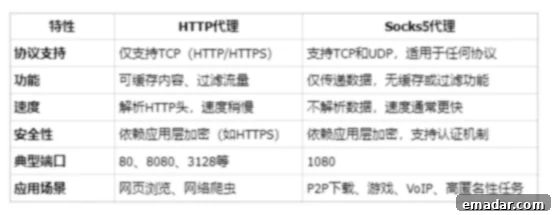
Beyond the simple feature list, the implications of these differences are profound. An HTTP proxy’s ability to interpret web requests means it can manage, cache, and even alter the data as it passes through. This is powerful for web-specific tasks but can be a security concern if the proxy is untrusted, especially for HTTPS traffic (though modern HTTP proxies tunnel HTTPS, mitigating this). Socks5, by contrast, operates with minimal intervention at the application layer, treating all data as generic packets. This ‘tunneling’ approach offers a higher degree of anonymity because the proxy doesn’t inject its own headers or modify the data in ways that could reveal its presence. Consequently, Socks5 proxies are often preferred for applications where the content of the data needs to remain completely untouched or for non-web protocols that HTTP proxies cannot handle.
How to Choose the Right Proxy Protocol for Your Needs
Selecting the most appropriate proxy protocol is a critical decision that should be guided by your specific requirements and the nature of your online activities. There’s no one-size-fits-all solution; instead, the ideal choice depends on factors such as the type of traffic you’re handling, your need for anonymity, performance expectations, and ease of configuration. Carefully considering these aspects will ensure you leverage the full potential of proxy technology while optimizing for efficiency and security.
- For Web-Related Tasks: If your primary activities involve web browsing, accessing websites, or conducting data scraping and market research, an HTTP proxy is often the optimal choice. Its inherent support for HTTP/HTTPS, coupled with beneficial features like caching (which speeds up repeat page loads and saves bandwidth) and content filtering (for blocking ads or malicious content), makes it highly efficient for web-centric operations.
- For Non-Web Applications and Real-Time Services: When dealing with applications that extend beyond standard web browsing, such as online gaming, large-scale P2P file downloads, video conferencing platforms (e.g., Zoom, Skype), or VoIP calls, a Socks5 proxy is undoubtedly the superior option. Its crucial ability to support both TCP and UDP protocols makes it universally compatible with nearly any internet application, ensuring smooth performance for real-time and diverse network traffic.
- For High Anonymity and Undetectability: If your objective is to maximize anonymity and minimize the chances of detection by target servers or services, Socks5 proxies are generally preferred. Because Socks5 operates at a lower level and does not modify the data packets or inject application-layer headers, it presents a much cleaner and less identifiable digital footprint, making it more challenging for sophisticated detection systems to identify the use of a proxy.
For instance, cross-border e-commerce users frequently need to switch IP addresses to avoid detection and blocking by target websites when performing competitive analysis or localized content checks. IPFLY’s dynamic residential proxies offer an excellent solution by providing rotating IP addresses that mimic real user behavior. This advanced feature ensures that data scraping and market research efforts proceed smoothly and without interruption, as the IP addresses are continuously refreshed, making it difficult for anti-bot systems to flag repeated requests. Conversely, for scenarios demanding a consistent and stable IP address, such as managing multiple social media accounts or maintaining persistent access to specific online services, IPFLY’s static residential proxies deliver reliable IP isolation. This prevents account linkage and protects against bans, offering a dedicated and trustworthy online identity for each managed account.
Why IPFLY’s Solutions are Highly Recommended: A Technical Edge
IPFLY distinguishes itself in the proxy market through a combination of robust technological infrastructure and intelligent IP management, enabling users to efficiently configure and leverage high-quality proxy IPs:
- Proprietary Server Network: IPFLY operates its own extensive server network strategically deployed across major global cities. This self-managed infrastructure ensures the highest purity and cleanliness of IP resources, significantly reducing the risk of encountering “blacklisted” or compromised IPs that could jeopardize user operations.
- Dynamic IP Allocation Mechanism: To combat detection and maintain seamless access, IPFLY implements an advanced dynamic IP allocation system. This automatically rotates IP addresses during usage, effectively mitigating the risks associated with prolonged use of a single IP address, such as rate limiting or outright bans from target websites.
- Multi-layered IP Filtering: Leveraging sophisticated big data algorithms, IPFLY rigorously screens and filters its IP pool. This multi-tiered approach systematically eliminates low-quality or suspicious IPs, guaranteeing a consistently high success rate for proxy connections and ensuring that users always receive reliable and efficient service.
“Don’t let dirty IPs ruin your accounts – secure your online presence now!” 👉 Claim your exclusive discount for premium IP addresses today!