

In the digital age, online activities have become a fundamental component of daily life and core business operations. Whether it’s cross-border e-commerce businesses accessing international platforms, or enterprises engaging in critical data collection and market analysis, Proxy IP technology serves as an indispensable tool, playing a pivotal role in enabling seamless and secure online interactions.
Understanding Proxy IP: Definition and Core Principles
A Proxy IP, or simply a proxy, refers to a technology that routes your internet requests through an intermediary server, known as a proxy server. When a user attempts to access a target website, their request is first sent to the proxy server. The proxy server then forwards this request to the intended destination website. Crucially, the target website receives and registers the IP address of the proxy server, rather than the user’s true IP address.
The core principle of proxy IP can be simplified into this straightforward mechanism:
User Device → Proxy Server → Target Website
Target Website Response → Proxy Server → User Device
This “middleman” or “relay” mechanism offers a multitude of benefits. It effectively conceals the user’s real IP address, which is vital for privacy and security. Furthermore, it enables users to circumvent geographical restrictions, accessing content or services that might otherwise be unavailable in their region. Beyond these, proxies significantly enhance network security by adding an extra layer of protection between the user and the vast expanse of the internet.
Key Advantages of Using Proxy IPs
Beyond the fundamental definition, understanding the practical advantages of proxy IPs highlights why they are so essential in today’s digital landscape. These benefits extend across various sectors and user needs:
- Enhanced Anonymity and Privacy: By masking your real IP address, proxies make it difficult for websites, advertisers, and even potential malicious actors to track your online activities or pinpoint your physical location. This is crucial for protecting personal information and maintaining privacy in an increasingly surveillance-heavy online environment.
- Bypassing Geo-Restrictions: Many online services, streaming platforms, and websites impose geographical restrictions on their content or services. A proxy server with an IP address from a different region can effectively “trick” these platforms into thinking you are accessing them from an allowed location, granting you unrestricted access.
- Improved Security: Proxies can act as a shield against various online threats. They can filter out malicious content, block unwanted ads, and protect your device from direct exposure to potentially harmful websites. In a corporate setting, proxies can be used to enforce security policies and protect internal networks.
- Optimized Performance and Speed: Some proxy servers utilize caching mechanisms. This means they store copies of frequently accessed web pages. When another user requests the same page, the proxy can deliver it from its cache, significantly reducing loading times and bandwidth usage.
- Data Collection and Web Scraping: For businesses and researchers, proxies are indispensable for large-scale data collection. They allow automated bots to make numerous requests to websites without being detected and blocked, enabling efficient market research, competitive analysis, and price monitoring.
Main Types of Proxy IPs and Their Ideal Use Cases
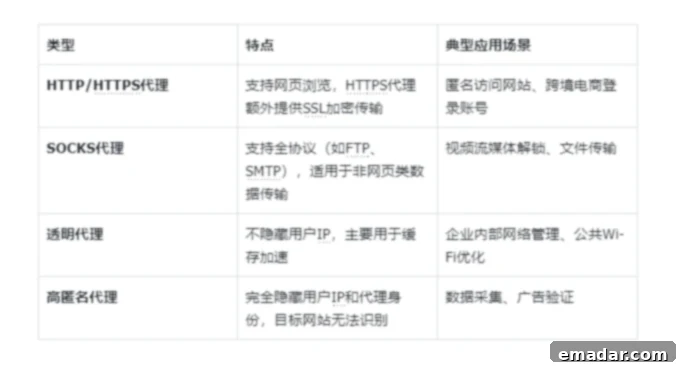
Proxy IPs come in various forms, each suited for different applications based on their underlying technology, anonymity levels, and performance characteristics. Understanding these distinctions is crucial for selecting the right proxy for your specific needs.
Residential Proxies
Residential proxies use IP addresses assigned by Internet Service Providers (ISPs) to real homes. These are considered highly legitimate and are less likely to be detected or blocked by websites. They mimic the behavior of a genuine user, making them ideal for tasks requiring high anonymity and trust.
- Static Residential Proxies: These proxies provide a consistent, dedicated IP address for an extended period. They are perfect for maintaining stable online identities, such as managing multiple social media accounts, running several e-commerce stores, or any situation where consistent IP identity is crucial to avoid triggering security alerts.
- Dynamic Residential Proxies: Also known as rotating residential proxies, these IPs change frequently, either with every request or at set intervals. They are invaluable for large-scale web scraping, data harvesting, ad verification, and market research where a vast pool of diverse IPs is needed to bypass IP blocking and rate limits.
Datacenter Proxies
Datacenter proxies originate from secondary servers within data centers. They are often faster and cheaper than residential proxies but can be more easily detected by sophisticated websites due to their identifiable server IP ranges.
- Use Cases: Ideal for high-speed, high-volume tasks where anonymity isn’t the absolute top priority, such as general browsing, accessing less protected websites, or performing simple speed tests. They are also used for traffic generation, SEO monitoring, and content delivery networks.
Mobile Proxies
Mobile proxies utilize real mobile IP addresses from cellular networks (3G, 4G, 5G). These are highly trusted because mobile IPs are shared among many users in a geographical area, making it very difficult for websites to identify and block them. They offer unparalleled legitimacy.
- Use Cases: Essential for social media management, testing mobile applications, accessing region-specific mobile content, and any task requiring the highest level of authenticity in a mobile environment.
Shared vs. Dedicated Proxies
- Shared Proxies: These IPs are used by multiple users simultaneously. While more affordable, their performance and reliability can be inconsistent, and there’s a higher risk of being blocked if another user abuses the IP.
- Dedicated Proxies: An IP address assigned exclusively to a single user. This offers maximum control, higher speed, and better reliability, making them suitable for critical tasks where performance and uptime are paramount.
Anonymity Levels
- Transparent Proxies: Websites can detect that you are using a proxy and can see your real IP address. Primarily used for caching.
- Anonymous Proxies: Websites can detect that you are using a proxy, but your real IP address remains hidden.
- Elite Proxies (High-Anonymity): Websites cannot detect that you are using a proxy, nor can they see your real IP address. These offer the highest level of anonymity and are preferred for sensitive tasks.
Practical Application Cases of Proxy IPs
The versatility of proxy IPs makes them invaluable across a wide range of real-world scenarios, transforming how individuals and businesses operate online.
Cross-border E-commerce and Social Media Operations
Cross-border e-commerce platforms often require access to overseas websites, such as Amazon, Shopify, or eBay. Direct access might be restricted due to IP geo-location, leading to account suspensions or limited functionality. By utilizing static residential proxies, businesses can simulate the real network environment of a target market user, ensuring stable account logins and seamless store management. This approach helps to avoid triggering risk control mechanisms that are often activated by anomalous IP addresses.
Example: A prominent cross-border e-commerce team successfully maintained the stability of their Amazon seller accounts for an extended period by using static residential IPs based in the United States. This strategic use of proxies not only prevented account suspensions but also led to a significant 30% improvement in order processing efficiency and overall operational fluidity. Similarly, for social media marketing, managing multiple accounts across different regions (e.g., Instagram, Facebook, TikTok) requires distinct, trusted IPs to avoid being flagged as spam or bot activity.
Data Collection and SEO Optimization
Search engines like Google employ sophisticated anti-scraping measures and may impose rate limits or block IPs that exhibit high-frequency access patterns. To circumvent these IP blocks and ensure continuous data flow, organizations can implement a strategy involving dynamic residential proxies with robust rotation capabilities. This allows for continuous data extraction without interruption.
Example: A leading market analysis company leveraged a vast pool of dynamic residential IPs to collect crucial pricing data from over 50 global e-commerce platforms. By rotating IPs frequently, they successfully completed over 100,000 requests daily with a success rate exceeding 99%, gaining competitive insights that would have been impossible with a single IP address. In SEO, proxies are used for keyword research, competitor analysis, monitoring SERP rankings from different geographical locations, verifying localized ad campaigns, and ensuring that websites are displayed correctly for various user demographics without triggering cloaking penalties.
Network Security and Privacy Protection
In public Wi-Fi environments, users’ real IP addresses can be vulnerable to various network attacks and surveillance. By routing traffic through a proxy IP, users can effectively isolate their internal network from potential external threats, significantly reducing the probability of data leakage or exposure to malicious actors. Proxies add a critical layer of defense, making it harder for cybercriminals to intercept data or identify specific users.

Proxy IP Configuration and Usage Guide
Effective utilization of proxy IPs requires careful selection and correct configuration. This section outlines key considerations and common setup methods.
Key Selection Criteria for Proxy Services
Choosing the right proxy provider is crucial for optimal performance and reliability. Consider these factors:
- IP Resource Scale: Look for providers with extensive coverage in terms of countries and regions. A larger and more diverse IP pool (especially for dynamic IPs) ensures better rotation and reduces the likelihood of blocks. The frequency of IP pool updates is also vital for fresh and unblocked IPs.
- Protocol Compatibility: Ensure the service supports all necessary protocols, such as HTTP, HTTPS, and SOCKS5. HTTP/HTTPS are standard for web browsing, while SOCKS5 offers more flexibility for various types of internet traffic and applications beyond just web pages.
- Stability and Speed: A reliable proxy service should guarantee high uptime (e.g., 99.9% availability) and offer low latency (millisecond-level response times). Test the proxy speed before committing, especially for latency-sensitive applications like gaming or real-time trading. Providers like IPFLY are known for meeting these stringent requirements.
- Anonymity Level: For tasks requiring privacy, opt for elite or high-anonymity proxies.
- Customer Support: Responsive and knowledgeable support can be invaluable when troubleshooting issues.
Common Configuration Methods
Proxies can be configured in various ways, depending on your operating system or application needs:
- System-wide Configuration (e.g., Windows):
- On Windows, navigate to Control Panel → Network and Internet → Internet Options.
- Go to the “Connections” tab and click “LAN settings.”
- Under “Proxy server,” check “Use a proxy server for your LAN” and manually enter the proxy IP address and port number provided by your proxy service. You can also specify exceptions for local addresses.
- Similar settings exist on macOS (System Settings → Network → Wi-Fi/Ethernet → Details → Proxies) and Linux (usually in network settings or environment variables).
- Browser-specific Extensions: Many web browsers offer extensions (e.g., FoxyProxy for Firefox/Chrome) that allow you to easily manage and switch between multiple proxy configurations without affecting your entire system.
- Programmatic Access (e.g., Python Web Scraping): For automated tasks like web scraping, proxies are typically integrated directly into the code using API interfaces. Libraries such as Python’s `requests` can be configured to use proxies:
import requestsproxies = {
'http': 'http://user:pass@proxy_ip:port',
'https': 'https://user:pass@proxy_ip:port',
}response = requests.get('http://example.com', proxies=proxies)Many proxy providers offer API endpoints for dynamic proxy rotation, allowing your application to request new IPs on demand.
Common Questions and Important Considerations
Navigating the world of proxy IPs can raise several questions, especially regarding legality, best practices, and potential pitfalls.
Is Using a Proxy IP Legal?
Proxy IP technology itself is neutral and perfectly legal. Its legality hinges entirely on how it is used. Using proxies for legitimate purposes, such as enhancing privacy, accessing public data, or managing multiple legitimate accounts, is generally acceptable. However, using proxies for illegal activities like committing fraud, distributing malware, or accessing copyrighted content without permission is, of course, illegal and carries severe consequences. Always ensure your proxy usage complies with local laws and the terms of service of the websites you access.
How Can I Avoid My IP Being Blocked or Banned?
Website administrators implement various anti-bot and anti-scraping measures to protect their resources. To avoid IP bans:
- For Dynamic IPs (Web Scraping/Data Collection):
- Set Reasonable Request Frequencies: Avoid making excessively rapid requests from a single IP. A general rule of thumb is 1-2 requests per second, but this can vary. Implement random delays between requests.
- Rotate IPs Effectively: Ensure your IP rotation strategy is robust. The more IPs you have and the more frequently you rotate them, the less likely you are to be flagged.
- Mimic Human Behavior: Use realistic User-Agent headers, manage cookies, and, if possible, incorporate mouse movements or scroll actions in your automation scripts.
- Handle Captchas: Integrate CAPTCHA-solving services if unavoidable.
- For Static IPs (Account Management):
- Choose High-Anonymity Services: Elite proxies are less likely to be detected.
- Maintain Consistency: Stick to one IP or a small set of IPs for specific accounts to build trust.
- Avoid Suspicious Activities: Do not engage in rapid, repetitive actions that would trigger anti-spam or fraud detection systems.
What are the Risks of Using Free Proxy IPs?
While appealing due to their cost, free proxy IPs come with significant risks and drawbacks:
- Security Vulnerabilities: Free proxies are often run by unknown entities and may intercept your traffic, potentially stealing sensitive data like login credentials or financial information. They can also inject malware or unwanted ads.
- Poor Performance: Free proxies are typically overcrowded, leading to extremely slow speeds, frequent disconnections, and high latency. They often have limited bandwidth.
- Unreliability and Instability: They are prone to sudden shutdowns, IP bans, and inconsistent availability, making them unsuitable for any serious or long-term tasks.
- IP Reuse and Blacklisting: Free IPs are heavily reused and often quickly blacklisted by websites, rendering them ineffective for bypassing restrictions.
It is strongly recommended to opt for reputable, enterprise-grade proxy services that guarantee security, performance, and dedicated support, such as IPFLY proxy services, to safeguard your operations and data.
Proxy IP vs. VPN: What’s the Difference?
While both proxies and VPNs (Virtual Private Networks) mask your IP address, they operate differently:
- VPNs: Encrypt all your internet traffic and route it through a secure tunnel to a remote server. This protects all applications on your device.
- Proxies: Typically operate at the application level (e.g., for a specific browser or program) and do not always encrypt traffic. They are more granular but offer less comprehensive security than a VPN.
The choice depends on whether you need system-wide encryption and privacy (VPN) or application-specific IP masking (proxy).
As a foundational network technology, proxy IP serves as both a shield for privacy protection and an accelerator for business efficiency. Whether for individual users seeking to bypass geographical restrictions or for enterprise-level applications involving large-scale data processing, the judicious selection of proxy IP types and their proper, ethical use will undoubtedly be a critical capability in the fiercely competitive digital landscape. Embracing this technology wisely can unlock new opportunities and ensure a safer, more open online experience for everyone.