
Every device connected to the internet operates with an assigned Internet Protocol (IP) address. This unique numerical identifier is fundamental for communication, enabling data packets to find their correct destination across vast global networks. IP addresses dictate how devices interact, from accessing websites to streaming content or hosting servers. Understanding the nuances between different types of IP addresses is critical for optimizing network performance, enhancing security, and managing online privacy. Fundamentally, IP addresses can be categorized into two primary types: **static** and **dynamic**.
A **static IP address** is a permanent fixture, remaining constant over extended periods, often indefinitely, unless manually reconfigured. In contrast, a **dynamic IP address** is temporary and changes periodically, typically assigned on a rotational basis by an Internet Service Provider (ISP). The choice between these two seemingly technical distinctions profoundly impacts various aspects of online activity, ranging from personal browsing habits and digital privacy concerns to the reliability of business operations and server hosting. Each type presents a unique set of advantages and disadvantages, making the decision dependent on specific user needs and operational requirements.
This comprehensive article delves into the core differences between static and dynamic IPs, meticulously exploring their respective benefits and drawbacks. We will examine ideal use cases for each, providing insights that can guide individuals and organizations in making informed decisions. Furthermore, we will highlight how advanced providers like IPFLY offer sophisticated proxy solutions, such as static residential IPs and dynamic proxies. These specialized services are engineered to blend stability, robust anonymity, and superior performance, offering a versatile approach to managing your online presence and protecting your digital assets in an ever-evolving internet landscape.
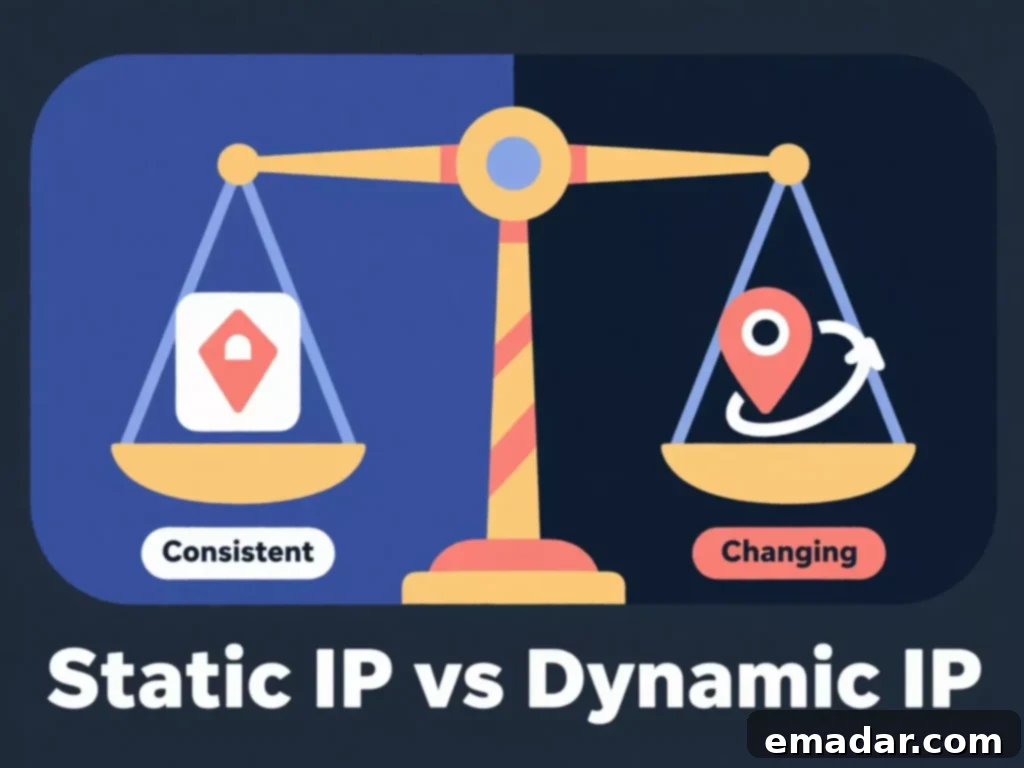
What Is a Static IP?
A static IP address is, by definition, an unchanging numerical label assigned to a device within a network. Once designated, this address remains constant until it is manually reconfigured by a network administrator or your Internet Service Provider (ISP). Think of it as a permanent street address for your digital device; it doesn’t shift, making it reliably traceable and consistently accessible.
This inherent stability makes static IPs particularly valuable in environments where consistent and uninterrupted connectivity is paramount. They are a cornerstone for many business operations and specialized services that demand predictable accessibility. Common applications include:
- Hosting Websites and Applications: For any server hosting a website, an e-commerce platform, or a dedicated application, a static IP ensures that its domain name (e.g., `www.yourwebsite.com`) consistently resolves to the correct server location. This eliminates downtime associated with IP changes and guarantees users can always reach your online services.
- Running Email Servers: Businesses often operate their own email servers for enhanced control, security, and branding. A static IP address for an email server is crucial for maintaining a strong sender reputation and ensuring reliable email delivery, preventing legitimate emails from being flagged as spam due to an inconsistent or blacklisted dynamic IP.
- Facilitating Remote Work and VPN Connections: Many organizations rely on Virtual Private Networks (VPNs) for secure remote access to internal networks and resources. A static IP on the corporate network’s gateway simplifies VPN configuration and ensures that remote employees can always establish a stable and predictable connection without needing frequent address updates.
- Managing Security Cameras and IoT Devices: Modern Internet of Things (IoT) devices, including smart home systems, industrial sensors, and surveillance cameras, often require remote access and monitoring. A static IP allows direct, reliable access to these devices from anywhere, enabling real-time management and security oversight without interruption.
- Dedicated Gaming Servers: For serious online gaming communities or professional esports teams, hosting a dedicated game server with a static IP ensures consistent availability, lower latency, and a stable connection for all players, enhancing the overall gaming experience.
The predictability offered by a static IP is a critical advantage for intricate network configurations, seamless remote access protocols, and guaranteeing maximum uptime for essential services. It simplifies network management by removing the variable of a changing IP address, allowing for more stable firewall rules, port forwarding configurations, and consistent DNS record management.
What Is a Dynamic IP?
In contrast to its static counterpart, a dynamic IP address is temporary and changes periodically. This rotation usually occurs every time a device reconnects to the internet, or at predetermined intervals orchestrated by your ISP’s Dynamic Host Configuration Protocol (DHCP) server. Instead of a fixed address, devices are assigned an IP from a pool of available addresses, which can then be reused by other devices once the lease expires or the device disconnects.
Dynamic IPs are the default and most prevalent type of IP address for the vast majority of internet users, especially in residential and small office environments. This widespread adoption is primarily due to several key advantages they offer to both ISPs and end-users:
- Easier Management for ISPs: Dynamic IP allocation streamlines network administration for Internet Service Providers. Rather than manually assigning and tracking individual IPs, ISPs can automate the process, efficiently managing a large pool of addresses and distributing them as needed. This reduces operational overhead and simplifies network scaling.
- Efficient Address Space Utilization: With the finite supply of IPv4 addresses, dynamic IP allocation is crucial for conservation. Instead of permanently assigning an address to every device (many of which are not always active), ISPs can dynamically assign addresses only when a device needs to be online. Once the device disconnects or its lease expires, the IP returns to the pool for another user, maximizing the efficient use of available addresses.
- Enhanced Privacy Through Rotation: For the average user, a dynamic IP offers a degree of enhanced privacy. Because your IP address changes periodically, it becomes more challenging for websites, advertisers, and third-party trackers to build a persistent long-term profile tied to a single, unchanging identifier. While not a foolproof privacy solution, the rotation makes consistent tracking more difficult without additional measures.
- Automatic Configuration: Dynamic IPs are incredibly user-friendly due to their automatic configuration. When a device connects to a network, the DHCP server automatically assigns it an IP address, along with other necessary network parameters (like gateway and DNS server addresses). This “plug-and-play” functionality eliminates the need for manual setup, making it ideal for non-technical users and simplifying network setup at home.
For casual internet users who primarily engage in activities such as browsing websites, streaming movies, or playing online games without the need to host public-facing services, a dynamic IP is typically the simplest, most convenient, and most cost-effective choice. It requires no technical configuration from the user and seamlessly integrates into everyday internet usage.
Advantages of Static IP
While dynamic IPs are the norm for general use, static IPs offer distinct advantages crucial for specific applications and professional environments.
1. Consistency for Hosting and Services
For anyone hosting a website, running a dedicated game server, or maintaining a specific application that needs to be continuously accessible to the public, a static IP is indispensable. It provides an unchangeable target for domain name system (DNS) records. This stability ensures that your domain name always points to the correct server without needing constant updates. The result is minimized downtime, increased reliability for your online services, and a guarantee that users can consistently connect without interruption. Businesses relying on e-commerce, content delivery networks (CDNs), or private cloud services greatly benefit from this unwavering connectivity.
2. Easier Remote Access and Management
A fixed IP address significantly simplifies the process of setting up and managing remote connections. Whether you need to access a remote desktop, connect to a company server via VPN, or manage smart home devices from afar, a static IP ensures a predictable entry point. IT administrators can configure firewalls, port forwarding rules, and access control lists with confidence, knowing that the target IP address will not change unexpectedly. This predictability is vital for maintaining secure and efficient remote operations, from industrial control systems to personal network-attached storage (NAS) devices.
3. Better Email Deliverability and Reputation
Email services, especially for businesses, rely heavily on a clean sending reputation. Dynamic IPs are often shared among many users, and if even one user engages in spamming or malicious activities, the shared IP address can be blacklisted by email providers. With a dedicated static IP, you maintain exclusive control over your sending reputation. This significantly improves the chances that your legitimate business emails, newsletters, or transactional messages land in recipients’ inboxes rather than being diverted to spam folders, protecting your communication effectiveness and brand integrity.
4. Enhanced Stability for Real-Time Applications
Applications that are highly sensitive to latency and connection drops, such as online gaming, video conferencing (VoIP), and live streaming, perform optimally with a stable and consistent connection. A static IP ensures that your network endpoint doesn’t reset or change unexpectedly, which can lead to frustrating disconnections, lag spikes, or degraded audio/video quality. This stability is crucial for professional gamers, remote teams conducting important video calls, and anyone relying on uninterrupted real-time communication.
5. Geographic Specificity for Certain Services
Some applications or services might require a fixed geographical location for compliance, content delivery, or licensing. A static IP can be tied to a specific region, providing consistent geo-location information which is vital for businesses operating with regional restrictions or offering geo-targeted content. This offers an advantage for local SEO or specialized applications.
Advantages of Dynamic IP
Despite the specific benefits of static IPs, dynamic IPs hold significant advantages for the majority of internet users, primarily revolving around cost, privacy, and ease of use.
1. Lower Cost and Accessibility
The most immediate and tangible benefit of dynamic IPs is their cost-effectiveness. They are typically included as the standard option in your basic internet service plan, incurring no additional charges. ISPs prefer dynamic allocation because it allows them to manage their IP address inventory more efficiently. This operational saving is passed on to consumers, making internet access more affordable and accessible for everyone, as static IPs often come with an extra monthly fee, sometimes substantial, depending on the provider and service level.
2. Enhanced Privacy and Anonymity (Relative)
While not a complete anonymity solution, the periodic changing of your IP address offers a degree of enhanced privacy. It makes it harder for websites, advertising networks, and data analytics companies to persistently track your online activities over extended periods using just your IP address as a unique identifier. Every time your IP changes, it creates a minor hurdle for building a comprehensive, long-term profile linked to a single identifiable point. This rotation helps obfuscate your digital footprint, making it more difficult for targeted surveillance or highly personalized advertising that relies on consistent IP-based tracking.
3. Automatic and Effortless Configuration
Dynamic IPs are designed for simplicity and convenience. There’s no manual setup required on the user’s part. When you connect a new device to your network or your existing device reconnects, the DHCP server automatically assigns an available IP address. This “set it and forget it” approach eliminates the need for any technical knowledge or complex configuration, making it ideal for home users and simplifying network management for small setups. It’s a true plug-and-play experience that contributes significantly to the ease of internet usage for the general public.
4. Reduced Risk of Persistent Targeting
Although it’s not a security feature in itself, the changing nature of dynamic IPs can make it more challenging for malicious actors to repeatedly target a specific device or network. If your IP address rotates, an attacker would need to constantly discover your new address, making sustained, persistent attacks (like distributed denial-of-service, or DDoS, attacks) more difficult to execute effectively against a single, unchanging target. This offers a minor layer of defense compared to a fixed static IP that is always at the same address.
Drawbacks to Consider
Choosing between a static and dynamic IP involves understanding not just their benefits but also their inherent limitations and potential drawbacks. Both types carry specific trade-offs that can influence network performance, security posture, and overall user experience.
| Feature | Static IP | Dynamic IP |
| Cost | Higher, often an extra fee | Typically included in standard plans |
| Privacy | Easier to track due to consistent identity | Harder for persistent tracking due to rotation |
| Security | Easier target if unprotected; constant visibility | Safer from repeated targeting; changing endpoint |
| Setup | Manual configuration or ISP assignment required | Automatic assignment via DHCP |
| Hosting Public Services | Ideal for servers, VPN gateways, remote access | Not ideal; requires Dynamic DNS for consistency |
| Reliability for Business | High; consistent connectivity for critical services | Lower; potential for IP changes impacting services |
| Email Deliverability | Better; controlled sender reputation | Risk of blacklisting if shared IP is abused |
Static IPs, despite their advantages in stability, come with notable security considerations. Because a static IP address is constant, it presents a continuous, unchanging target for potential attackers. This persistent visibility makes it easier for malicious entities to perform reconnaissance, identify vulnerabilities, and launch repeated, sustained attacks like brute-force attempts or Denial of Service (DoS) attacks. Without robust security measures such as advanced firewalls, intrusion detection systems, and vigilant network monitoring, a static IP can indeed become a more vulnerable point of entry into a network. Moreover, they are generally more expensive and offer less inherent privacy due to their fixed nature.
Conversely, dynamic IPs, while offering cost savings and a degree of privacy, introduce inconveniences, particularly for users who require consistent access or wish to host services. The changing nature of a dynamic IP means that any service relying on a specific address will experience disruptions. For instance, if you’re trying to remotely access your home computer or host a small website, the IP address changing will break the connection until the new IP is updated. This often necessitates the use of dynamic DNS (DDNS) services, which automatically update your domain name to point to your new IP address. While DDNS can mitigate this issue, it adds a layer of complexity and an additional service to manage, detracting from the “simplicity” benefit of dynamic IPs when hosting is a requirement.
Security Considerations
Security is an undeniably critical factor in the debate between static and dynamic IPs, especially for businesses and individuals with valuable digital assets. A static IP, by its very nature of being a permanent, unchanging address, is inherently easier for attackers to target and monitor. This consistent visibility means that once an attacker identifies your network’s static IP, they have a stable target for prolonged reconnaissance, vulnerability scanning, and sustained attacks. This risk, however, is not insurmountable and can be effectively mitigated through a layered security approach:
- Robust Firewalls: Implementing advanced firewalls (both hardware and software) is fundamental. These act as the first line of defense, monitoring and controlling incoming and outgoing network traffic based on predefined security rules. They can block unauthorized access attempts, filter malicious packets, and prevent common attack vectors.
- VPN Encryption: Utilizing Virtual Private Networks (VPNs) for all remote access and sensitive communications adds a crucial layer of encryption. A VPN encrypts your data traffic, making it unreadable to eavesdroppers, and can also mask your real IP address from the outside world, effectively shielding your static IP from direct exposure.
- Intrusion Detection and Prevention Systems (IDS/IPS): These systems continuously monitor network traffic for suspicious activity and known attack patterns. An IDS will alert administrators to potential threats, while an IPS can automatically block or prevent detected intrusions in real-time, providing proactive defense against evolving cyber threats.
- Regular Security Audits and Updates: Consistent patching of software, firmware, and operating systems, coupled with regular security audits, helps identify and remediate vulnerabilities before they can be exploited by attackers.
Beyond these conventional measures, many users and organizations combine the benefits of a static IP with additional layers of protection by employing specialized proxy services, such as those offered by IPFLY. IPFLY can provide access to a static IP through a secure proxy server. This setup means your devices communicate with the internet via the proxy’s IP address, effectively masking your real, internal static IP address from the public eye. This approach not only adds a layer of encryption and obfuscation but also allows you to choose from a vast pool of global IP locations. By routing your traffic through a proxy, you make it significantly harder for attackers to pinpoint your actual network infrastructure, enhancing anonymity and providing geographical flexibility for your online operations. This blend of reliability and enhanced security makes proxy services an attractive option for sophisticated users.
Choosing Based on Your Needs
The decision between a static and a dynamic IP address, or leveraging a proxy service, boils down to understanding your specific operational requirements and priorities. Each option serves different needs effectively.
Use a Static IP if you:
- Run Servers or Services Accessible Remotely: This includes web servers, email servers, FTP servers, private cloud storage (NAS), CCTV systems, or any application that needs a consistent public endpoint for users to connect to reliably. Critical for businesses hosting their own infrastructure.
- Require Predictable Network Access: If your business relies on stable remote access for employees via VPNs, or if you need consistent port forwarding for specific applications (like online gaming servers, VoIP systems, or industrial IoT devices), a static IP guarantees that these connections remain uninterrupted.
- Host Sensitive or Real-Time Applications: For applications where connection stability and low latency are paramount, such as financial trading platforms, dedicated multiplayer game servers, high-definition video conferencing, or real-time data streaming, a static IP minimizes disruptions and optimizes performance.
- Need a Reliable Sender Reputation: Businesses that frequently send emails, newsletters, or transactional messages benefit from the dedicated reputation of a static IP, reducing the likelihood of their legitimate communications being flagged as spam.
Use a Dynamic IP if you:
- Mainly Browse, Stream, or Game Casually: For the average home user whose primary internet activities involve surfing the web, watching Netflix, making video calls, or playing non-dedicated online games, a dynamic IP is perfectly sufficient and often preferable due to its cost-effectiveness and ease of use.
- Prioritize Cost and Simplicity: If budget is a primary concern and you don’t require any advanced network configurations or hosting capabilities, a dynamic IP is the default, free option included with most internet plans, offering a hassle-free, automatically configured connection.
- Value Rotating Privacy Without Added Tools: While not absolute, the periodic change in IP address provides a basic layer of privacy by making it more challenging for persistent tracking through IP-based identification alone. For users who prefer not to invest in additional VPNs or proxy services, this inherent rotation offers a degree of obfuscation.
Use a Static IP Proxy from IPFLY if you:
- Want the Reliability of a Fixed IP Without Exposing Your Actual Address: This is ideal for tasks requiring consistent session management (e.g., managing multiple social media accounts, e-commerce store operations) where stability is key but protecting your true identity is also crucial. IPFLY’s static residential proxies provide this blend of permanence and anonymity.
- Need Global IP Coverage for Marketing, Scraping, or Localization: For advanced use cases like web scraping large datasets, competitive intelligence, ad verification, market research, or testing localized content from specific geographical regions, IPFLY offers a vast network of static IPs across many countries, allowing precise geo-targeting while maintaining session integrity.
- Require Seamless Setup, Strong Anonymity, and Flexibility: IPFLY provides an intuitive dashboard for managing your proxy settings, ensuring easy deployment. Their proxies offer robust anonymity features to bypass detection, coupled with the flexibility to switch between static and dynamic, or different types of proxies, depending on the evolving needs of your tasks, offering a superior solution compared to basic ISP offerings.
How IPFLY Enables Static IP Flexibility
IPFLY distinguishes itself as a premier proxy service provider by offering a diverse and robust portfolio of IP solutions designed to meet the most demanding digital needs. Their comprehensive suite goes beyond standard ISP offerings, providing unparalleled flexibility, performance, and anonymity for both individuals and enterprises.
- Static Residential Proxies (ISP-level): These are a cornerstone of IPFLY’s offerings, featuring over 10 million real, high-quality IP addresses sourced directly from Internet Service Providers (ISPs) across 30+ countries. Unlike typical data center proxies, ISP-level residential proxies mimic genuine home user connections, offering exceptionally high trust and low detection rates. This makes them ideal for sensitive tasks requiring stable, dedicated connections, such as managing multiple e-commerce accounts, social media automation, brand protection, or accessing geo-restricted content where consistent sessions are vital. Their static nature ensures unwavering connectivity, preventing session drops and IP bans that can plague dynamic alternatives.
- Dynamic Residential Proxies: For tasks demanding maximum anonymity and the ability to frequently change IP addresses, IPFLY provides an expansive pool of over 90 million dynamic residential IPs spanning more than 190 countries. These proxies rotate to conceal identity, making them perfect for large-scale web scraping, market research, competitive analysis, and ad verification. The sheer volume and global distribution allow users to bypass IP bans and geographic restrictions effectively, maintaining a global reach while ensuring privacy and avoiding detection.
- Data Center Proxies: When speed and cost-efficiency are the top priorities for less sensitive tasks, IPFLY offers over 2 million high-performance data center IPs in 90+ countries. These proxies are designed for large-scale, fast operations such as bulk data transfers, certain types of content delivery, and tasks where the IP source is less critical than raw speed and reliability. They offer a cost-effective solution for high-volume activities without compromising on connectivity.
IPFLY places a strong emphasis on delivering fast, stable, and high-availability proxy services suitable for a wide array of professional applications, including sophisticated web scraping operations, detailed SEO monitoring, rigorous ad verification processes, and intricate e-commerce strategies. Their platform is meticulously designed to support multiple internet protocols—HTTP, HTTPS, and SOCKS5—offering broad compatibility with various software and network configurations. Furthermore, users benefit from highly customizable configurations accessible through a user-friendly dashboard, empowering them to fine-tune proxy settings to match specific project requirements. With IPFLY, users gain the unique advantage of choosing between static or dynamic IP settings based on the precise demands of their tasks, providing a level of control and flexibility significantly superior to what standard ISP offerings can provide.
Best Practices When Using IPFLY
To maximize the effectiveness and security of your IPFLY proxy services, adhere to these best practices:
- Define Your Objective Clearly: Before selecting a proxy type, explicitly define your task. For operations requiring consistent session management, such as account management, sensitive transactions, or long-term data monitoring, static residential proxies are the optimal choice. For tasks demanding high anonymity, rapid IP changes, and large-scale data collection (e.g., extensive web scraping or competitive analysis), dynamic proxies will be more effective. Understanding your goal helps tailor the proxy solution to achieve the best results.
- Strategically Select Target Regions: IPFLY’s extensive network allows for precise geolocation targeting. Utilize this feature to your advantage by selecting proxies in specific target regions. This is ideal for validating localized content, testing geo-restricted services, conducting regional market research, or bypassing geographic access limitations. Accurate geo-targeting ensures your data appears authentic to the target website or service.
- Implement Robust Security Measures for Your Setup: Always prioritize the security of your proxy usage. Employ secure authentication methods, such as strong username/password combinations or IP whitelisting, to prevent unauthorized access to your proxies. For dynamic proxies, configure appropriate rotation settings to enhance anonymity without causing disruptions. Regularly review and update your security protocols to safeguard your data and maintain the integrity of your operations.
- Continuously Monitor Performance and Usage: Leverage the IPFLY user dashboard to actively monitor your proxy usage, bandwidth consumption, and connection statistics. This oversight is crucial for optimizing your operations, identifying any potential issues (like slowdowns or excessive resource use), and ensuring cost-effectiveness. Regular monitoring allows for timely adjustments and maintains peak performance.
- Plan for Scalability and Future Needs: IPFLY’s widespread and vast IP network is designed to support scalable operations. When planning for data-intensive tasks or projects requiring global coverage, consider how your proxy usage might grow. IPFLY’s infrastructure allows for easy scaling up or down, ensuring that your proxy solution can adapt seamlessly to evolving project demands without compromising speed or reliability.
Conclusion

In the intricate landscape of modern networking, static and dynamic IP addresses each fulfill distinct and vital roles. Static IPs are the backbone for consistent access, providing an unwavering identity essential for hosting servers, enabling reliable remote operations, and maintaining a stable online presence for businesses. Conversely, dynamic IPs offer an appealing combination of cost-effectiveness, automatic configuration, and a foundational layer of privacy through their rotational nature, making them the preferred choice for the majority of everyday internet users.
However, the complexities of today’s digital world often demand a more sophisticated approach than what standard ISP offerings can provide. This is where specialized proxy service providers like IPFLY become indispensable. By offering a diverse range of solutions, including high-quality static residential proxies and extensive dynamic IP pools, IPFLY empowers users to precisely tailor their proxy setup to fit their unique and evolving needs. Whether your goal is to ensure uninterrupted reliability for critical applications, achieve robust anonymity for large-scale data collection, or conduct geo-targeted operations with unparalleled flexibility, IPFLY provides the tools to combine stability and anonymity effectively.
Making an informed decision about your IP strategy is paramount for navigating the internet efficiently and securely. With comprehensive options and expert guidance, you can optimize your online activities and protect your digital footprint. To stay updated with the latest trends and insights in the world of proxies and digital anonymity, we invite you to join IPFLY’s Telegram channel and never miss important proxy trends again.