
In the high-stakes world of cross-border e-commerce, international marketing, and data collection, the quality of your IP address often dictates the lifespan of your accounts and the success of your operations. While many understand the importance of using “residential IPs,” a more critical and often overlooked metric exists: IP Purity.
IP Purity refers to an IP address’s historical reputation and its susceptibility to being flagged for abuse on the internet. It’s not a visible technical parameter, yet it serves as the core determinant for how platform risk control systems assess the trustworthiness of your online requests. An IP with low purity, regardless of its connection speed, can trigger an immediate account ban the moment you attempt to log in or initiate a critical transaction.
This comprehensive guide will delve deep into the components of IP Purity, illustrate its profound impact on your cross-border ventures, and provide actionable strategies for scientifically selecting high-purity IP assets.
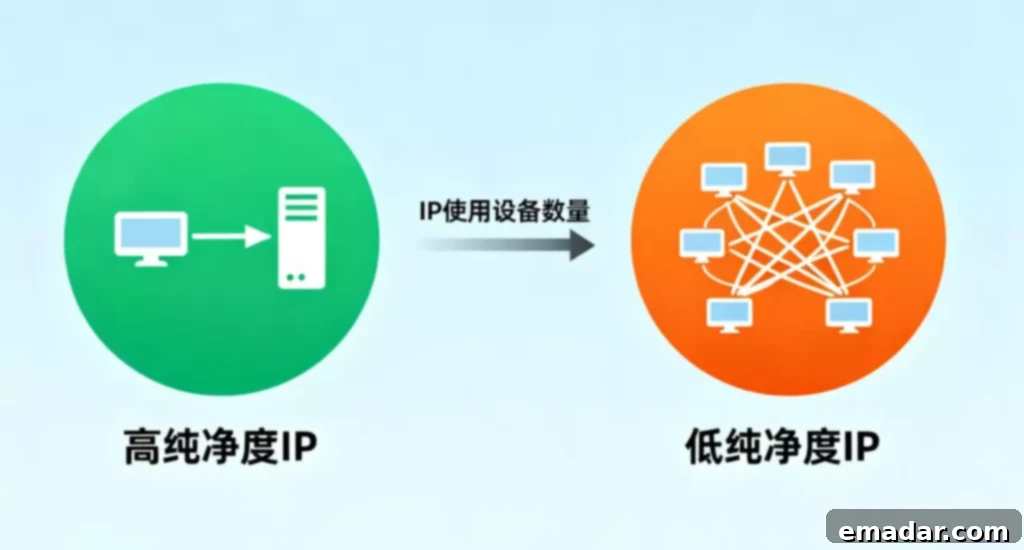
1. What is IP Purity? Unveiling the Secrets of Risk Control Systems
IP Purity is a multifaceted metric that quantifies the historical behavior and reputation of an IP address. You can conceptualize it as the IP address’s “digital credit report” or “reputation score” within the vast landscape of the internet. A high score signifies a clean, untainted history, while a low score indicates past misuse or association with suspicious activities.
1.1. Core Components Defining IP Purity
The overall purity of an IP address is predominantly influenced by several key factors:
- Blacklisting Records: This is arguably the most critical factor. An IP’s purity significantly plummets if it has ever been listed on major anti-spam or anti-fraud blacklists maintained by organizations like Spamhaus, IPQS, or other reputable threat intelligence providers. These blacklists compile IP addresses that have been reported for, or detected in, malicious activities such as sending spam, engaging in phishing, or distributing malware. Once an IP is blacklisted, it carries a severe stigma, making it instantly suspicious to most online platforms.
- Abuse History and Association: Beyond formal blacklists, platforms meticulously track an IP’s history of misuse. This includes instances where the IP was involved in sending bulk unsolicited emails, participating in distributed denial-of-service (DDoS) attacks, brute-force login attempts, large-scale automated account registrations, click fraud, or any form of policy violation. Even if not formally blacklisted, a history of such activities significantly degrades an IP’s purity score, as it suggests a pattern of potentially harmful or fraudulent behavior.
- IP Type and Origin: The inherent nature of an IP address plays a crucial role in its perceived purity. IP addresses originating from data centers (IDC IPs) are inherently viewed with more skepticism by risk control systems. This is because IDC IPs are frequently used by businesses for hosting, cloud services, and, importantly, for automated scripts, bots, and VPN services. In contrast, residential IPs, which are assigned by internet service providers (ISPs) to real homes and typically represent human users, inherently possess a higher baseline of purity. Their association with legitimate, organic user behavior makes them far more trusted by online platforms.
1.2. The Consequences of Low IP Purity: Digital “Guilt by Association”
When you attempt to interact with high-security or sensitive platforms (such as Amazon, Facebook, Stripe, Google Ads, etc.) using an IP address with low purity, the platform’s advanced risk control systems can instantly detect its tainted history. This often triggers immediate defensive measures, leading to severe operational disruptions:
- Account Bans or Association: The most direct and damaging consequence. A low-purity IP can instantly trigger platform fraud detection, leading to the immediate suspension or permanent banning of your account. Furthermore, platforms can link multiple accounts that have ever used the same low-purity IP, leading to a cascade of bans or permanent flags, effectively shutting down your operations.
- Frequent Human Verification Challenges: You’ll encounter an incessant barrage of CAPTCHAs, reCAPTCHAs, two-factor authentication requests, or other human verification steps during logins, navigation, or transactions. These measures are designed to deter automated bots and slow down suspicious activity, but for a legitimate user on a low-purity IP, they become a frustrating and time-consuming barrier.
- Advertising Account Rejection or Prolonged Review: For advertisers, a low-purity IP can be a nightmare. Ad accounts connected through suspicious IP environments are highly likely to be rejected outright or subjected to lengthy, often inconclusive, manual reviews by platforms like Facebook Ads or Google Ads. This not only delays your campaigns but can also lead to significant financial losses due to missed opportunities and wasted resources.
- Limited Access or Functionality: Some platforms may not outright ban you but will restrict certain functionalities, limit your viewing options, or prevent critical actions like posting, purchasing, or making payments, effectively rendering your account useless for its intended purpose.
2. Why High IP Purity is an Indispensable Requirement for Cross-Border Business
In every core facet of cross-border operations, from managing e-commerce stores to running advertising campaigns and gathering crucial market data, IP Purity plays an absolutely vital and non-negotiable role. It forms the unseen backbone of your digital credibility.
2.1. Cross-Border E-commerce: The Lifeblood of Your Accounts
For cross-border e-commerce businesses operating on platforms like Amazon, eBay, Etsy, or managing payment gateways such as Shopify Payments, PayPal, or Stripe, IP purity is paramount. An IP that fails to meet purity standards can lead to a multitude of crippling issues:
- Registration Failures: Attempts to register new seller accounts or buyer accounts often fail due to suspicious IP addresses, preventing you from even getting started.
- Payment Processing Issues: Transactions can be declined, or payment accounts flagged, severely impacting your ability to process orders and receive payments.
- Account Health and Longevity: High-purity IPs are crucial for maintaining long-term account health. Platforms are constantly monitoring user behavior; a clean IP helps establish a consistent, trustworthy profile, reducing the risk of sudden suspensions or bans that can cripple your business.
- Competitive Intelligence: Even for activities like monitoring competitor pricing, product listings, or market trends, a low-purity IP will quickly get blocked, preventing you from gathering essential strategic insights.
In essence, consistently utilizing high-purity IPs helps your accounts build a bedrock of trust with these platforms, ensuring smoother operations and long-term stability.
2.2. Advertising Campaigns: Lowering the Audit Barriers
The advertising ecosystems of giants like Facebook and Google Ads are equipped with extremely stringent audit mechanisms designed to combat fraud and maintain ad quality. If your advertising account is accessed via an IP address with a blacklisting record or a history of abuse, the system will automatically classify that account as high-risk, potentially associated with fraudulent activities. This has immediate and dire consequences:
- Ad Account Suspensions: Your ad accounts can be instantly suspended, halting all your campaigns and causing significant financial losses.
- Ad Rejections: New ad creatives or campaigns will likely be rejected outright, preventing them from ever reaching your target audience.
- Increased Ad Costs: Even if ads are approved, platforms may place stricter scrutiny on your account, potentially leading to higher bidding costs or limited reach due to a perceived lack of trust.
By deploying high-purity residential proxy IPs, advertisers can significantly enhance the approval rate and overall stability of their ad campaigns, ensuring their messages reach their intended audience without unnecessary roadblocks.
2.3. Data Collection: Boosting Success Rates and Efficiency
For businesses that rely on web scraping or data collection, the target websites’ anti-bot and anti-scraping mechanisms are a constant challenge. IP blacklisting is one of the primary defense strategies employed by these sites. A high-purity IP address, with its unblemished record, is far less likely to be blocked or rate-limited by target websites.
- Higher Success Rates: Pure IPs ensure that your data collection requests are perceived as legitimate, leading to a significantly higher success rate in retrieving the desired information.
- Data Integrity: Fewer blocks mean more consistent and complete data sets, crucial for accurate market analysis, competitive intelligence, and trend forecasting.
- Operational Efficiency: Avoiding constant IP blocks reduces the need for frequent IP rotation and troubleshooting, streamlining your data collection processes and saving valuable time and resources.
For example, providers like IPFLY prioritize IP purity. They leverage proprietary big data algorithms to meticulously screen and filter their IP pools. This rigorous process ensures that their dynamic and static residential proxies consistently offer IP Purity levels significantly above the industry average, effectively preventing business interruptions caused by compromised IP histories.
3. How to Scientifically Assess IP Purity?
As a savvy cross-border operator, relying solely on a service provider’s verbal assurances about IP quality is insufficient. It’s imperative to equip yourself with the knowledge and tools to independently verify the IP Purity of any proxy you intend to use. Here’s a systematic approach:
- Blacklist Query Tools: This is your first line of defense. Utilize widely recognized and authoritative blacklist checking tools such as Spamhaus, IPQS (IPQualityScore), or other reputable threat intelligence databases. Simply input the IP address you wish to check. If the query results indicate that the IP has any adverse records in these databases—such as being listed for spam, botnet activity, or fraudulent behavior—you should immediately discard it. A single negative entry can be a red flag.
- IP Type and Origin Verification: Understanding the true nature and origin of an IP is crucial. Visit reliable IP information services like
ipinfo.io,whoer.net, orwhatismyipaddress.com. These tools will provide a wealth of data about the IP, including:- Connection Type: Verify if the IP is identified as “Residential.” If it shows “Datacenter,” “VPN,” “Hosting,” or “Cloud,” its purity is inherently lower for most cross-border tasks.
- ISP (Internet Service Provider) Organization Name: A pure residential IP should be associated with a legitimate local broadband provider (e.g., AT&T, Comcast, Vodafone, BT Group). If it shows a cloud hosting provider (e.g., Amazon AWS, Google Cloud, DigitalOcean) or a known VPN service, it’s a datacenter or VPN IP, not a true residential one.
- ASN (Autonomous System Number): This number identifies the network to which the IP belongs. Cross-referencing the ASN with known ISP networks can further confirm its authenticity.
A genuinely pure IP will clearly display its affiliation with a local residential broadband provider, not a commercial hosting service.
- DNS Leak and WebRTC Leak Checks: Even with a proxy, your true identity can be compromised if there are DNS or WebRTC leaks.
- DNS Leak Check: When using a proxy, all your traffic, including DNS requests, should route through the proxy. A DNS leak occurs when your system bypasses the proxy for DNS requests, sending them directly to your local ISP’s DNS servers. This reveals your true geographical location and ISP, effectively nullifying the anonymity and IP Purity provided by the proxy. Use sites like
dnsleaktest.comto verify. - WebRTC Leak Check: WebRTC (Web Real-Time Communication) is a technology built into modern browsers that can, in some cases, expose your real IP address even when you’re behind a VPN or proxy. This is another critical vulnerability that can compromise your digital identity. Use sites like
browserleaks.com/webrtcto perform this check.
Ensure that both DNS and WebRTC checks show only the proxy’s location and IP, with no traces of your actual local connection. A proper proxy setup should prevent these leaks, preserving the integrity of your digital footprint.
- DNS Leak Check: When using a proxy, all your traffic, including DNS requests, should route through the proxy. A DNS leak occurs when your system bypasses the proxy for DNS requests, sending them directly to your local ISP’s DNS servers. This reveals your true geographical location and ISP, effectively nullifying the anonymity and IP Purity provided by the proxy. Use sites like
4. Conclusion: IP Purity – The Foremost Standard for Proxy Selection
In today’s digital economy, where IP resources are becoming increasingly scarce and platforms are employing sophisticated risk control mechanisms, IP Purity has transcended speed and price to become the single most critical indicator of proxy IP quality. A high-purity IP address is not merely a technical specification; it is your digital “credit score,” the bedrock upon which your accounts can build trust and operate securely on international platforms.
Choosing a proxy IP is synonymous with choosing your digital identity. For the long-term security and stability of your cross-border business assets, it is strongly recommended to partner with service providers like IPFLY. These providers champion IP Purity as a core product standard, offering residential proxy IPs that undergo stringent screening processes and continuous maintenance. Investing in high-purity IP assets is not an option but a fundamental requirement for achieving consistent and sustainable operational success.
Why IPFLY’s Solution Offers Greater Peace of Mind?
IPFLY empowers users with efficient proxy IP configuration and unparalleled reliability through the following advanced technical advantages:
1. Proprietary Global Server Network: IPFLY operates its own extensive server network, strategically located across major global cities. This self-built infrastructure ensures a high degree of control over their IP resources, allowing for rigorous quality assurance and maintaining superior IP purity. By owning their network, they can effectively mitigate common “blacklist” issues often associated with third-party IP sources, delivering a cleaner and more trusted IP pool.
2. Sophisticated Dynamic IP Allocation Mechanism: Their advanced system automatically rotates IP addresses for users, significantly reducing the risks associated with prolonged use of a single IP. This dynamic allocation helps prevent IP blacklisting, rate limiting, and detection by anti-bot systems, ensuring a fresh and untainted digital footprint for your operations. This constant rotation mimics organic user behavior, making your activities less suspicious.
3. Multi-Layered IP Filtering Powered by Big Data Algorithms: IPFLY utilizes proprietary big data algorithms to perform multi-layered, rigorous screening of its entire IP pool. This sophisticated filtering process proactively identifies and removes low-quality, compromised, or suspicious IP addresses. By continuously cleansing their IP database, they guarantee an exceptionally high success rate for proxy connections, minimizing disruptions and maximizing the efficiency of your cross-border business tasks.
👉Choose IPFLY for enhanced peace of mind. Claim your discount and access premium IP services today!