
In the vast and dynamic digital landscape, proxies have become indispensable tools for individuals and businesses alike. Whether you’re navigating the complexities of cross-border e-commerce, nurturing multiple social media accounts, or performing extensive data scraping, selecting the right type of IP address is crucial for success and security. You’ve likely encountered terms like “ISP,” “Single ISP,” and “Dual ISP” proxies in your research, but the nuances between them can often lead to confusion. What do these terms truly signify? Is a “Dual ISP” proxy inherently superior, or does its value depend on your specific operational requirements? This comprehensive guide aims to demystify these concepts, clarify the distinctions, and empower you to make an informed choice for your proxy needs.
Understanding the Foundation: What Exactly is an ISP?
ISP, an acronym for Internet Service Provider, refers to the company that provides individuals and organizations with access to the internet. These are the broadband operators we interact with daily. Globally, prominent examples include Comcast, AT&T, Verizon, and CenturyLink in the United States; BT, Virgin Media, and Sky in the UK; Deutsche Telekom and Vodafone in Germany; Orange in France; and China Telecom, China Unicom, and China Mobile in Asia. ISPs manage the infrastructure that connects users to the internet, assigning unique IP addresses to their subscribers.
When we discuss “ISP proxy IPs,” we are primarily referring to residential IPs. These are IP addresses assigned by legitimate ISPs to their home users. This stands in stark contrast to data center IPs, which are typically issued by cloud hosting providers or server farms. Residential IPs are highly valued because they originate from real-world locations and are perceived by online platforms as belonging to genuine, everyday internet users. This authenticity is a critical factor in bypassing sophisticated anti-bot systems and maintaining a low profile for various online activities.
A key concept related to ISPs is the Autonomous System Number (ASN). An ASN is a unique identifier for a network (an Autonomous System) that exchanges routing information with other networks. Essentially, it’s a number that publicly identifies a specific network provider, like an ISP, within the global internet routing system. Understanding the ASN associated with an IP address is fundamental to discerning its true origin and whether it’s a Single or Dual ISP proxy.
Delving into Single ISP Proxies: Purity and Authenticity
A Single ISP proxy refers to an IP address that originates from, and is demonstrably associated with, a singular Internet Service Provider. In this scenario, the IP address’s ASN, its registered organization information, and its network routing paths all consistently point to the same broadband operator. This uniformity makes Single ISP proxies appear highly authentic and trustworthy to online platforms.
Key Characteristics of Single ISP Proxies:
- Undisputed Origin: The IP address’s full registration details, including its ASN and the company or organization name, unequivocally align with one specific, established Internet Service Provider. For instance, an IP from China Unicom would show China Unicom across all identification metrics.
- Consistent Routing Path: Data traffic routed through a Single ISP proxy traverses a network infrastructure that is predominantly managed and owned by that sole provider. This leads to predictable and uniform network behavior, mimicking a typical home internet connection.
- Enhanced Authenticity: Because they mirror standard home internet connections, Single ISP proxies are often perceived as highly authentic by sophisticated online platforms and their anti-fraud systems. This makes them ideal for tasks requiring a “real user” footprint, reducing the likelihood of detection and blocking.
- Localized Environment: These proxies are excellent for creating a highly localized online presence, making it appear as if the user is genuinely browsing from a specific geographical area under a particular ISP.
Who Benefits Most from Single ISP Proxies?
- Cross-Border E-commerce Professionals: Those managing multiple merchant accounts on platforms like Amazon, eBay, or Etsy, or conducting localized market research, benefit from the ability to simulate genuine local user activity and avoid account flags.
- Social Media Marketers and Account Managers: For cultivating and managing numerous profiles across sensitive platforms such as TikTok, Instagram, YouTube, Facebook, and Reddit, the high authenticity of Single ISP proxies is critical for maintaining account health and avoiding bans. Platforms aggressively monitor for suspicious multi-account activity, making genuine-looking IPs indispensable.
- Account Farming and Verification: Businesses involved in the creation and nurturing of new online accounts, where a pristine IP history and a consistent user environment are paramount, will find Single ISP proxies invaluable.
- Users Requiring High Environment Realism: Any operation that demands the highest level of environmental authenticity, where mimicking a unique, local residential user is key to success, will benefit from the purity offered by Single ISP IPs.

Unpacking Dual ISP Proxies: Stability and Resilience
A Dual ISP proxy, often referred to as a multi-ISP proxy, is an IP address where the routing information, ASN, or registration details indicate involvement from two or more Internet Service Providers. This typically means the network path for the IP address may traverse, or be owned by, multiple distinct ISP networks. This phenomenon often arises from network mergers, acquisitions, infrastructure transfers, or complex peering agreements between providers.
Defining Characteristics of Dual ISP Proxies:
- Diverse Routing Paths: Unlike Single ISP proxies, traffic for Dual ISP proxies might be routed through multiple broadband providers’ networks, creating a more complex and sometimes less direct path to its destination.
- Enhanced Redundancy and Stability: The primary advantage of Dual ISP proxies lies in their inherent redundancy. If one network segment or provider experiences an outage or congestion, traffic can potentially be rerouted through an alternative path or ISP, leading to greater uptime and network resilience. This makes them exceptionally stable.
- Mixed Network Background: The historical information or current routing of a Dual ISP IP might reveal transfers, reassignments, or connections to different network operators over time. This “mixed background” suggests a dynamic network topology. While still residential, this history can sometimes be interpreted differently by sophisticated detection systems compared to the pristine nature of a Single ISP.
- Robustness for Demanding Tasks: Their ability to withstand network fluctuations makes them highly suitable for tasks where consistent connectivity and minimal interruptions are paramount.
Who Should Consider Dual ISP Proxies?
- High-Volume Data Scrapers and Automation Experts: For large-scale data harvesting or automated tasks where the sheer volume of requests and the need for uninterrupted operation outweigh the requirement for perfect “human-like” authenticity, Dual ISP proxies offer robust performance. Websites like IPFLY specifically cater to these needs.
- Businesses with Frequent Overseas Access: Enterprises that routinely access international websites or services, particularly those requiring stable and reliable connections for continuous operations, will benefit from the added redundancy.
- Live Streaming and Content Delivery Platforms: For applications that demand extremely stable and high-bandwidth connections, such as live video streaming, online gaming, or real-time communications, the fault tolerance of Dual ISP proxies can be a significant advantage.
- Users Where Anti-Bot Sensitivity is Lower: In scenarios where the risk of being flagged by anti-bot systems is not the absolute highest priority, but continuous operation and network resilience are paramount, Dual ISP proxies present a compelling option.
Single ISP vs. Dual ISP: A Comprehensive Comparison
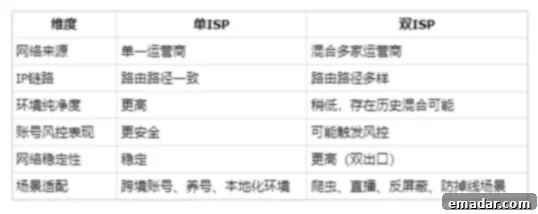
While both Single and Dual ISP proxies are types of residential IPs, their underlying network structures lead to distinct advantages and suitable use cases. Understanding these differences is key to making the optimal choice for your operations.
Authenticity & Perceived Trust:
Single ISP: Generally offers a higher degree of perceived authenticity. The uniform network path and consistent ISP identification make it appear as a ‘purer’ and more genuine home user connection. This is invaluable for platforms with stringent anti-fraud measures.
Dual ISP: Still residential and generally trusted, but the mixed network background might occasionally present a slightly less ‘clean’ profile. While not inherently problematic, some highly sophisticated detection systems might notice the diverse routing.
Network Stability & Redundancy:
Single ISP: Stable within its single provider’s network. Performance depends on the reliability of that specific ISP. If that ISP experiences issues, the connection might be affected.
Dual ISP: Typically boasts superior stability and redundancy. The ability to route traffic through multiple networks provides a fallback mechanism, ensuring greater uptime even if one network segment faces an issue. This makes them more resilient against localized network problems.
Ideal Use Cases:
Single ISP: Best suited for tasks requiring a strong emphasis on appearing as a unique, localized, and genuine home user. This includes social media management, e-commerce account farming, localized content access, and any activity where avoiding detection by behavioral analysis is crucial.
Dual ISP: Preferred for operations where consistent, uninterrupted network access and robustness are the top priorities. This encompasses large-scale data scraping, high-frequency automated tasks, content streaming, and scenarios where sheer operational continuity outweighs minimal authenticity nuances.
Risk of Detection:
Single ISP: Often carries a lower risk for activities that scrutinize the ‘humanness’ of a connection, particularly on platforms like social media. Its predictable nature helps it blend in.
Dual ISP: While still a residential IP, its complex routing and potential mixed history might, in very specific and advanced detection scenarios, be perceived differently. However, for most robust scraping or general web access, this risk is negligible.
How to Determine if Your Proxy is Single ISP or Dual ISP
Identifying whether an IP address is a Single ISP or Dual ISP is a straightforward process that involves using publicly available IP lookup tools. These tools provide detailed information about an IP address’s origin and network properties. Here’s how you can typically ascertain the type:
- Utilize IP Query Tools: Access reputable IP information websites such as ipinfo.io, whatismyip.com, or IPlocation.net. Enter the proxy IP address you wish to examine.
- Examine the ASN (Autonomous System Number): Look for the field that displays the ASN. If the ASN is clearly and solely associated with a major Internet Service Provider (e.g., AS7018 AT&T Services, Inc.), this is a strong indicator.
- Verify the Organization/Company Information: Cross-reference the “Org” (Organization) or “Company” field with the ASN. For a standard Single ISP, these details should be perfectly consistent, both naming the same, singular broadband provider.
- Review IP History (if available): Some advanced IP lookup tools or services might offer historical data for an IP address. Look for any records indicating transfers between network owners, unusual routing changes, or previous blocklist entries. A clean, consistent history reinforces the Single ISP classification.
In summary:
- If the ASN, Organization, and associated details precisely match and point to a single, legitimate Internet Service Provider, it is a clear indication of a Single ISP proxy.
- If the ASN and the registered Organization details do not perfectly align, or if the routing path shows clear indications of traversing multiple ISP networks (even if all are legitimate ISPs), it suggests a Dual ISP proxy. This might happen, for example, if an IP was originally owned by one ISP and then transferred to another, or if the network uses complex inter-provider routing.
Choosing the Right Proxy: It Depends on Your Specific Needs!
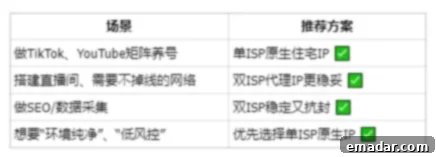
The “better” proxy type isn’t universal; it’s entirely contingent on your operational objectives and the specific platforms you’re interacting with. A deep understanding of your requirements is paramount to making the optimal choice.
Consider Single ISP Proxies if:
- Your primary goal is to mimic a real, localized internet user as closely as possible.
- You are managing sensitive social media accounts (e.g., TikTok, Instagram, Twitter) where platforms aggressively monitor for suspicious or non-residential IP usage.
- You are engaged in e-commerce activities requiring localized IP addresses for account management, price monitoring, or geo-specific content access.
- Account farming, verification, or any task demanding a pristine IP reputation and a consistent, believable online footprint is central to your strategy.
- You prioritize avoiding detection and maintaining a low profile over raw network redundancy.
Opt for Dual ISP Proxies if:
- Your operations demand exceptional network stability, uptime, and resilience against potential outages or congestion.
- You are performing large-scale data scraping, web crawling, or automated tasks where continuous, uninterrupted data flow is more critical than appearing as a unique “human” user on highly sensitive platforms.
- You frequently access geo-restricted content or services from various international locations and require a robust connection that can adapt to changing network conditions.
- You are involved in activities like live streaming, high-frequency trading, or critical business operations where even brief service interruptions are costly.
- While still valuing the residential nature of the IP, your tasks are less susceptible to highly granular anti-bot detection based purely on network path purity.
Key Takeaways for Smart Proxy Selection
Navigating the world of proxies doesn’t have to be complicated. By understanding the core distinctions between Single ISP and Dual ISP proxies, you can significantly enhance the effectiveness and stability of your online operations.
- Single ISP proxies offer unparalleled authenticity and a cleaner, more predictable network footprint. They are ideal for tasks demanding a genuine, localized user presence, such as social media management, e-commerce account nurturing, and any activity where bypassing sophisticated anti-bot detection based on user behavior is crucial.
- Dual ISP proxies excel in stability and redundancy. Their ability to route through multiple network providers makes them highly resilient, perfect for high-volume data scraping, live streaming, and automated tasks where continuous uptime and robust connectivity are paramount.
- To identify your proxy type, simply use an IP lookup tool to examine the Autonomous System Number (ASN) and Organization details. A perfect match indicates a Single ISP, while discrepancies or mixed routing suggest a Dual ISP.
- The ultimate choice depends on your specific needs. Align your proxy selection with your project’s primary goals – whether it’s unassailable authenticity or unwavering network resilience – to ensure smoother operations and more stable accounts.
Making an informed decision about your proxy type is a strategic advantage in today’s digital landscape. Choosing wisely empowers you to optimize your workflows, safeguard your accounts, and achieve your online objectives with greater efficiency.
Are you looking for the perfect IP type that aligns seamlessly with your business requirements?
IPFLY offers a comprehensive suite of IP solutions sourced from over 190 countries worldwide, designed to meet diverse operational needs.
- ✔ We support static/dynamic residential proxies, pure native IPs, and robust data center proxies.
- ✔ We provide exclusive, pristine IPs, ensuring dedicated use for your specific accounts.
- ✔ Enjoy a no-logs policy, high anonymity, and seamless integration with leading fingerprint browsers.
- ✔ Our platform supports API integration, making batch configuration and management effortless.
👉 Claim your special offer today and access premium IP solutions!