
In the dynamic and increasingly complex digital landscape of 2025, the demand for secure, reliable, and authentic internet access has never been higher. Businesses, marketers, and developers navigating this environment face ever-evolving challenges, from geo-restrictions and sophisticated anti-bot systems to the critical need for vast amounts of data. Among the diverse array of proxy solutions available, residential proxies have emerged as the gold standard, prized for their unparalleled authenticity and exceptional reliability. But what exactly defines a residential proxy, and why is its role so profoundly important in the current and future digital ecosystem? This comprehensive guide will delve deep into the intricacies of residential proxies, explaining their operational mechanisms, outlining their myriad benefits, exploring their most common and advanced use cases, and highlighting how leading proxy providers deliver trustworthy and scalable solutions to meet modern demands.
Understanding Residential Proxies: The Gateway to Authentic Web Interaction
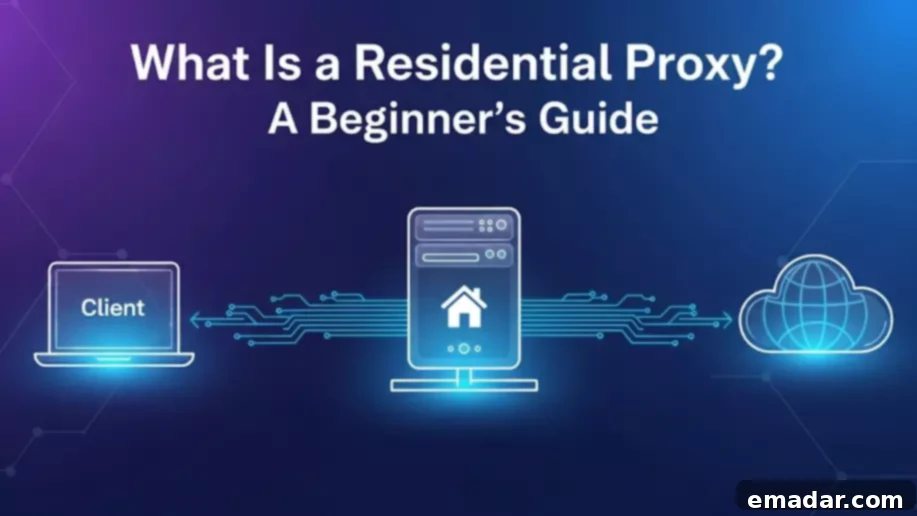
At its core, a residential proxy is an IP address genuinely assigned by an Internet Service Provider (ISP) to a residential homeowner. This fundamental characteristic distinguishes it sharply from other proxy types, such as data center proxies, which originate from commercial server farms. When you route your internet traffic through a residential proxy, your online requests appear to originate from an actual, legitimate internet user residing in a specific geographical location, rather than from a server within a data center. This critical difference is what imbues residential IPs with such a high degree of trust from websites and online services.
The internet is increasingly adept at identifying and blocking non-human or suspicious traffic. Websites employ advanced algorithms to detect patterns associated with data centers, VPNs, or malicious bots. Data center proxies, while offering speed and affordability, are often flagged due to their easily identifiable IP ranges. Residential proxies, conversely, blend seamlessly with regular user traffic. This inherent authenticity makes them indispensable for any task that demands a high level of legitimacy and a low risk of detection or blocking, including sophisticated web scraping operations, precise ad verification, or accessing geo-restricted content without impediment.
How Residential Proxies Work: A Detailed Look at the Mechanism
The operational efficiency of residential proxies stems from a sophisticated network architecture that effectively masks your true IP address and location. When you initiate an internet connection or send a request through a residential proxy network, the process unfolds as follows:
- Request Routing: Your initial request is securely routed through the proxy provider’s infrastructure.
- IP Pool Assignment: The proxy network then assigns a real residential IP address from its vast pool of authentic, ISP-provided IPs. This pool is comprised of devices (e.g., home computers, smartphones) whose owners have consented to share their bandwidth, often in exchange for a service or application.
- Traffic Tunneling: Your request is then tunneled through this chosen residential IP address. The target website or online service receives the request, perceiving it as originating from a genuine user in a specific, real geographical location associated with that residential IP.
- Bypass and Success: Because the request appears legitimate, it can effectively bypass various restrictions, avoid IP bans, and achieve significantly higher success rates compared to using less trusted proxy types.
Residential proxies offer crucial flexibility regarding IP management: static residential proxies and rotating residential proxies. Static residential proxies (often referred to as sticky IPs) provide a consistent, singular IP address for extended periods. This stability is invaluable for tasks requiring persistent identity, such as managing multiple social media accounts, maintaining long-term sessions on e-commerce platforms, or conducting brand protection efforts where a fixed digital footprint is beneficial. In contrast, rotating residential proxies automatically cycle through a vast pool of different IP addresses, changing them after each request, after a specified time interval, or based on specific user-defined triggers. This dynamic rotation is supremely effective for large-scale data harvesting or web scraping, where rapidly changing IPs prevents detection and blocks from anti-bot systems, allowing for continuous, high-volume data collection without interruption.
Key Benefits of Residential Proxies: Unlocking Digital Opportunities
Residential proxies are not merely a technical solution; they are a strategic asset that empowers businesses and professionals across numerous sectors. Their distinct advantages contribute directly to enhanced efficiency, accuracy, and security in online operations:
- Unparalleled Trust and Reliability: The paramount benefit of residential proxies is the high level of trust they command from target websites. Since these IPs belong to real users, websites are far less likely to flag them as suspicious or block them, significantly reducing the risk of encountering CAPTCHAs, IP bans, or other access restrictions. This reliability ensures uninterrupted operations, which is critical for time-sensitive tasks.
- Seamless Access to Geo-Restricted Content: Residential proxies allow users to virtually appear as if they are browsing from virtually any country or city supported by the proxy network. This capability is indispensable for market research, allowing businesses to test global ad campaigns, monitor localized content, analyze regional pricing strategies, and access content or services that are geographically locked.
- Superior Success Rates for Web Scraping: For businesses reliant on extracting vast amounts of public data, residential proxies are a game-changer. The ability of rotating IPs to automatically switch with each request or after a set period means that large-scale scraping operations can proceed without triggering sophisticated anti-bot mechanisms. This leads to higher data collection volumes, faster completion times, and more accurate datasets.
- Enhanced Anonymity and Secure Browsing: Residential proxies effectively mask your original IP address, providing a crucial layer of anonymity and security. This protects your identity and location from being exposed to target websites and potential adversaries, safeguarding your privacy during sensitive operations and mitigating cyber threats.
- Scalability for Enterprise Needs: Modern proxy networks offer vast pools of residential IPs, providing the scalability required for enterprise-level operations. Whether managing thousands of concurrent requests or deploying complex global monitoring campaigns, residential proxies can handle high volumes without compromising performance or reliability.
For instance, an international digital marketing agency tasked with verifying ad placements across dozens of countries can leverage residential proxies to simulate local user perspectives. This ensures ads are displayed correctly, preventing ad fraud and ensuring brand safety, all without facing any interruptions or blocks.
Common Use Cases: Where Residential Proxies Make a Difference
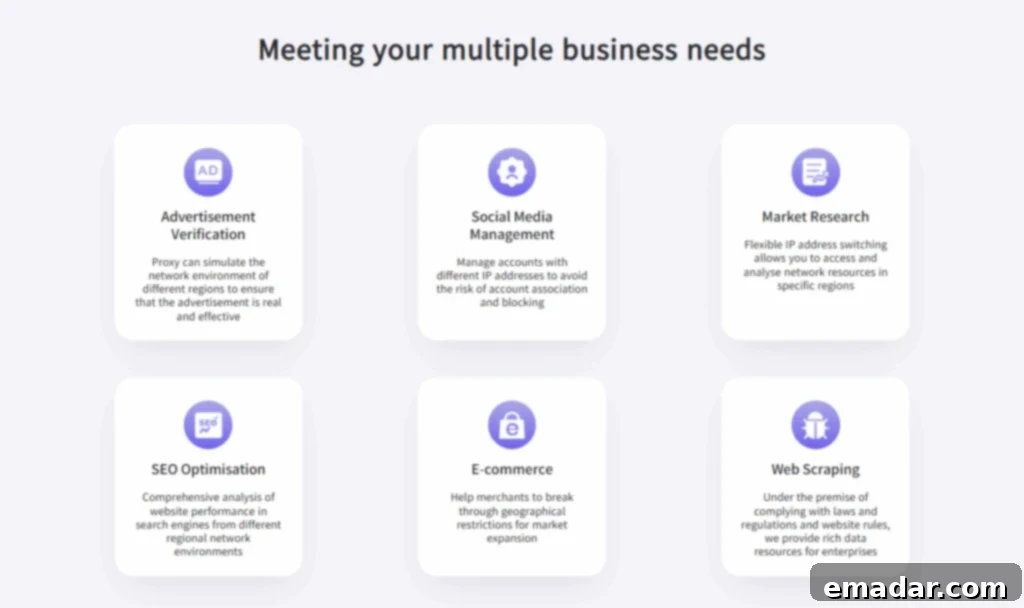
The versatility of residential proxies makes them invaluable across a wide spectrum of industries and professional applications:
1. Advanced Web Scraping and Data Collection
Organizations across finance, retail, and tech require massive amounts of publicly available data for market analysis, competitive intelligence, and trend prediction. Residential proxies are the preferred solution for ethical web scraping, allowing businesses to extract data from e-commerce sites, news portals, financial platforms, and social media without triggering anti-bot systems. Their authentic nature ensures data accuracy and reduces the risk of IP bans, enabling seamless, high-volume data acquisition.
2. Precise Ad Verification and Brand Protection
For advertisers and agencies, ensuring that digital ads are displayed correctly, in the right geographical locations, and on appropriate websites is paramount. Residential proxies enable precise ad verification by simulating local users, allowing marketers to confirm ad placement, check for malicious redirects, detect ad fraud, and ensure brand safety across diverse international markets. This protects ad spend and maintains brand reputation.
3. E-Commerce Monitoring and Competitive Intelligence
In the highly competitive e-commerce sector, staying ahead means constantly monitoring the market. Retailers use residential proxies to track competitor pricing, stock availability, product reviews, and promotional strategies in real time. By appearing as a regular shopper from various regions, businesses can gather critical competitive intelligence without revealing their own identity or corporate IP, enabling dynamic pricing adjustments and strategic market positioning.
4. Efficient Social Media Management and Marketing
Managing multiple social media accounts, running targeted marketing campaigns, or conducting influencer outreach can often trigger security flags when performed from a single IP. Residential proxies allow marketers to operate numerous accounts, post content, and engage with audiences from different locations safely and discreetly. This capability is essential for scaling social media strategies and conducting comprehensive market research.
5. Bypassing Geo-Restrictions for Content Access and Testing
Many online services, streaming platforms, and websites restrict content access based on the user’s geographical location. Residential proxies provide a reliable way to bypass these geo-restrictions, enabling users to access international content, test website localization, perform global SEO audits, or conduct market research in regions where direct access might be limited.
6. SEO Monitoring and Rank Tracking
Search Engine Optimization (SEO) professionals rely on accurate data to monitor keyword rankings, analyze competitor strategies, and assess local search results. Residential proxies allow SEOs to perform geo-targeted rank tracking from various locations, ensuring that the collected data accurately reflects search engine results pages (SERPs) for specific audiences, free from personalization biases.
Residential Proxies vs. Other Proxy Types: A Comparative Overview
To fully appreciate the unique value of residential proxies, it’s essential to understand how they compare to other common proxy solutions:
| Feature | Residential Proxy | Datacenter Proxy | ISP Proxy (Static Residential) |
| IP Source | Real ISP to homeowners | Commercial data center servers | ISP network (dedicated to business) |
| Trust Level | Highest (appears as a real user) | Low to Medium (easily detectable) | High (hybrid of residential & datacenter) |
| Speed | Medium (dependent on network) | High (direct server connection) | Medium-High (dedicated bandwidth) |
| Best For | Web scraping, ad verification, social media, geo-access, sensitive tasks | Fast bulk operations, anonymous browsing (less critical tasks) | Long-term sessions, local SEO, secure tasks requiring stable IP |
| Block Risk | Lowest (due to authenticity) | Highest (due to identifiable IP ranges) | Low (dedicated and less shared) |
| Cost | Highest (premium solution) | Lowest (most affordable) | Medium-High (balance of trust & speed) |
While datacenter proxies are known for their raw speed and lower cost, their origin from commercial data centers makes them highly susceptible to detection and blocking by sophisticated websites. They are best suited for less sensitive tasks where the risk of being blocked is acceptable or less impactful. Residential proxies, conversely, offer a superior balance of trust, reliability, and anonymity, making them ideal for tasks that demand genuine user-like behavior and high success rates, despite potentially having slightly lower speeds than direct datacenter connections due to routing through real user devices. ISP proxies, sometimes called Static Residential Proxies, bridge this gap by being IP addresses from an ISP but hosted in a data center. They offer high trust and good speed but typically have a smaller pool of IPs compared to traditional rotating residential networks. Choosing the right proxy type depends entirely on the specific requirements, budget, and sensitivity of your online operations.
How IPFLY Provides Leading Residential Proxy Solutions
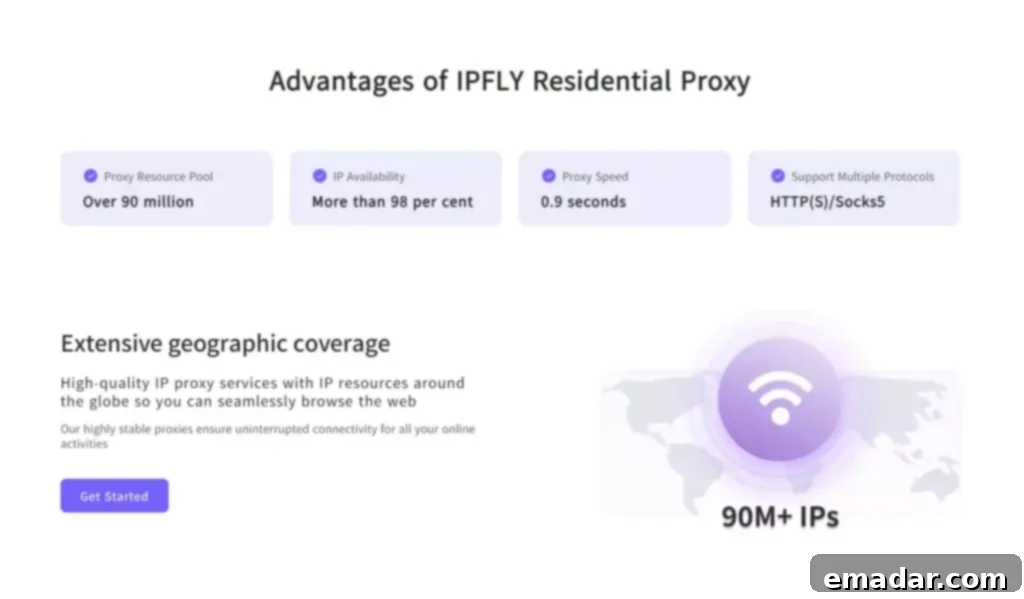
At IPFLY, we are committed to providing robust and cutting-edge residential proxy solutions tailored to meet the exacting demands of professional and enterprise-level operations. Our infrastructure is engineered for maximum performance, reliability, and security, ensuring that our clients can execute their digital strategies with confidence and efficiency. Key features of IPFLY’s residential proxy offerings include:
- Extensive Global IP Pool: IPFLY boasts an expansive network of over 90 million residential IP addresses, strategically distributed across more than 190 countries and regions worldwide. This colossal pool ensures unparalleled geographic coverage, allowing users to select IPs from virtually any location, guaranteeing local authenticity for geo-targeting and market research, and significantly reducing the likelihood of IP exhaustion or detection.
- Guaranteed High Success Rates: Our advanced network infrastructure is meticulously optimized to deliver exceptional success rates. By intelligently routing requests and dynamically managing our IP pool, IPFLY effectively minimizes the risk of blocks, CAPTCHAs, and other interruptions, even during the most data-intensive and high-volume operations. This focus on reliability translates directly into more efficient data collection and seamless online interactions.
- Flexible Rotating and Static IP Options: Understanding that different tasks require different IP behaviors, IPFLY offers both dynamic rotating residential proxies and stable static residential proxies. Our rotating options are perfect for web scraping, ad verification, and competitor monitoring, where frequent IP changes are crucial for stealth and success. Conversely, our static residential IPs provide consistent identity for long-term sessions, social media management, or any task requiring a stable and dedicated online presence.
- Secure, Scalable, and User-Friendly: IPFLY’s proxy network is built with enterprise scalability and security at its core. Our platform is designed to handle immense volumes of traffic and concurrent requests, making it ideal for businesses running multiple global campaigns, extensive market research, or high-volume data operations. Furthermore, our intuitive dashboard and API integrations ensure easy setup and management, allowing businesses to integrate our solutions seamlessly into their existing workflows while maintaining stringent security protocols and respecting data privacy.
By synergizing a robust, globally distributed infrastructure with intelligent IP rotation and dedicated support, IPFLY empowers organizations to access the web reliably, maintain complete privacy and security, and achieve their strategic objectives without digital barriers.
Tips for Choosing a Residential Proxy Provider
Selecting the right residential proxy provider is a critical decision that can significantly impact the success of your online operations. Consider these key factors before making your choice:
- IP Pool Size and Diversity: A larger and more geographically diverse IP pool is paramount. It provides greater flexibility for geo-targeting, reduces the chance of encountering blacklisted IPs, and ensures that you have enough unique addresses for high-volume tasks without running into IP exhaustion. A provider with millions of IPs across many countries offers superior reliability and scalability.
- Rotation Capabilities and Control: Assess whether the provider offers both rotating and static IP options, and how granular the control over rotation is. Can you customize rotation intervals? Are there sticky sessions available for a fixed duration? These features are vital for tailoring the proxy service to your specific use cases, from rapid scraping to stable account management.
- Performance, Speed, and Uptime: Proxy speed is crucial, especially for time-sensitive data collection or real-time monitoring. Evaluate the provider’s infrastructure for high performance, low latency, and consistent uptime. Look for transparent reporting on network stability and speed, as unreliable service can lead to lost data and wasted resources.
- Reliability and Responsive Customer Support: For business-critical operations, stable uptime is non-negotiable. A reputable provider will offer a high uptime guarantee and responsive customer service that can address technical issues quickly and efficiently. Testing their support before committing is often a good strategy.
- Compliance, Security, and Ethical Practices: Ensure the provider adheres to strict data privacy regulations (like GDPR) and maintains secure networks. Transparent policies on how they acquire and manage their residential IPs are essential. Ethical sourcing of IPs not only protects end-users but also ensures the longevity and integrity of the proxy network.
- Pricing Structure and Scalability: Compare pricing models (e.g., bandwidth-based, port-based) and ensure they align with your anticipated usage and budget. A good provider will offer scalable plans that can grow with your needs, from starter packages to enterprise solutions, providing cost-effectiveness as your demands evolve.
Conclusion: The Indispensable Role of Residential Proxies in 2025
In conclusion, residential proxies are far more than just a means to hide an IP address; they are an indispensable and sophisticated tool for businesses, marketers, and developers seeking authentic, reliable, and scalable access to the internet. They masterfully combine the trust inherent in real ISP-assigned IP addresses with the flexibility needed for a vast array of complex tasks, including advanced web scraping, meticulous ad verification, dynamic e-commerce monitoring, secure social media management, and seamless geo-restriction bypassing. Their ability to mimic genuine user behavior makes them exceptionally resistant to detection and blocking, ensuring uninterrupted and successful online operations.
With leading providers like IPFLY at the forefront, organizations can confidently leverage the full power of residential proxies to achieve consistently high success rates, maintain secure global access, and streamline their digital operations. Whether you are a beginner just entering the world of online data or a seasoned professional executing enterprise-level strategies, a deep understanding and strategic utilization of residential proxies are absolutely essential for navigating and succeeding in today’s increasingly complex and competitive online landscape.
👉 Visit ipfly.net or join the IPFLY Telegram channel for more insights on proxies, cutting-edge digital marketing strategies, and expert tips for optimized YouTube access.